If you are tracking calories, eating below your estimated needs, and the scale has not moved in weeks, the honest answer is that something between your estimate and your body does not add up. Weight loss is not a daily event, and a real deficit is usually visible over three to four weeks of average weight, not on one Tuesday morning.
This guide walks through how to check your numbers, the tracking mistakes that quietly erase a small deficit, what water weight does to a scale reading, and the medical reasons worth raising with a doctor. Nothing here is a personal calorie prescription, and your own needs can only be measured, not assumed.
Table of Contents
- How Can a Calorie Deficit Fail to Produce Weight Loss?
- Fat loss is not the same thing as scale weight
- First, Check Whether You Are in a Real Calorie Deficit
- Common Reasons Your Weight Is Not Moving
- Your calorie counts are simply wrong
- Oils, sauces and drinks are missing from the log
- Your daily movement quietly dropped
- Your body needs fewer calories than it used to
- Sleep, stress and your cycle are having a month
- Medications and health conditions
- How to Track Your Deficit More Accurately
- What Is a Weight-Loss Plateau?
- How to Fix a Stalled Deficit Safely
- When to Ask a Doctor or Registered Dietitian
- Frequently Asked Questions
- Is it possible to be in a calorie deficit and not lose weight?
- Why am I not losing weight on 1500 calories a day?
- Why am I in a calorie deficit for a week but not losing weight?
- What is the 3-3-3 rule to lose weight?
- Should I eat more to restart my metabolism?
- Conclusion: Start With the Trend, Not One Weigh-In
How Can a Calorie Deficit Fail to Produce Weight Loss?
It is possible to be in a calorie deficit and not see the scale drop, because a deficit changes body fat while the scale measures total body mass. A genuine deficit reduces stored energy, and fat is the largest thing on the scale you actually want to reduce, but water, glycogen, gut contents and new muscle all register the same pound.
There are four broad reasons the number stalls while fat loss continues. Your tracking may be off, your estimate of what you burn may be too generous, fluid may be masking the change, or something medical is shifting the equation. The first three are common and fixable at home. The fourth needs a clinician.
Fat loss is not the same thing as scale weight
Fat loss vs weight loss is the distinction that ends most arguments on weight loss forums. One pound of fat is fat. One pound of water from a salty meal, a long run, or a week of poor sleep is not. When both move in opposite directions in the same week, the scale shows a flat line even though the fat is gone.
Muscle gain is the quieter version of the same problem. If you started lifting two or three times a week while dieting, the new muscle tissue adds mass that offsets the fat leaving. Your waistband tells you the truth here long before the scale does.
| What changed | Direction on the scale | What it actually is |
|---|---|---|
| Fat lost | Down | The change you wanted |
| Glycogen dropping with lower carbs | Down | Water bound to glycogen, not fat |
| New training stimulus | Up | Muscle, inflammation and stored water |
| Salt, alcohol or a bowel movement | Up | Fluid in the gut and tissues |
| Menstrual cycle | Up then down | Normal hormonal water shifts |
First, Check Whether You Are in a Real Calorie Deficit

Most stalled deficits are not metabolic mysteries. They are arithmetic problems, and the most common one is assuming a calculator figure for total daily energy expenditure is accurate for you. Activity-based estimates and online TDEE calculators are starting points, and the better the estimate, the further off it can be in either direction.
Start with a two-week measurement rather than a formula. Weigh food for a full week with a scale, log drinks and cooking fats, and record your daily steps from your phone or watch. Then recalculate your estimated maintenance from what you actually weighed and did, not from a number you picked months ago when you weighed more.
| Estimated daily maintenance | Average daily intake | Weekly deficit | Typical weekly fat-loss range |
|---|---|---|---|
| 2,400 | 1,900 | 3,500 | About 1 lb |
| 2,000 | 1,600 | 2,800 | About 0.75 lb |
| 1,800 | 1,500 | 2,100 | About 0.5 to 0.75 lb |
| 1,500 | 1,200 | 2,100 | About 0.5 lb |
These are illustrations, not targets. Your maintenance depends on your size, age, sex, muscle mass and how much you move, and only a tracking period of consistent weighing tells you anything useful about yours. If a week of accurate logs produces no downward trend in your average weight, your real deficit is smaller than you think or absent.
Common Reasons Your Weight Is Not Moving
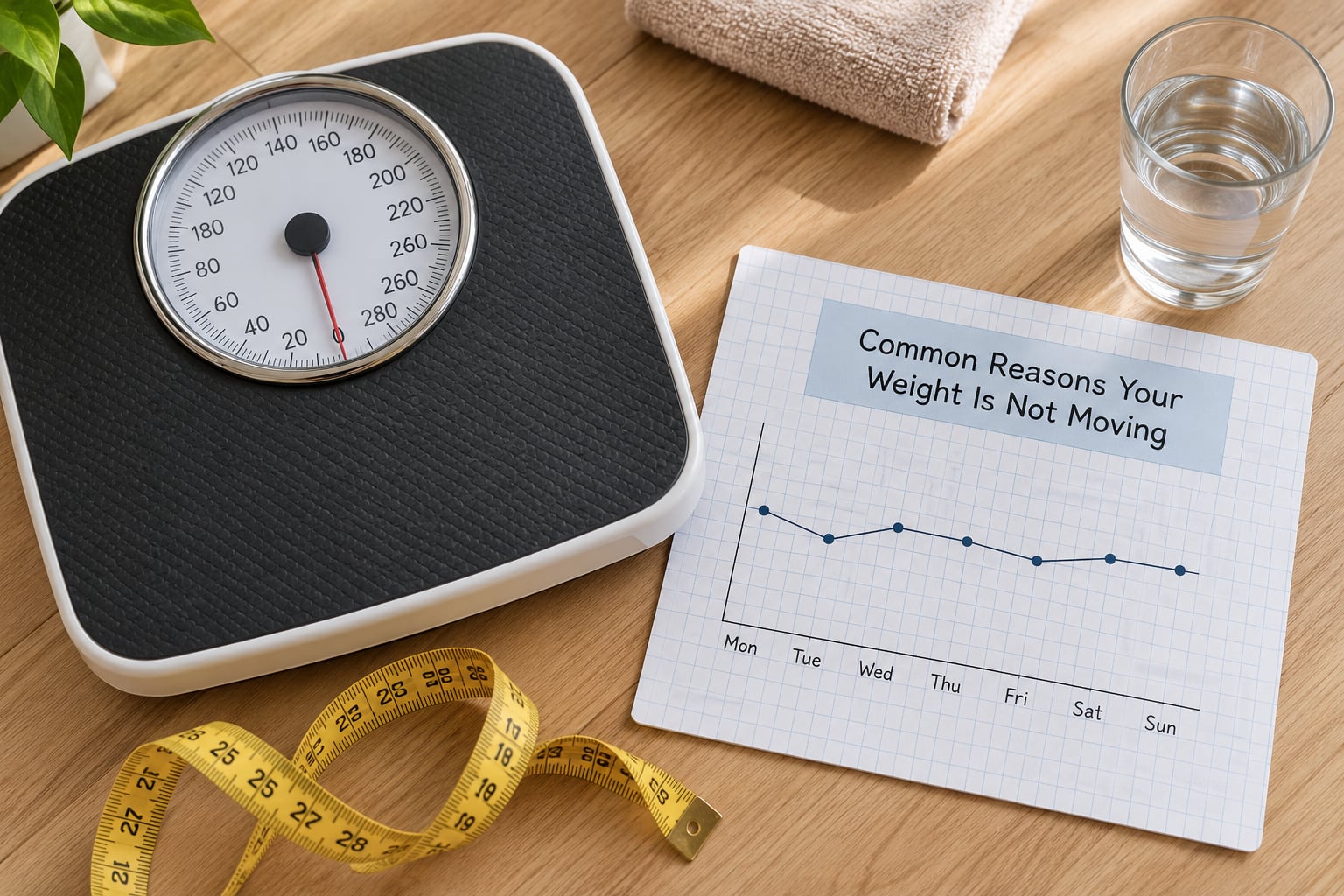
These are the causes that come up again and again, roughly in the order of how often they turn out to be the problem. Read down the list and be honest about which ones you have never once checked.
Your calorie counts are simply wrong
Home-cooked meals and restaurant food are where most tracking errors live, and portion estimation without a scale is where they start. A “bowl of cereal” logged from memory, a serving of pasta scooped with a serving spoon, a chicken breast weighed after cooking when the database lists it raw. Any one of these can add a hundred calories without you noticing.
Oils, sauces and drinks are missing from the log
Cooking oils, butter, dressings and creamy sauces are the classic hidden calories, because they are poured or spooned rather than measured. A tablespoon of oil is around 120 calories, and a typical restaurant entrée can carry two or three of them. Liquid calories in coffee, juice, alcohol and energy drinks are just as easy to skip, and unlike solid food they add up without filling you up.
| Water retention trigger | Typical duration | What the scale does |
|---|---|---|
| New or increased strength training | 1 to 4 weeks | Up 2 to 5 lb, then settles |
| More carbs or more salt | 2 to 5 days | Up 1 to 3 lb, then drops |
| A long walk or a heat wave | 1 to 3 days | Up 1 to 2 lb |
| Poor sleep or a stressful week | 3 to 7 days | Up, sometimes more |
| Constipation or a slow gut | 1 to 3 days | Up 1 to 2 lb |
| Late-cycle water changes | Several days | Up, then down after it starts |
| Starting or stopping a medication | Weeks | Any direction |
Your daily movement quietly dropped
NEAT, non-exercise activity thermogenesis, is everything you burn just by existing: walking to the car, standing while the kettle boils, shifting around while on a call. It is the part of expenditure nobody plans, and it tends to fall as weight drops and as sitting increases. People on weight loss forums describe taking the lift, parking closer, and generally moving less without noticing any decision to do so.
Fitness trackers make this worse in the other direction. They commonly overestimate the calories burned by a workout, so eating back the number on the watch can quietly erase the deficit you built all day.
Your body needs fewer calories than it used to
A smaller body burns fewer calories. Losing twenty pounds means the machine doing the burning is lighter, so the same food intake produces a smaller gap than it did three months ago. This is arithmetic, not a broken metabolism, and the fix is recalculating from your current weight rather than defending a target you built at a higher one.
Metabolic adaptation, sometimes called adaptive thermogenesis, is the body’s response to sustained lower intake and higher fat loss. It is real and measurable, and it is generally modest in people eating at reasonable deficits. The dramatic version of the idea, starvation mode, is a myth that keeps people eating at dangerously low intakes when the real answer is a modest maintenance break and a recalculation.
Sleep, stress and your cycle are having a month
Short sleep and high stress raise hunger and make food tracking harder, usually without changing the laws of energy balance. Cortisol and the hormones around your menstrual cycle move water around, so a week of poor sleep can undo two weeks of a good trend on the scale. On r/loseit, the most common advice for a stalled scale is to stop weighing daily, average the numbers for a month, and look at the direction of the line.
Medications and health conditions
Some prescriptions, including certain antidepressants, steroids, antipsychotics, some diabetes drugs and hormonal contraceptives, affect appetite, fluid balance or metabolism. Thyroid conditions, PCOS, insulin resistance, anemia, celiac disease and gut disorders can all change how weight behaves. None of these are things to self-diagnose from a search page, and a doctor can run the bloodwork that tells you which, if any, apply.
How to Track Your Deficit More Accurately
A one-week audit fixes more tracking problems than any other single habit, because it forces you to look at what you actually eat instead of what you meant to eat. Here is how to run it without a formula.
- Weigh everything for seven days. Use a kitchen scale for anything portioned, and log packaged items by the label weight rather than by serving guess.
- Log oils and sauces separately. Reverse weighing means putting the empty pan on the scale, taring it, then pouring in the oil and reading the difference. Same trick for butter, dressing and syrup, so the number is real instead of remembered.
- Check raw versus cooked weights. Chicken breast loses roughly a quarter of its weight when it cooks, because water evaporates. Logging the cooked weight against a raw entry can quietly cost you over a hundred calories a meal.
- Log every drink. Coffee, juice, soda, alcohol and milk all count, and the ones you sip without noticing count the most.
- Divide recipes, do not guess them. Weigh the whole finished dish, add up the ingredients, then divide by the number of portions you actually froze or boxed.
- Record movement, not just workouts. Write down daily steps and any unplanned activity, and treat the watch’s calorie number as an estimate rather than a fact.
- Average your weight by week. Weigh at the same time under the same conditions and look at the seven-day average, not the lowest reading and not a single number.
If you want a second opinion on the numbers, a registered dietitian is the right person to see. Bring your seven-day food log, your weekly average weights, your current medication list, and any recent bloodwork, because that is exactly the set of information they need to see whether your arithmetic matches your reality.
What Is a Weight-Loss Plateau?
A plateau is a flat trend in your multiweek average weight, not a single unmoved number. One week is far too short to judge, because daily weight routinely swings two to four pounds from water, glycogen and gut contents, and that range is big enough to hide a normal half-pound of weekly fat loss for a month.
The widely repeated community rule is that a flat average across four or more weeks of accurate tracking means the real deficit is not there, not that the plan has failed. Before you call it a plateau, confirm three things: you have at least three weeks of data, the data was weighed rather than estimated, and the conditions were consistent enough for the average to mean something.
Once it is a real plateau, the usual reasons are a maintenance estimate that no longer matches your weight, unlogged calories, less daily movement, a stress or sleep stretch, or a change in medication. It is rarely a physiological emergency and it is almost never a reason to cut food further.
How to Fix a Stalled Deficit Safely
The productive response to a plateau is a recalculation, not a cut. Work through these in order and give each one two to three weeks before judging it.
- Recalculate from current numbers. Use your measured intake and your actual movement rather than an old maintenance figure. A smaller body needs less, and your old target may now sit at maintenance.
- Close the tracking gaps you found. Weigh for two weeks, log the fats and drinks, and fix the recipe entries that were guesses.
- Put the movement back in. Daily walking and two or three resistance sessions a week protect muscle and make your expenditure easier to predict.
- Fix sleep first. Consistent sleep hours reduce the hunger spikes that quietly add calories, and they calm the water swings that confuse the scale.
- Make small, sustainable adjustments. When a genuine recalculation points to a smaller deficit, change portions gradually, not abruptly, and keep protein and fibre where they are.
- Take a maintenance break when needed. A few weeks at roughly your current maintenance can help with hunger, sleep and training, and it does not undo the fat you have already lost.
- Track more than the scale. Waist measurements, how your clothes fit, your strength in the gym, and progress photos move before the number does.
On the last point, weigh-ins can take over a person’s mood, and that is a bad trade for a slow-moving number. If daily weighing leaves you anxious or obsessive, weigh weekly or fortnightly instead, or measure and drop the scale entirely for a stretch. A habit you dread is easy to abandon, and the fat loss does not require a daily audience.
When to Ask a Doctor or Registered Dietitian
Some stalled scales are worth a phone call rather than another week of auditing. Book an appointment if you notice any of the following, and mention the weight change specifically rather than hoping it comes up.
- Unintended weight loss or gain with no change to your eating or activity
- Severe fatigue, weakness, dizziness or fainting
- Persistent thirst or frequent urination
- Ongoing heartburn, diarrhoea, bloating or other gut symptoms
- Feeling unusually cold, constipated, or noticing hair thinning, which can point to thyroid problems
- Menstrual changes, or periods that stop, while dieting
- A history of disordered eating, or a plan that has pushed you into compulsive restriction
- Starting or stopping any medication around the time your progress changed
A doctor can check thyroid function, iron, vitamin D and blood glucose, and look for conditions such as PCOS. A pharmacist can tell you whether a medicine you take is known to affect appetite or weight. Neither of them is a substitute for a plan, but both can tell you whether your body is working against you for a reason you cannot see from the outside.
Frequently Asked Questions
Is it possible to be in a calorie deficit and not lose weight?
Yes, for a few weeks at a time. A real deficit reduces stored fat, but water retention, muscle gain, glycogen changes and gut contents all move the scale the other way, so fat loss can happen while the number stays flat. Judge progress on the weekly average over three to four weeks rather than on single weigh-ins.
Why am I not losing weight on 1500 calories a day?
Usually because 1500 calories is closer to your current maintenance than you planned. Your estimated maintenance may have been too high, your body is lighter now and needs less, or hidden calories such as cooking oil, drinks and weekend eating have closed the gap. Recalculate from your current weight, weigh your food for two weeks, and compare weekly averages.
Why am I in a calorie deficit for a week but not losing weight?
One week is not long enough to tell. Daily weight can swing two to four pounds from water, salt, bowel movements and what you exercised the day before, which easily covers a normal half-pound of weekly fat loss. Keep your conditions consistent, average seven days at a time, and only judge the result after three or four weeks.
What is the 3-3-3 rule to lose weight?
The 3-3-3 rule is not a standardised medical protocol, and it is used for several different things, including meal timing and habit stacking. The evidence-based targets are steadier: losing roughly 0.5 to 1 percent of body weight per week, eating 1.6 to 2.2 grams of protein per kilogram of body weight, and training two to four times a week.
Should I eat more to restart my metabolism?
Eating significantly more does not restart a metabolism that was never stopped. A mild, temporary drop in energy expenditure happens with weight loss and is proportional to how much you lost, so the usual response is to recalculate your needs at your current weight and eat at a moderate deficit you can hold. A short period at maintenance can help with hunger, sleep and training.
Conclusion: Start With the Trend, Not One Weigh-In
Start by confirming that a deficit exists at all: weigh your food for a week, log the oils and drinks, and recalculate your needs from your current weight and your actual daily movement. Then stop looking at individual weigh-ins and read the weekly average over three to four weeks, because that is the only view where fat loss becomes visible.
If the trend is flat after that, close the tracking gaps you found, put daily movement and resistance training back in, and fix your sleep before you change anything about your food. If the stall comes with fatigue, thirst, gut symptoms, menstrual changes or an unexplained weight shift, talk to a doctor or registered dietitian rather than trying to out-restrict a body that may need medical attention.