If your scale has sat still for two to four weeks while you kept eating well and moving, the answer to a weight loss plateau after 3 months is not to eat less. It is to check whether the stall is real, then adjust calories, protein, steps, sleep, and stress one variable at a time. Most people can restart progress in a month without going anywhere near a crash diet.
Three months is a natural checkpoint. You started heavier, and your body now needs fewer calories to run itself, so the same routine quietly stops producing the same deficit. That is normal biology, not a willpower failure.
Here is the honest version: a real weight loss plateau is two to four weeks of a flat trend, not two flat days. Before you change anything, you need to see the last three months of data clearly, know what your current numbers actually are, and have a safe, one-change-at-a-time plan rather than a dramatic overhaul.
Table of Contents
- What You Need to Break a Weight Loss Plateau After 3 Months
- Three months of weight data, averaged
- A tape measure and two sets of photos
- A food record for at least one honest week
- Your baseline activity and sleep numbers
- A medical note if anything has changed
- A realistic timeline for the next four weeks
- Step-by-Step: What to Do About a Three-Month Weight Loss Plateau
- Step 1: Confirm That the Plateau Is Real
- Step 2: Review Your Eating Routine Without Starting Another Crash Diet
- Step 3: Check Whether Your Habits Have Drifted
- Step 4: Strengthen Your Everyday Nutrition
- Step 5: Adjust Exercise Gradually
- Step 6: Improve Sleep, Stress, and Recovery
- Step 7: Set a Realistic Next Four-Week Plan
- Common Mistakes That Can Worsen a Weight Loss Plateau
- Frequently Asked Questions
- How long should I wait before changing my weight loss plan after a plateau?
- Is a weight loss plateau after 3 months normal, and how is it different from daily weight changes?
- Should I eat less or exercise more to break a weight loss plateau?
- How can I tell whether my weight is truly plateauing instead of fluctuating?
- When should I talk with a doctor or registered dietitian about stalled weight loss?
- Conclusion: Start With One Sustainable Change
What You Need to Break a Weight Loss Plateau After 3 Months
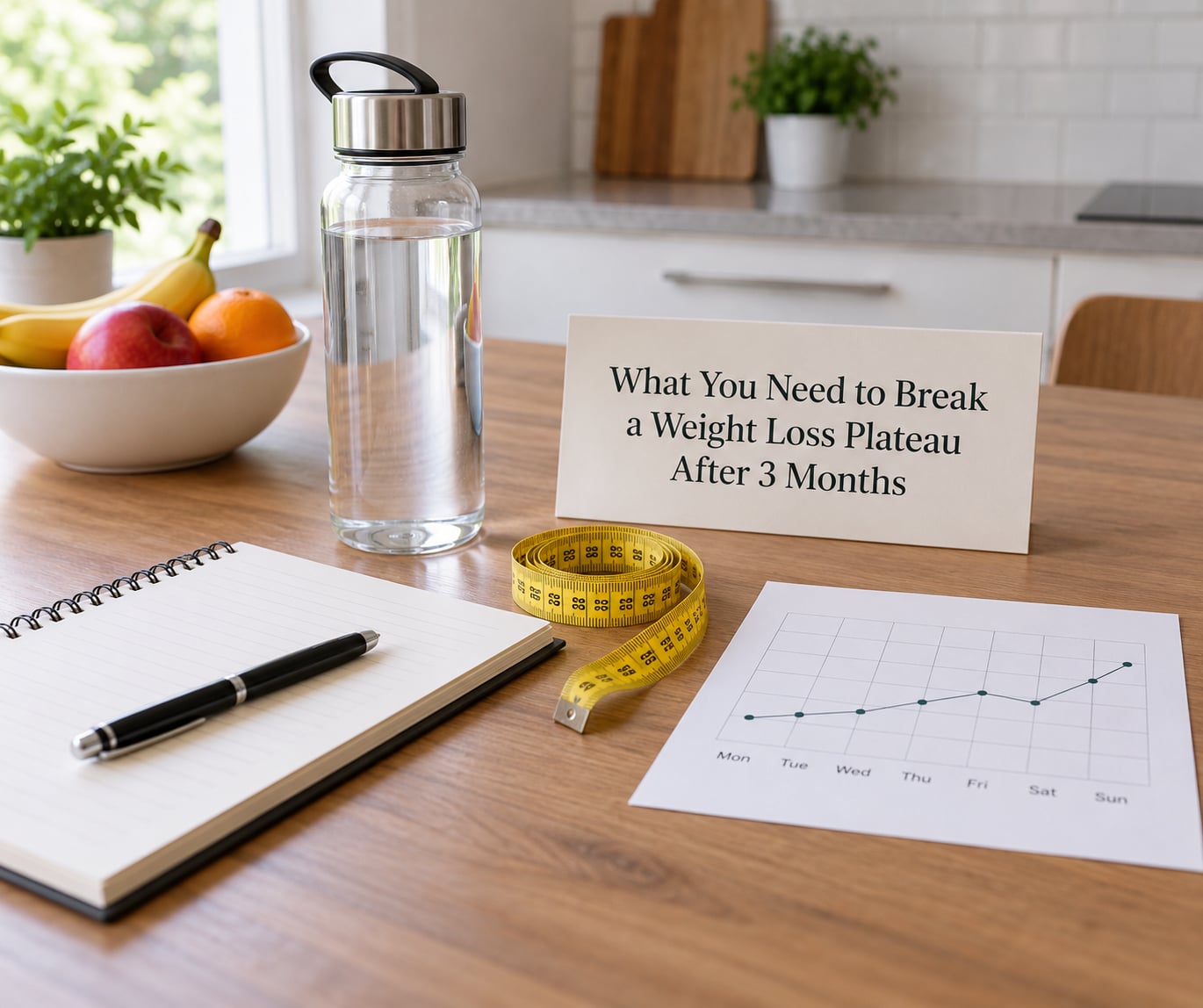
You do not need new equipment or a fancier app. You need a clear view of what already happened, because most plateau decisions fail simply because people are guessing.
Three months of weight data, averaged
Dump every weigh-in you have into one place and calculate a weekly average. Seven-day averages smooth out the noise that salt, hydration, bowel habits, and workout soreness create. Readers on r/MacroFactor have been doing exactly this for years, and it is the single change that ends most false plateau diagnoses.
A tape measure and two sets of photos
Waist circumference at the navel, same time of day, same conditions, once a week. Photos from the front, side, and back in the same spot and lighting. The scale cannot see that your waist dropped two inches while your weight held steady, and neither can you without a record.
A food record for at least one honest week
Not a perfect diary of your best behavior. A representative one, including the weekend, the takeout, the sauces you don’t count, and the oil you pour without weighing. Portion creep of 200 calories a day adds up to 1,400 calories a week, which is nearly a third of a pound of fat, and it happens without anyone noticing.
Your baseline activity and sleep numbers
Average daily steps, sessions of resistance training, average bedtime and hours asleep. Write down the numbers rather than your impression of them. Three months is also when work stress, a new baby, a shift change, or a medication change can quietly rearrange your day.
A medical note if anything has changed
Recent medication starts or stops, thyroid history, perimenopause or menopause, PCOS, a new prescription, an injury, an illness. Keep it in one place so you can tell a doctor the full story in thirty seconds.
A realistic timeline for the next four weeks
Most guidance from the CDC, NIH, and NHS puts sustainable loss at roughly 0.5 to 1 pound per week, and slower as you get lighter. That is the number to judge a four-week experiment against, not daily scale readings. If you started at a higher weight, you may already have lost 20 or 30 pounds and be sitting at what is genuinely a new maintenance level rather than a stalled plan.
Safety note: everything here is general information, not a treatment plan. If you have a medical condition, take prescription medication, are pregnant or breastfeeding, or have a history of disordered eating, talk to a doctor or registered dietitian before changing how much you eat or how hard you train.
Step-by-Step: What to Do About a Three-Month Weight Loss Plateau

Step 1: Confirm That the Plateau Is Real
Start with the 2-to-3 week rule. If your average weight has not moved for two to three consecutive weeks while your calorie deficit and activity were genuinely unchanged, call it a plateau. If it has not moved for eight days, you have water weight, not a metabolic stall.
Before you agree with the scale, look at the trend and the tape. Waist measurement, clothing fit, strength in the gym, energy through the afternoon, and how you feel climbing stairs all tell you something the scale cannot. People who are recompounding at a steady weight often lose two to three inches of waist and add reps on the same lift, which is a real result.
Also count your cumulative loss honestly. People who define success only as “the scale keeps dropping” end up at a healthy new weight and call it failure. How you feel, how your clothes fit, and what your blood pressure and lab work say are allowed to count too.
How to tell it worked: your seven-day average is not a hair over your previous average for three weeks running.
Step 2: Review Your Eating Routine Without Starting Another Crash Diet
The instinct after a plateau is to cut harder. At three months, that instinct is usually wrong, because your body has already reduced its energy expenditure. Cutting further often triggers lower appetite, more fatigue, less training, and less spontaneous movement, which erases the deficit you tried to create.
Look for the common drifts first: portions that grew while meals got less bulky, protein that dropped as vegetables and fruit filled the plate, liquid calories like coffee, juice, soda, and alcohol, frequent grazing on trigger foods, and meals skipped during the day and recovered at night. A skipped meal rarely saves calories when a late dinner cancels it out.
Recalculate from your current weight. The maintenance estimate you started with was built for the person you were three months ago, and you are no longer that person. Many calculators overestimate current maintenance by a wide margin, so when you recalculate, subtract a realistic margin of error rather than trusting a single digit.
How to tell it worked: two weeks of tracked eating show your actual average intake, and you adjust that number downward by a modest amount or not at all, rather than guessing.
Step 3: Check Whether Your Habits Have Drifted
The 3-month plateau almost always has a behavior attached to it. Travel, holidays, work deadlines, eating out three times a week, drinking on weekends, later dinners, inconsistent meal timing, or a gym membership you stopped using. None of these feel like failure at the time. They just quietly become the plan.
Rank your sticking points by impact, not by how guilty they make you feel. If the two biggest ones are weekend alcohol and portions at restaurants, fix those two and leave everything else alone. Chasing five problems at once is how people burn out by month four.
Pick one or two, write down the specific swap, and put it somewhere you will see it. “Drink one fewer drink on Friday” beats “be better about alcohol.” Specific is testable; vague is a wish.
How to tell it worked: for two weeks, the drifting behavior happens noticeably less often, and the weekly average reacts within a month.
Step 4: Strengthen Your Everyday Nutrition
Build meals you would happily eat for years: a protein you like, a vegetable or fruit, a high-fiber carbohydrate, and a fat that makes the meal taste good. That structure keeps you full enough to stick to the plan, which matters more than any single food.
Protein is the one lever most worth auditing. Adequate protein across the day supports satiety and helps protect the lean mass you are trying to keep, and lean mass is metabolically active tissue. Many people cut protein when they cut calories, then feel hungrier, move less, and lose the muscle they were trying to preserve.
Fiber does similar quiet work. Vegetables, beans, whole grains, and fruit slow digestion, take up room, and blunt the afternoon crash that ends in a snack. Meal planning does not have to be elaborate: pick two breakfasts and two dinners you repeat, and buy the same produce on the same day.
How to tell it worked: you are eating three satisfying meals, you are not hungry most of the afternoon, and your weight moves again within four to six weeks.
Step 5: Adjust Exercise Gradually
Keep what you are already doing and add to it, rather than replacing your routine with something punishing. Three months in, the most useful additions are usually walking and resistance training.
Non-exercise activity thermogenesis, the movement you do outside planned workouts, quietly drops when life gets busy. Adding a thousand to two thousand steps a day is often the easiest change of the whole plan because it does not require gym time, and readers on r/loseit and r/CICO frequently report a stall breaking after a couple of weeks of more walking.
Resistance training protects and builds the muscle that keeps your expenditure up. Two or three sessions a week, progressively adding weight or reps, is plenty. Change one thing at a time: if you add steps and change workouts and cut calories in the same month, you will not know which one worked or which one broke your sleep.
Recover properly. Add volume in small steps, take a lighter week every so often, and stop treating a hard session as punishment for eating. How to tell it worked: your average daily steps or your trained weight goes up while your appetite stays manageable.
Step 6: Improve Sleep, Stress, and Recovery
Short sleep raises appetite and cravings, and chronic stress keeps cortisol elevated, which tends to push cravings toward higher-calorie foods and hold water. On top of that, poor recovery makes training harder, which cuts activity, which lowers your expenditure. People spend weeks blaming their food plan for what is really a sleep and stress problem.
Track your bedtime, hours slept, and general stress level for a week before you change them. Most adults do better with a consistent wake time than with an aggressive bedtime, and a ten-minute wind-down that you actually repeat beats an elaborate routine you abandon in four nights.
Worth raising with a doctor rather than solving alone: fatigue that will not budge, feeling cold all the time, constipation or other gut changes, heavy or irregular periods, a rapid heart rate, changes in thirst, or any sudden change in weight with no explanation. Thyroid problems, perimenopause, PCOS, anemia, and medication side effects all affect weight, appetite, energy, and water retention, and only a clinician can sort those out.
How to tell it worked: sleep and stress look more consistent week to week, and cravings stop dictating the evening.
Step 7: Set a Realistic Next Four-Week Plan
Turn the audit into four weeks of small, named commitments. Two eating habits, one movement habit, one sleep or stress habit, and a weekly review on a day you do not spend arguing with yourself about food.
One sample four-week plan: eat a protein-forward breakfast five days a week, add fifteen minutes of walking after lunch on weekdays, hold a consistent wake time six days a week, and check the weekly average and waist every Sunday morning. That is it. That is the whole plan.
A structured maintenance or diet break week is a legitimate tool too. Some readers find the stall resolves on its own after a month or two at maintenance, followed by renewed loss. If you take one, make it a planned maintenance period with your usual habits rather than a week of uncontrolled eating, and then return to a moderate deficit.
Decide in advance what each outcome means. If the average moves by a quarter to a half pound a week over four weeks, hold the plan. If it does not move at all while your habits were consistent, change one variable and keep watching. If it has not moved after four to six weeks of honest, consistent effort, that is the point to bring in a registered dietitian or doctor rather than tightening the screws yourself.
How to tell it worked: at the four-week review you can name which change helped, which one made your life harder, and what you are keeping.
Common Mistakes That Can Worsen a Weight Loss Plateau
Overreacting to a few high weigh-ins. Daily weight swings of two to three pounds are normal from salt, hydration, and bowel patterns. Fix: look only at your seven-day average, and only every week.
Eating too little. Very low intakes drive fatigue, hunger, reduced spontaneous movement, and possible lean mass loss, all of which shrink your deficit. Fix: hold your current intake, improve protein and fiber, and only adjust modestly after two weeks of accurate tracking.
Chasing detoxes, cleanses, and supplements. Most weight-loss teas and supplements deliver little beyond a fluid shift that reverses within days. Fix: spend the money on better produce and a food scale.
Increasing exercise too fast. A sudden jump can cause injury and poor recovery without meaningfully raising your total expenditure. Fix: add a little each week and keep a lighter week in the schedule.
Measuring only weight. The scale ignores waist, lean mass, blood pressure, labs, and how you climb stairs. Fix: measure waist and strength once a week and treat those as progress too.
Blaming yourself. Self-blame is the most reliable way to end up in an all-or-nothing cycle, and plateau guilt shows up in nearly every weight-loss forum. Fix: treat a plateau as a data problem, not a character flaw, and ask what needs to change rather than what is wrong with you.
Waiting forever. Some plateaus need help, not more patience. Fix: set a four to six week review date in advance, and book the appointment when it arrives.
Frequently Asked Questions
How long should I wait before changing my weight loss plan after a plateau?
Most mainstream guidance and clinical practice suggests two to four weeks of a flat weekly average before treating it as a real plateau. Shorter stalls are usually water retention from salt, hydration, or your menstrual cycle. Confirm it with a seven-day average and a waist measurement first, then make one change at a time and give that change four to six weeks to show up.
Is a weight loss plateau after 3 months normal, and how is it different from daily weight changes?
Yes, it is common, because you are lighter now and need fewer calories than three months ago. Daily weight changes are noise caused by water, salt, fiber, bowel habits, and workout soreness. A plateau is a trend: two to four weeks of a weekly average that refuses to move while your eating and activity stayed consistent.
Should I eat less or exercise more to break a weight loss plateau?
Usually neither, on their own. Recalculate your maintenance estimate from your current weight, hold intake steady or trim it modestly, and add daily steps rather than punishing sessions. The most common cause is a combination of drifting portions and reduced spontaneous movement, so fixing both at once in small ways tends to work better than slashing calories.
How can I tell whether my weight is truly plateauing instead of fluctuating?
Weigh daily if you want to, then only ever look at the seven-day average. Take a waist measurement weekly under the same conditions, and note clothing fit, strength, and energy. If the average is flat for two to four weeks but your waist is down or your lifts are up, you are recompounding rather than stalled.
When should I talk with a doctor or registered dietitian about stalled weight loss?
Talk to a professional if the stall lasts four to six weeks despite consistent effort, or sooner if you have fatigue, feeling cold, constipation, heavy or irregular periods, rapid heart rate, thirst changes, or a sudden unexplained weight change. Thyroid conditions, perimenopause, PCOS, anemia, and medication side effects can all affect weight, so a clinician should rule those out.
Conclusion: Start With One Sustainable Change
Pull up the last three months of weigh-ins, average them by week, and pull out your waist measurements and photos. Find the one sticking point doing the most damage and change that one thing for four weeks. A weight loss plateau after 3 months is a normal checkpoint, not a verdict on you.
Progress at a slower rate is still progress, and if honest effort produces nothing after four to six weeks, a doctor or registered dietitian can see things you cannot from the outside.