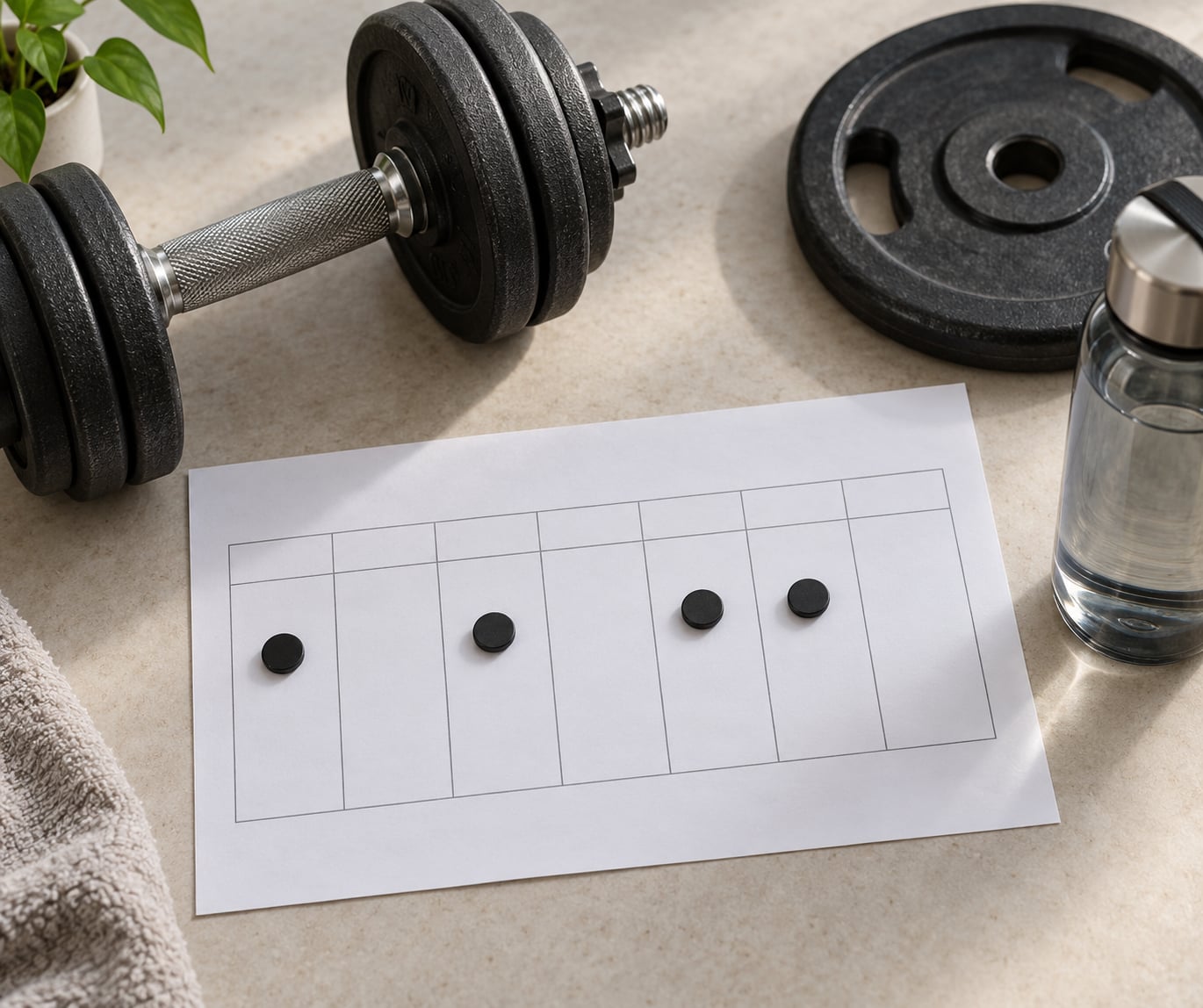
If you want a straight answer: most adults should lift weights two to four days a week, and three days is the sweet spot for most beginners. The CDC and WHO both put the floor at two sessions covering all the major muscle groups. Frequency matters, but what really decides fat loss is how long you keep lifting, how you eat, and whether you recover well enough to train hard each time.
I know plenty of people who thought they needed six days in the gym and stalled for months, then went to three days, ate sensibly, and finally saw the change they wanted. The three-day version is the one most of them are still running a year later.
This guide walks through what counts as a lifting day, how to pick a number of days you can actually keep, what a realistic week looks like at two, three and four days, and how to add a session without burning out.
Table of Contents
- The Short Answer: How Many Days a Week Should You Lift Weights to Lose Fat?
- Weight-Lifting Frequency at a Glance
- What Counts as a Weight-Lifting Day?
- How to Choose the Right Number of Days for You
- Best Weekly Weight-Lifting Schedules
- Two-Day Full-Body Schedule
- Three-Day Full-Body Schedule
- Four-Day Upper-Lower Schedule
- How to Make Each Session Support Fat Loss
- How to Increase Frequency Without Overtraining
- Common Mistakes When Trying to Lose Fat With Weights
- Frequently Asked Questions
- Is three days a week enough to lose fat?
- Should I lift 3 or 4 days a week?
- Is it bad to lift weights 7 days a week?
- Will I lose belly fat if I just lift weights?
- Do women need a different lifting frequency than men?
- Can I lose fat just by lifting weights, with no cardio?
The Short Answer: How Many Days a Week Should You Lift Weights to Lose Fat?
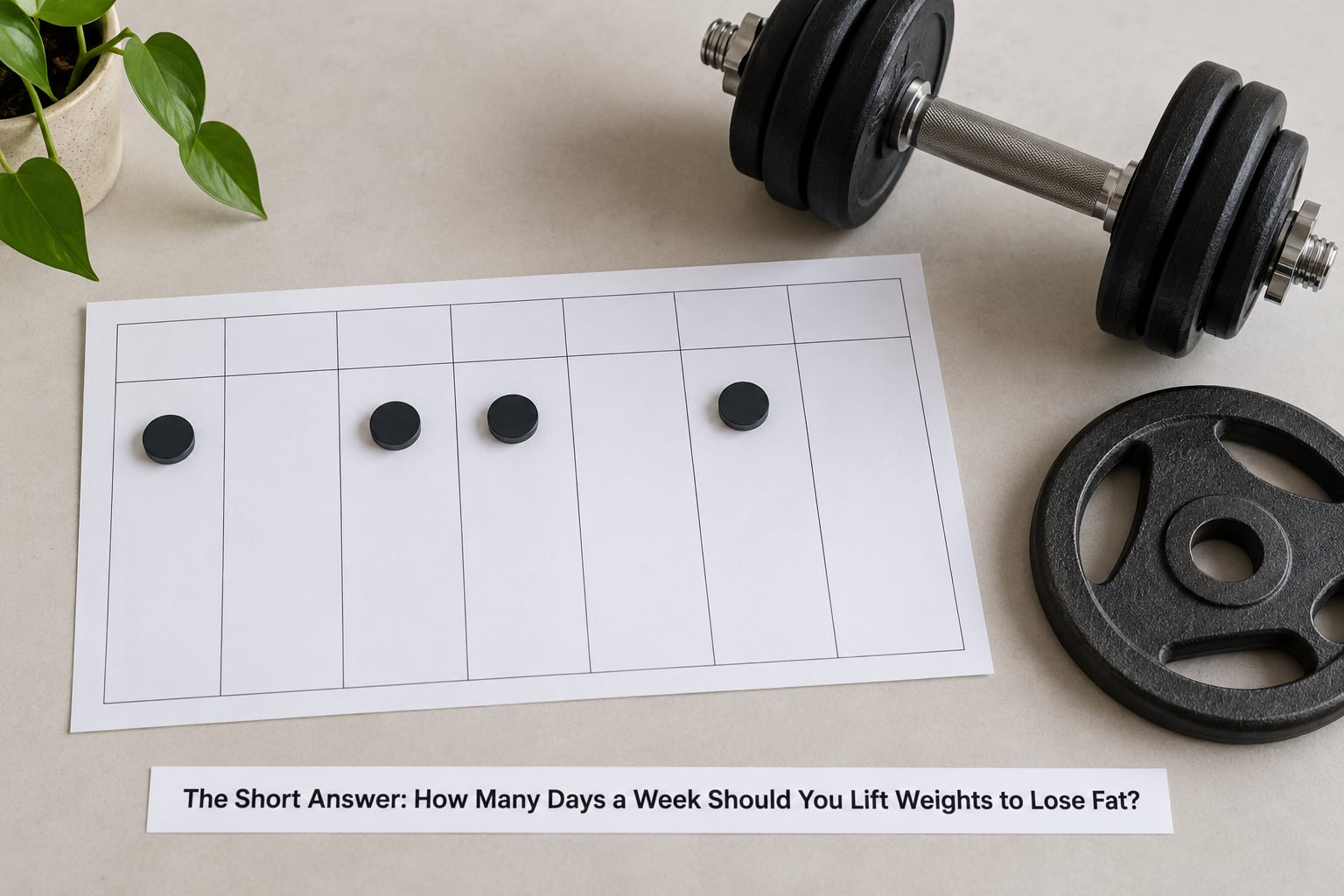
Two to four days per week, with three being the most practical starting point for most beginners. The CDC and WHO recommend at least two days a week of strength training that works all the major muscle groups, and the 2018 US Physical Activity Guidelines add that more sessions bring additional benefit for adults with no limits on the activity.
Three to five sessions is the range most trainers land on for fat loss, and the difference between three days and five is far smaller than people expect. What actually drives fat loss is a sustained calorie balance, and lifting is what lets you lose fat while keeping muscle instead of shrinking everywhere.
Here’s the part I wish someone had told me years ago. The best number for you is the highest one you can recover from and still show up for in month three. A four-day split you abandon in five weeks beats a six-day split you never finish.
Weight-Lifting Frequency at a Glance
The table below compares two, three and four lifting days per week so you can pick a realistic starting point rather than a number that sounds impressive on paper.
| Days per week | Best fit | Possible weekly structure | Recovery demand | Who it suits |
|---|---|---|---|---|
| 2 days | Minimum effective dose | Monday and Thursday, full body both days | Low | Beginners, busy schedules, returning after a long break, anyone rebuilding a habit |
| 3 days | Most popular balance of effort and results | Monday, Wednesday, Friday full body | Moderate | Most beginners and intermediates who want steady fat loss and muscle retention |
| 4 days | More volume with shorter sessions | Monday and Tuesday upper and lower, Thursday and Friday upper and lower | Moderate to high | Intermediates who already have solid technique and a track record of consistency |
Most readers land on the middle row. If you’re unsure, start at two days for a month to learn the movements, then move to three once the routine feels automatic.
What Counts as a Weight-Lifting Day?
A lifting day is any session where you train the big movement patterns with resistance and make them progressively harder over time. Squats or leg presses, rows or pull-ups, presses, hinges like deadlifts or Romanian deadlifts, and carries cover most of what matters.
A 30-minute session counts. Five or six hard compound movements in a circuit-style format is a real strength session, and 45 minutes with time to warm up and rest between sets is plenty. The length matters much less than whether you trained those patterns and challenged them.
What doesn’t add to your lifting frequency: a 20-minute walk, a light mobility flow, an ab finisher on its own, or steady cardio. Those are good, but they aren’t a second strength session. Ten thousand steps a day is a different kind of win, and you can have both in the same week.
How to Choose the Right Number of Days for You
Six factors decide whether three days beats five for your life: training age, weekly volume per muscle group, session length, recovery, work schedule, and how consistent you can realistically be.
Beginners. Two to three days. You get nearly all the early return from training when the technique is new, because your body is responding to almost any consistent stimulus. Adding a fifth session mostly adds soreness.
Intermediates. Three to four days. Once you’re adding real load, each muscle group benefits from being trained twice a week rather than once, so a four-day upper-lower split lets you hit each pattern twice without doubling any single session.
Limited time. Three short sessions beat two long ones, because a 40-minute session you actually do outperforms an 80-minute session you keep postponing. Cut the accessories first and keep the compounds.
Good recovery, limited schedule. If you sleep well, eat enough, and nothing hurts, a fourth day is worth adding. If you’re sleeping five hours and eating poorly, adding a day won’t fix that, and it will make recovery worse.
One useful test: run your chosen frequency for four weeks and check three things. Are your lifts going up or holding steady? Do you feel normal between sessions? Are the non-scale changes happening, like clothes fitting better and your waist measurement dropping? If strength is flat and you’re wrecked every week, your volume is too high. If strength climbs and you feel fine, you can handle more.
Best Weekly Weight-Lifting Schedules
Two-Day Full-Body Schedule
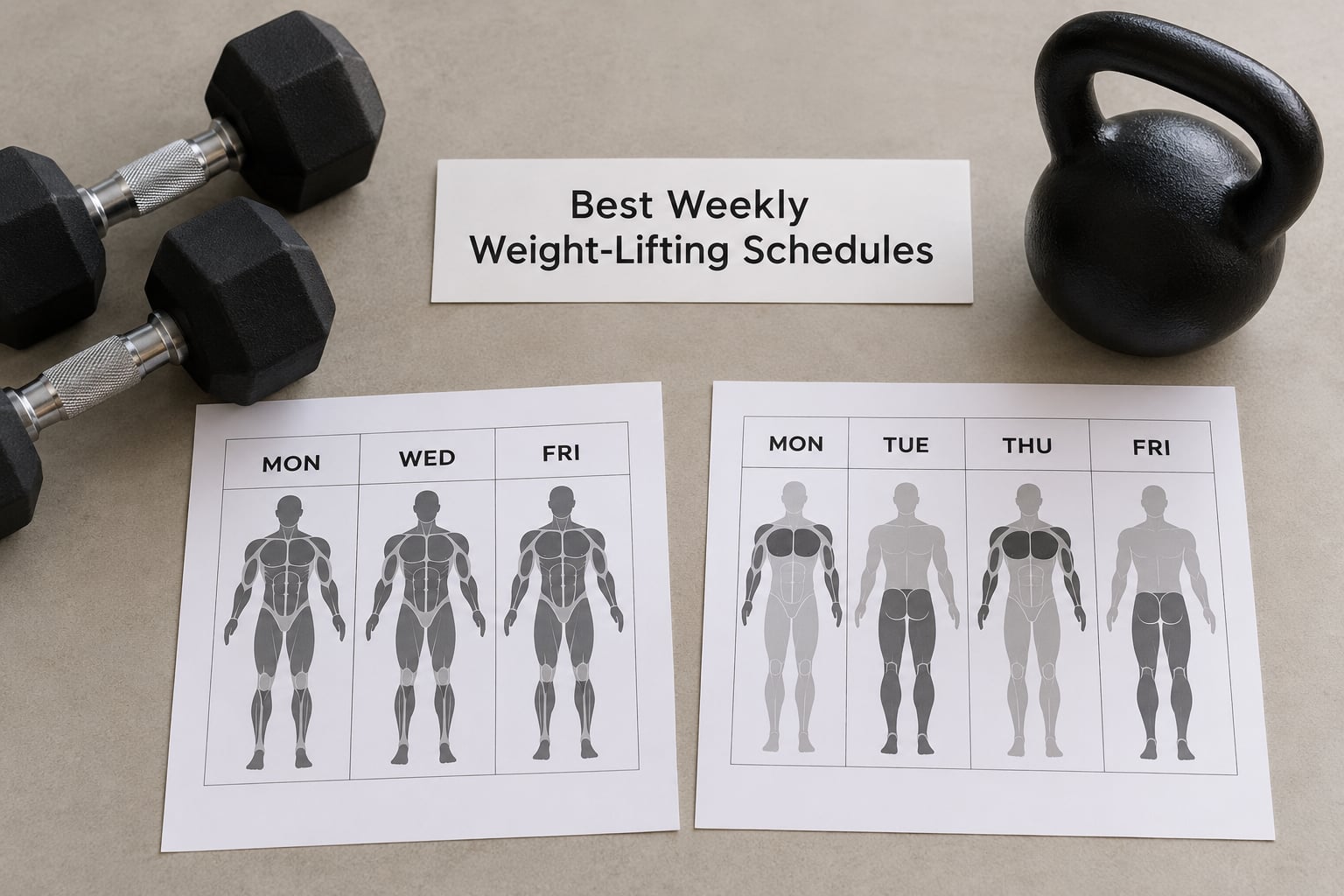
Monday: squat, push press, row, Romanian deadlift, plus a carry or core movement. Thursday: repeat the same five patterns with different variations, and try to beat Monday’s numbers. Two sessions with at least 48 hours between them is the CDC’s minimum recommendation for adults, and it works.
Three-Day Full-Body Schedule
Monday, Wednesday and Friday, about 45 minutes each. Squat, hinge, push and pull in every session, with one accessory that rotates. This is the schedule I’d hand most people starting out, because it trains every muscle three times a week without a single session getting long.
Four-Day Upper-Lower Schedule
Monday upper, Tuesday lower, Thursday upper, Friday lower, with Wednesday and the weekend free. Each session is shorter, you hit each body half twice, and it scales cleanly. The tradeoff is session quality: four rushed days often lose to three solid ones, so keep the rest between sets short and skip the filler.
How to Make Each Session Support Fat Loss
Lifting preserves muscle, and muscle keeps your resting metabolic rate higher than a cardio-only approach would. Walking and daily movement quietly add up too, and most people badly underestimate them. A cheap step tracker is often the most useful fat-loss tool you already own.
Pair the sessions with a modest calorie deficit rather than an aggressive one. A deficit you can hold for months beats a crash diet that ends in six weeks, and it’s where the evidence is clearest: fat loss comes from sustained energy balance, while training decides how much muscle you keep while it’s happening.
Get enough protein, sleep seven to nine hours, and keep your rest days genuinely restful. You’ll hear constantly that diet beats exercise for fat loss. That’s mostly true and also incomplete, because exercise is what stops the weight you lose from coming back as fat instead of muscle.
How to Increase Frequency Without Overtraining
Add days in order, not all at once. Get your technique clean and show up reliably for a month, keep weekly volume manageable, then add a fourth day if you’re recovering well and your weights have stopped moving for a couple of weeks.
Only after that consider a fifth day, and treat it as a small experiment rather than an upgrade. Cut one set from an existing day so total weekly volume rises by less than 10% instead of doubling.
Warning signs that you’re under-recovering include a resting heart rate noticeably higher than usual, sleep that won’t stay asleep, persistent soreness, irritability, feeling flat for days, and strength that drops for two sessions in a row. If you see those, take a lighter week, not a harder one.
In a week where you feel run-down, drop to two sessions at about half your usual volume and skip the cardio if you were planning intervals. Light weeks are a normal part of training rather than a sign of failure, and they tend to keep your joints healthier over a full year.
Persistent fatigue, chest pain, unusual shortness of breath, or any sharp joint pain are reasons to stop and talk to a doctor or a qualified physical therapist. So are warning signs during pregnancy, after surgery, or if you have a condition that affects your heart, joints or bones.
Common Mistakes When Trying to Lose Fat With Weights
Chasing an ideal frequency. The fix: choose the number you’ll still be doing in twelve weeks. Two days done religiously beats four days done for a month.
Training the same muscles on consecutive days. Full body on Monday and Tuesday means you get through the pattern once, and that’s it. The fix: leave at least one day before repeating a body part.
Adding load too fast. Progressing more than about 5% on your main lifts per week is a reasonable rule of thumb. The fix: add reps before you add weight, and keep a simple log.
Treating extra cardio as compensation. The fix: treat the week’s activity as one budget. A heavy lifting day plus hard interval sessions is often why people feel flat.
Using extreme calorie cuts. Cutting hard, dropping protein, and training four days is a recipe for losing muscle and stalling. The fix: aim for roughly 1 to 2 pounds of loss per week, then adjust from there rather than assuming more is better.
Trusting the scale alone. Muscle holds water, and a new training phase often spikes the scale while the waist shrinks. The fix: track your waist measurement, take photos every four weeks, and watch your lifting numbers alongside the weight.
Frequently Asked Questions
Is three days a week enough to lose fat?
Yes, for most people three days a week of full-body strength training is plenty. You train every major muscle pattern three times, which is enough to keep or build muscle while you lose fat. Two days also works and meets the CDC minimum. Add a fourth only when your technique is solid and recovery is good, not because a higher number sounds better.
Should I lift 3 or 4 days a week?
Pick three if you’re new to training, returning after a break, or juggling a heavy work week. Pick four if you’ve been lifting consistently for a few months, your technique is solid, and you want each muscle group hit twice a week with shorter sessions. Test three for four weeks first, and only move up if your lifts are still climbing and you feel recovered between sessions.
Is it bad to lift weights 7 days a week?
For most people, yes. Lifting every day leaves no room for muscle protein synthesis and recovery, and it usually ends in soreness, stalled progress, or burnout. A lighter activity like walking, easy cycling or mobility work is a different story, and fills those extra days without adding lifting stress. If you do train seven days, treat most of them as light technique work.
Will I lose belly fat if I just lift weights?
You can’t spot-reduce fat from one area. Strength training helps because it preserves muscle and raises your resting calorie burn, but the fat comes off through a sustained calorie balance across your whole body. Many lifters notice the scale barely move while their waist shrinks and their clothes fit better, because they lost fat and kept or gained muscle. Measure the waist, not just the scale.
Do women need a different lifting frequency than men?
The weekly minimum is the same: two to four days covering all the major muscle groups. What differs is scheduling around the menstrual cycle, when energy and soreness can shift, and around the lower recovery that comes with hormone shifts later in life. If your cycle affects how you feel, shift a heavy session away from the days you recover poorly and keep the weekly total steady.
Can I lose fat just by lifting weights, with no cardio?
You can, and it’s a solid approach, because lifting preserves muscle better than cardio alone. What weights don’t do for you is burn a lot of calories during the session, so the calorie balance has to come from food and from everyday movement like walking. Adding regular walking to your lifting week is the simplest way to close that gap without adding recovery load.
Start with the schedule you’d still be doing in three months, run it for four weeks, and judge it by your waist measurement and your lifting numbers rather than the scale. Once your technique is solid and recovery is steady, a fourth day is the easiest place to add more.