Losing weight in a month realistically means running a modest calorie deficit and staying with it for 30 days, which for most healthy adults works out to about 1 to 2 pounds a week, or 4 to 8 pounds across the month. That is slower than the results you will see on social media, and it is the pace most people are able to keep.
The CDC points to a gradual, steady rate for most adults rather than a dramatic one. A month is long enough to build habits that survive past day 30, but it is short enough that consistency matters more than intensity, so the plan below is built around small repeatable changes instead of a strict diet. Individual results vary with your starting weight, age, sex, activity level and current intake, and this is general information rather than personal medical advice.
Table of Contents
- What You Need
- How to Lose Weight in a Month Realistically: Step-by-Step
- How to Lose Weight in a Month Realistically by Starting Small
- Create a Balanced Eating Routine
- The Calorie Math Behind a Realistic Month
- Plan Your Weekly Movement
- Sleep, Stress, and Recovery
- Track Progress Without Obsessing Over the Scale
- Adjust the Final Week
- Common Mistakes
- Frequently Asked Questions
- How much weight can you realistically lose in a month?
- How many calories should I cut to lose weight in a month?
- How often should I exercise while losing weight in 30 days?
- What should I do if my weight loss plateaus in the first month?
- How do I keep the weight off after the 30 days end?
- Conclusion
What You Need
You do not need a gym membership, a fancy tracking device or a bag of supplements. A few ordinary things make the month much easier to run.
- A food and activity log. A notebook works fine, and so does a phone app. Writing things down for the first two weeks is the single highest-return habit in most plans.
- Comfortable walking shoes. If you can walk 30 minutes without your feet complaining, you already have everything the first two weeks ask of you.
- A kitchen scale, or the nutrition labels. One or the other. Labels work when you buy packaged food, and a scale works when you cook from scratch.
- A weekly planner. Thirty days fits neatly into four weeks, so one page per week is enough to see what you are actually doing.
- A tape measure and your phone. Waist measurements and progress photos catch changes the scale misses, especially in week three.
- Access to a doctor or registered dietitian. Useful before you start if you have a health condition, and essential if something feels wrong while you are in it.
Talk to a healthcare professional before making major dietary changes if you have diabetes, kidney disease, heart conditions, a history of disordered eating, if you are pregnant or breastfeeding, or if you take medication that affects appetite or blood sugar, including GLP-1 medications. That is not a formality. Those situations change what a safe deficit looks like, and only your clinician can work that out with you.
How to Lose Weight in a Month Realistically: Step-by-Step
The process has six parts. Each one is simple on its own, and the order matters because the early habits make the later ones easier. Here is the shape of the month before the detail.
| Week | Focus | What actually changes |
|---|---|---|
| Week 1 (days 1-7) | Baseline and setup | Measure everything, pick two habits, cook at home for most meals |
| Week 2 (days 8-14) | Consistency | Same meals, walking routine becomes a habit, protein at every meal |
| Week 3 (days 15-21) | Add load | Two or three resistance sessions, portions adjusted from logged data |
| Week 4 (days 22-30) | Hold and adjust | Keep what works, handle a stall, step food back up toward maintenance |
Most people lose the first few pounds in week one and then watch the rate drop, which is normal and covered in the tracking and final-week sections below.
How to Lose Weight in a Month Realistically by Starting Small
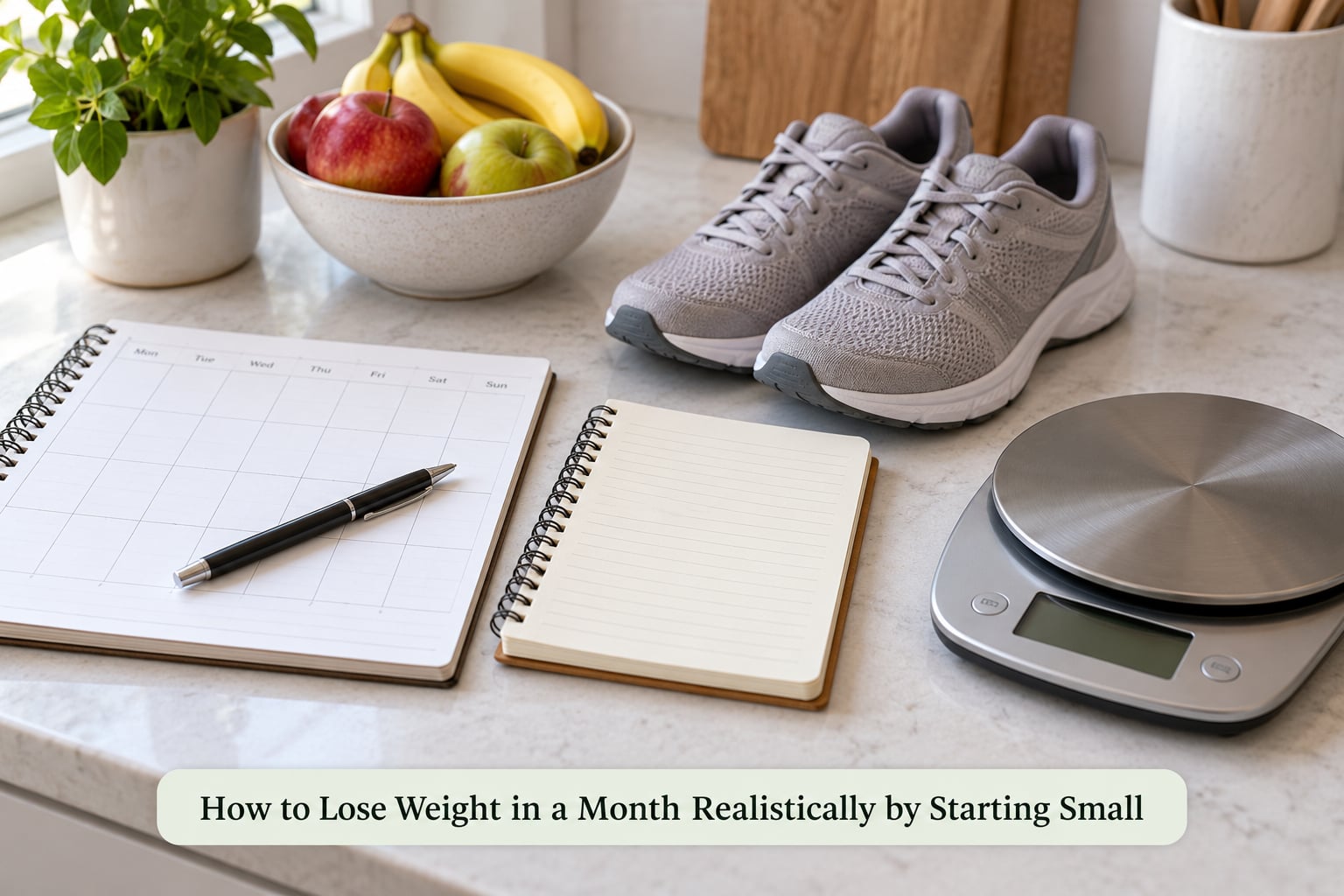
Start with one food habit and one movement habit. That is it. Add a vegetable to two meals a day, or take a 10-minute walk after dinner, or log everything you eat. Two changes is the ceiling for week one, because that is roughly how many new habits an adult can hold onto at once.
Decide in advance how you will judge it. Completion rate beats weight here: if you logged on five of seven days, or walked on five of seven nights, the habit worked regardless of what the scale said that morning. Missed days get fixed by shrinking the habit, not by restarting. A 10-minute walk becomes five minutes, which is easy enough to keep doing until it grows back.
People who keep the weight off tend to describe swaps rather than diets: soda to sparkling water, a portion change at dinner, a snack eaten sitting down instead of in the car. Small repeatable swaps survive a bad week in a way a named diet does not.
Take baseline measurements now, before anything changes. Weight, waist at the navel, and two photos in the same clothes and lighting. They take five minutes and they give you something to look at in week three when the scale has gone quiet and you start wondering whether any of this is working. Starting measurements also mean you can tell a plateau apart from a slow trend.
Create a Balanced Eating Routine
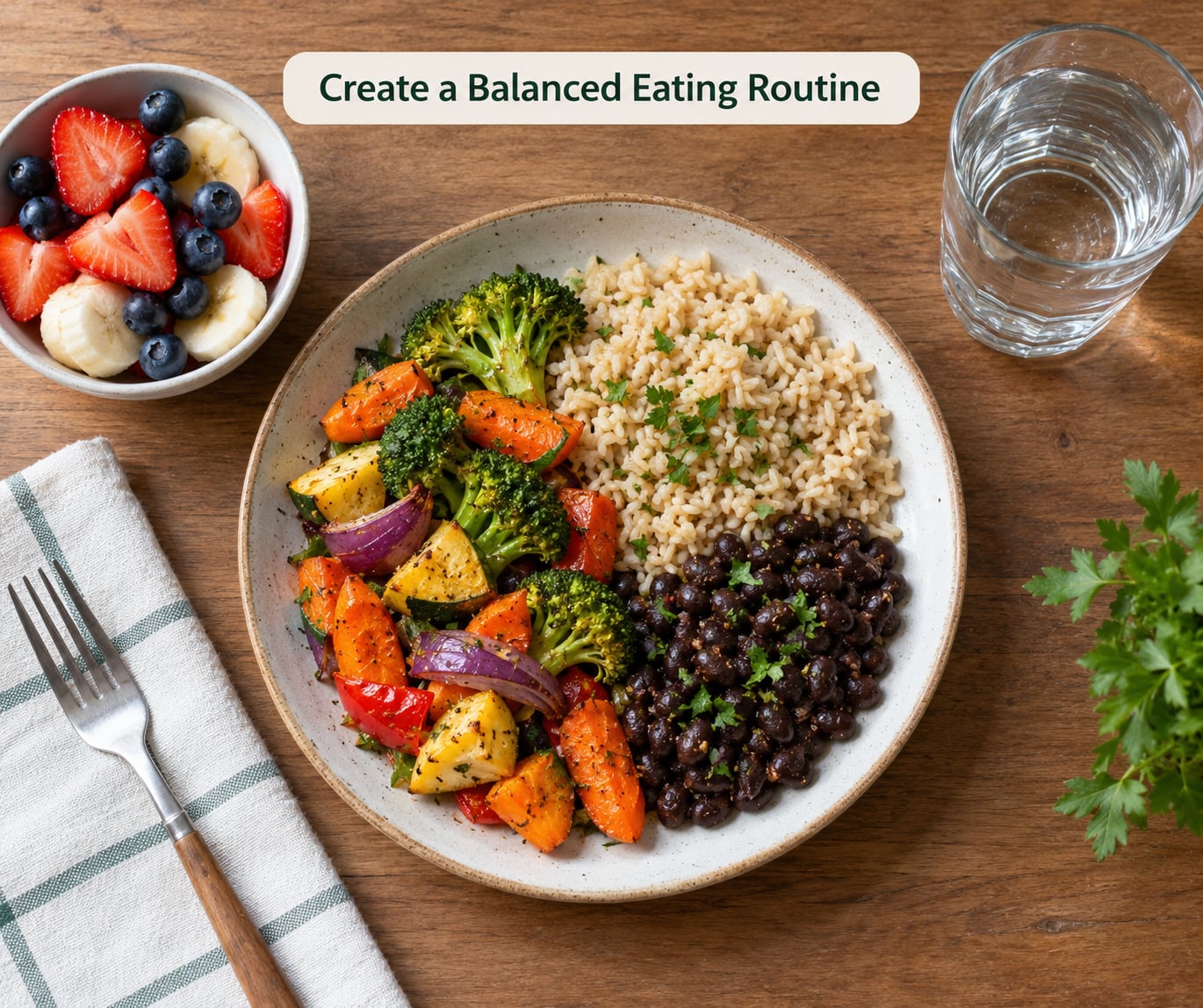
Build meals from vegetables, fruit, whole grains, a protein source and some fat, and eat them roughly on schedule. Three regular meals and one or two planned snacks beat a day of skipped meals followed by an evening of eating whatever is easiest, which is where most month-long plans fall apart.
Aim for protein at every meal and dietary fiber in the 25 to 30 gram range. Fiber fills space, keeps digestion steady and takes the edge off between meals, and protein helps you keep lean muscle mass while you are in a deficit. Read labels for the first week and notice where the added sugar actually is, because sugary beverages are the easiest calories to remove without touching how a meal feels.
For portions, use your hand as a guide rather than weighing everything: a palm of protein, a fist of grains, a handful of nuts, a thumb of fat. Then create a modest deficit of roughly 250 to 500 calories a day, mostly from small changes, sometimes paired with a little more movement. Skipping meals, banning carbohydrates and relying on supplements are all ways of creating a deficit that tend to fail within a month.
Cooking at home does most of the work here, not because homemade is somehow healthier by definition, but because you control the oil, the portion and what is on the plate. A simple rotation of a protein, a vegetable and a grain gets you through a week without thinking about it, which is the real requirement. Batch cooking on one afternoon covers roughly half the week, and the leftovers take less effort than a takeaway decision ever does.
Two contexts change how this plan should be approached. Menopause, PCOS and thyroid conditions each affect appetite, metabolism or energy in ways that a generic plan does not account for, and medication such as GLP-1s changes appetite and makes preserving muscle more urgent rather than less. If any of that describes you, the food half of this plan should be reviewed with a doctor or registered dietitian first.
The Calorie Math Behind a Realistic Month
One pound of body fat represents roughly 3,500 calories of stored energy, so a daily deficit of about 500 calories adds up to roughly a pound per week, or four pounds across 30 days. Push the deficit toward 750 calories a day and the math points to six or so pounds in a month, which sits at the upper end of a reasonable range for many adults.
That rule is a useful estimate rather than a law. Bodies do not respond identically, they move differently, some absorb more of the same food than others, and the scale registers changes in water and glycogen alongside fat. Treat the number as a direction of travel, not a promise on the calendar.
A more personal version of the same idea comes from coaching practice, where the target is often 0.5 to 1 percent of body weight per week. That range exists to protect lean muscle rather than because the number is magic, and it explains why two people running identical deficits get different results. The table below is a rough guide to what 30 days can look like at different starting weights.
| Starting weight | Weekly fat-loss target at 0.5-1 percent | Typical 30-day result |
|---|---|---|
| Under 150 lb | Under 1 lb | 2 to 4 lb, slower than most social media claims |
| 150 to 200 lb | About 1 lb | 4 to 5 lb |
| 200 to 250 lb | 1 to 2 lb | 4 to 8 lb |
| Over 250 lb | 2 lb or more early on | 8 to 12 lb, more of it fat rather than water |
Starting weight is the factor people cite most often when they explain why their month looked different from someone else’s. Early losses at higher starting weights often include less water, which is why the same plan can feel slow for one person and fast for another.
Plan Your Weekly Movement
Weeks one and two are walking work. Start at 20 minutes a day, five days a week, and build toward 30 to 45 minutes as your body allows. Many people add a step goal around 10,000 steps a day, though the more useful target is the one that fits your current baseline. Going up in stages matters more than hitting a number.
From week three, add resistance training two or three times a week, 30 to 45 minutes per session. Push-ups, squats, rows with a band or a backpack, hip hinges and carries cover the basics, and a home workout or no-equipment circuit works if a gym is not convenient. Two sessions a week is enough to protect muscle mass during a deficit.
If time is the problem, the honest answer from people who succeed is that walking wins. Five 15-minute walks beat one missed 60-minute session, and movement built into a commute, a lunch break or a phone call at work counts fully. Non-exercise movement, the walking around a job or a busy household, often outweighs a planned workout, and tracking steps is the easiest way to see whether that has slipped during a stressful stretch.
Classes and group sessions help some people because the schedule is already made for them. Others find the commute and the crowd worth more than the workout itself. The right routine is the one that still happens in week three on a bad day.
Judge intensity by the talk test: you should be able to speak in short sentences but not sing. Track how the sessions felt and whether you did them, not whether you were sore. If you have a condition, are returning after an injury, or are taking medication that affects heart rate, check with a clinician before starting a new routine.
Sleep, Stress, and Recovery
Seven to eight hours of sleep is the range most adults are aimed at, and short sleep works against you on the days that matter most. It raises appetite, makes cravings harder to refuse, and leaves you choosing convenience food after a long day.
Practical moves beat good intentions here. Keep a consistent bedtime and wake time, including weekends. Prep two or three meals ahead so a hard evening does not turn into a drive-through. When stress eating is the pattern, the fix is usually structural: more sleep earlier in the week, food already prepared, and one planned non-food evening activity.
Persistent fatigue, dizziness, feeling cold all the time, hair loss, or changes to your menstrual cycle are reasons to stop and speak with a doctor rather than push harder. Those are not things a plan should ask you to work through.
A short deadline brings its own strain. Most people starting a 30-day plan describe it as a reset rather than a punishment, and the framing that survives is the one where an off-plan meal is an ordinary Tuesday rather than a failure. If the month has taken over your eating, your sleep or your mood, that is worth raising with someone qualified before day 30 arrives.
Track Progress Without Obsessing Over the Scale
Weekly averages, not single weigh-ins. Step on the scale in the morning a few times a week, write the numbers down, and look at the trend across two or three weeks. Daily swings of two pounds or more are normal and usually mean water, salt, digestion or your menstrual cycle, not fat.
Weight is one measure among several. Here is a small set that tells a fuller story over four weeks.
| Measure | How often | What a good trend looks like |
|---|---|---|
| Weekly weight average | Each week | Slowly trending down across three or four weeks |
| Waist measurement | Weekly | Shrinking even on weeks the scale stalls |
| Progress photos | Every two weeks | Same time, same lighting, same clothes |
| Energy and mood | Daily, one word | Stable or improving |
| Strength and walking ease | Each session | Same or better reps, easier stairs |
| Habits completed | Weekly | Most of the planned sessions done |
Keto and other very low carbohydrate approaches often produce a fast first week, but much of that early drop is water weight as glycogen stores shrink. Fat loss is slower and steadier, so a plan that looks dramatic in week one and flat in week four is not the same thing as a plan that works.
Adjust the Final Week
Review weeks one through three and look for patterns rather than totals. Which meals repeated because you genuinely liked them, and which repeated because you were tired and cooking felt like a decision? Keep the first group, simplify the second.
If the scale stalls in week three, it is usually one of four things: logging stopped being accurate, portions crept up, non-exercise movement dropped without you noticing, or you are looking at water weight. Change one variable for a week rather than cutting everything again. Add a walk back, fix one meal, and check your sleep before touching food quantity.
Days 25 through 30 are for stepping back toward maintenance. Add roughly 100 to 150 calories every few days rather than jumping straight back to where you started, keep your walking and strength sessions in place, and hold your weigh-ins to once a week. The habits you built are the point; the last few days are where you decide whether they become permanent.
This part matters more than any single week of the month. A deficit you stop abruptly is often met with a rebound, partly because appetite hormones rise as calories drop, and partly because the old routine is still sitting there untouched. Raising intake in small steps while keeping movement in place gives your body a reason to hold what it lost.
Write down what you are keeping before day 30 arrives, while the month still feels normal. Three lines is enough: the meal you cooked most days, the movement you did most often, and the check-in you want to keep. Habits you can name are easier to keep than a vague intention to eat better.
Common Mistakes
These are the patterns that derail month-long plans, with the fix for each.
- Crash dieting. Very low intakes drive down energy, cost you muscle and create a rebound. Fix: use a modest deficit, keep meals regular, and treat a daily floor around 1,200 calories for women and 1,500 for men as a line not to cross without professional guidance.
- Banning entire food groups. Rules this strict rarely survive 30 days and rarely help the numbers after. Fix: cut frequency and portion of the problem food instead of declaring it off limits.
- Weight-loss supplements. Most add little and some carry real risk, especially alongside medication. Fix: spend the effort on food quality and steps, and raise supplements with a pharmacist or doctor first.
- Overtraining. Stacking long sessions, HIIT and daily walks leaves you sore, injured and tired, which pushes intake up. Fix: two or three resistance sessions plus regular walking, with rest days built in.
- Changing everything at once. A new diet, a new gym routine and a new sleep schedule rarely survive week two. Fix: one food habit and one movement habit for week one, then add.
- Judging progress by the scale alone. Daily weigh-ins hide the trend and end plans early. Fix: weekly averages plus waist measurement, photos, energy and strength.
After the month ends, do not return to the exact eating and movement that got you here. Keep two or three specific things: a meal you now cook most days, a movement routine you actually enjoy, and a weekly weigh-in. Keeping the habits while returning to maintenance calories is the part most guides leave out, and it is the part that decides the outcome.
Frequently Asked Questions
How much weight can you realistically lose in a month?
Most healthy adults lose 4 to 8 pounds in a month, which is 1 to 2 pounds a week, and that matches the gradual rate the CDC suggests for sustainable loss. People with a much higher starting weight may lose faster at first, and some of that early drop is water rather than fat. Set your expectation at the steady rate and treat the scale as a weekly trend.
How many calories should I cut to lose weight in a month?
A deficit of roughly 500 calories a day points to about a pound per week, or four pounds in 30 days, because one pound of fat holds roughly 3,500 calories. Many people do better with 250 to 300 calories cut from food plus a similar amount added through walking. Avoid dropping below about 1,200 calories a day for women or 1,500 for men without medical guidance.
How often should I exercise while losing weight in 30 days?
Walking on five days a week, building from about 20 minutes toward 30 or 45, is enough for the first two weeks. From week three, add resistance training two or three times a week to protect lean muscle. If you cannot train, daily movement still helps, and raising your step count from your current baseline beats trying to match someone else’s number.
What should I do if my weight loss plateaus in the first month?
Check your logging first, then your portions, then how much you move outside workouts, and finally your sleep and water intake. Pick one thing to adjust for a week rather than cutting calories sharply. A stall inside 30 days is usually a measurement or consistency problem, and plateaus that persist for several weeks are a good reason to talk with a doctor or registered dietitian.
How do I keep the weight off after the 30 days end?
Add roughly 100 to 150 calories every few days in the final week rather than jumping straight back to your old intake, and keep the walking and strength habits you built. Weigh in once a week instead of daily, and keep two or three specific anchors, such as a meal you cook most days. Habits that survive the month do more for maintenance than any single diet name.
Conclusion
Start with two things this week: one food habit and one movement habit, then review your weekly average every Sunday. How to lose weight in a month realistically is not about hitting a number on day 30, it is about building habits that still work in month two. Progress on energy, waist measurement and strength counts, and bring any health condition or medication to your doctor before you cut calories.