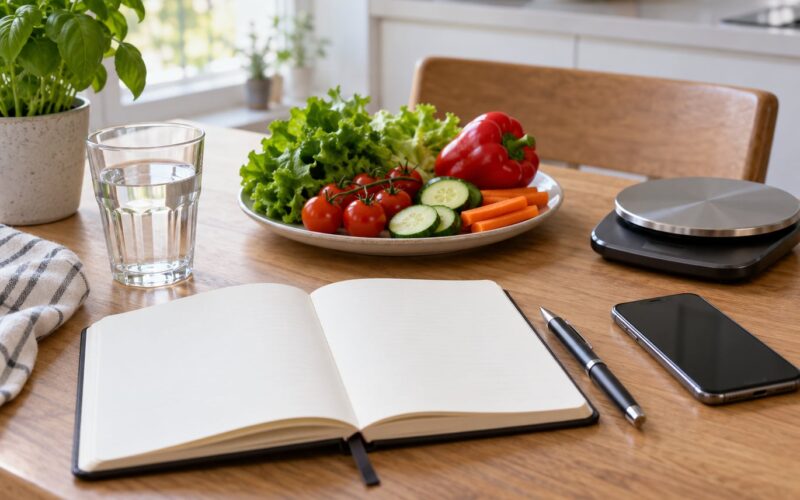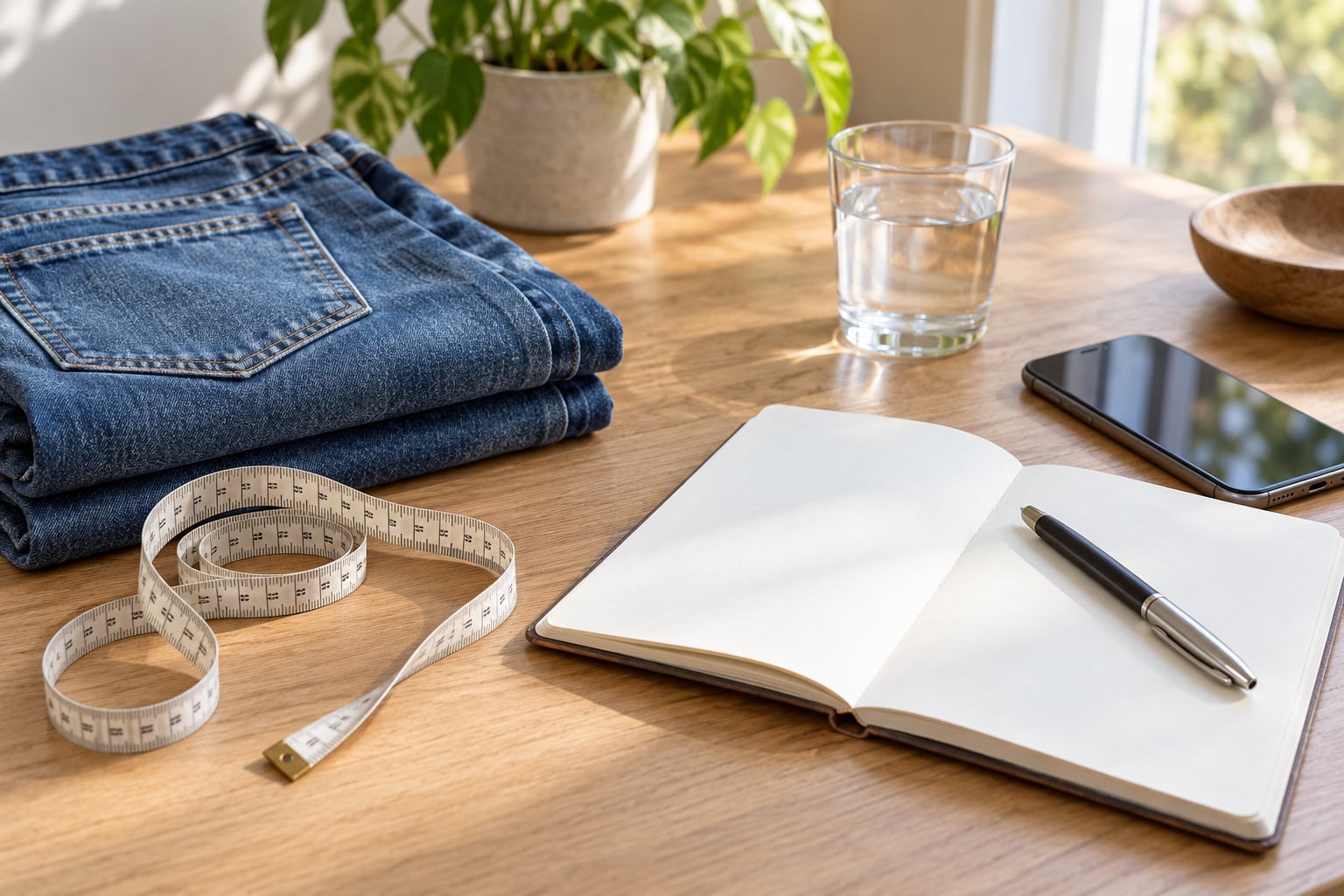
You can track weight loss progress without a scale by measuring the same things on a fixed schedule: waist and other circumference measurements, how your clothes fit, progress photos, gym performance and everyday energy. Those signals move steadily even on days when bodyweight does not. The whole system takes about fifteen minutes a week once you have it set up.
The reason a scale is such a poor progress tool on its own is that bodyweight swings two to five pounds in a day from water, sodium, digestion, time of day and the menstrual cycle. A single reading tells you what you drank last night, not what changed in your body composition. Muscle is denser than fat, so someone strength training can be losing fat and gaining weight at the same time.
Measuring the same landmarks every two to four weeks filters all of that out. You are no longer reading a noisy number, you are reading a trend.
Table of Contents
- What You Need
- Step-by-Step: How to Track Weight Loss Progress Without a Scale
- How to track weight loss progress without a scale: Establish a baseline
- How to track weight loss progress without a scale: Measure consistently
- How to track weight loss progress without a scale: Notice clothing changes
- How to track weight loss progress without a scale: Use progress photos
- How to track weight loss progress without a scale: Record performance and habits
- How to track weight loss progress without a scale: Review trends and adjust
- A two-week log you can copy today
- Common Mistakes
- Frequently Asked Questions
- How often should I measure my waist without a scale?
- What is the most accurate way to track fat loss without weighing yourself?
- Can clothing fit tell me whether I am losing weight?
- Why am I not seeing progress even though my habits are improving?
- How do I take progress photos so they are genuinely comparable?
- When should I ask a doctor or registered dietitian for help with weight loss?
- Start This Week
What You Need
Nothing here requires a subscription, a clinic or a smart device. You need a soft measuring tape, clothes you already own, a phone camera, and somewhere to write numbers down.
- A soft measuring tape. The fabric kind, not a metal tailor’s tape. Dollar-store versions work fine as long as the numbers are printed in inches and you can read them without stretching.
- One fitted garment per checkpoint. A pair of jeans, a belt, a ring, a bra strap. Pick items tight enough now that a change is obvious.
- A phone or camera with a timer. For progress photos, and for the video that settles any argument about your posture.
- A notebook, notes app or habit tracker. Somewhere that holds a date next to a number, because an unlogged measurement is just a fact you will forget.
- A fixed weekly slot. Sunday morning works better than any weekday. Pick one and protect it.
Add a fitness log if you already have one, and the cuff on your blood pressure monitor if it is not gathering dust. Those two turn a vague feeling into a number you can trend.
Step-by-Step: How to Track Weight Loss Progress Without a Scale
Six steps, run in order. The first three give you hard numbers and evidence, the last three keep you moving when those numbers stall.
How to track weight loss progress without a scale: Establish a baseline
Start with a baseline week where you record everything but change nothing. This is the single most skipped step, and skipping it is why most people feel lost two months in.
Record five body measurements in inches: waist at the narrowest point above the navel, hips at the widest point, chest under the armpits, thigh just below the glutes, and upper arm at the midpoint. Do it twice and write down both numbers, then use the average. Measuring error is usually a quarter to a half inch, and knowing your own error is what stops you chasing noise later.
Then note the rest of the baseline. How the waistband of your jeans sits when buttoned. Whether you can climb three flights without stopping. What your resting heart rate reads before you get out of bed, or your average step count for a typical weekday. How much sleep you got and how alert you felt. Take your first photo set.
Write all of it down with today’s date. A baseline is only useful if it was honest about the boring parts too, and it should look average, not impressive.
How to track weight loss progress without a scale: Measure consistently
Consistency beats accuracy here. A waist measurement taken sloppily at the same time every month tells you more than a perfect one taken whenever you remember.
Keep four conditions fixed: same time of day, same landmarks, same tension on the tape, same general conditions. Morning before breakfast works well because you are not carrying a meal or a liter of water. If you prefer evenings, that is fine, as long as it is always evening.
For the waist, the tape goes around the narrowest point of the torso, usually just above the navel, with the tape snug but not digging in. Breathe out normally first, not fully emptied, because forcing a breath inward changes the reading. Measure the hips at the widest point, roughly level with the top of the pubic bone. For the thigh, mark the spot on the first measurement so week eight lands in the same place every time.
Measure every two to four weeks. Any more often and you are reading fat-free mass, which is muscle and bone and water, and that barely moves week to week.
Waist circumference is the one most worth tracking, because it tracks visceral fat, the fat around your organs, which is what public-health guidance cares about most. A waist-to-height ratio under roughly 0.5 is the threshold commonly used for men and women alike. At 5 foot 4, that is a waist under 27 inches. You do not need to hit a number, but knowing where you started makes the direction obvious.
How to track weight loss progress without a scale: Notice clothing changes
How your clothes fit is the most convincing signal most people never formally track, because the feedback is slow and vague until it suddenly is not.
Test the same items on the same schedule and grade the fit instead of guessing. Use a simple four-point scale: tight, snug, comfortable, loose. Record the grade for the waistband of your jeans, a belt loop, a ring, and a bra strap. Those four are good because they are unforgiving and they are sized in discrete steps you can actually feel.
Specific things to watch for: the number of belt notches you have moved since your baseline, whether you can zip a jeans button without holding your breath, whether your ring spins freely or has to be pushed past your knuckle, and where the waistband sits when you bend forward. People notice belt notches and ring size far later than they notice waistbands, which is exactly why they are worth writing down.
The one-inch feedback loop matters. When the fat loss is small, the waistband barely registers. After a few inches across, the same jeans feel visibly different and you stop needing a tape to believe it.
How to track weight loss progress without a scale: Use progress photos
Photos are the only scale-free method that shows you the change instead of describing it. They also go bad fast if you change the conditions between shots, which is the reason most people give up on them.
Shoot front, side and back, every two to four weeks. Keep four things locked: the same clothing, ideally fitted underwear or the same fitted outfit; the same time of day, ideally morning before eating; the same distance and lens height, with the camera propped at waist height or using a timer on the floor; and the same lighting, ideally the same spot in the same room with the same window behind you.
Stand the same way each time. Feet hip-width, arms relaxed at your sides, shoulders back, one exhale, then hold. Turn ninety degrees for the side shot rather than twisting. Do not arch your back, do not tense, do not pull your shirt tight.
Name the files with the date and put them in one album you never reorganize. Reviewing the same ten images side by side is what makes the change visible. A single photo seen once proves nothing.
Your phone is a genuinely good tool for this. The camera, the timer and the side-by-side compare view do everything a tracking app does, without the logins or the daily notifications.
How to track weight loss progress without a scale: Record performance and habits
Fat loss shows up in what you can do before it shows up in what you look like. This is where most people find the motivation to continue on a week when the waist has not moved.
Pick two or three performance benchmarks and retest them monthly instead of chasing daily. A mile time on a track or treadmill, the weight on your squat or deadlift for three lifts, the number of flights of stairs you can take without resting, your resting heart rate over a week, and your average daily step count are all workable. Write the number down, not the feeling.
Track habits as adherence, not totals. What share of planned workouts did you finish? How many days hit your protein target? How many nights got seven hours of sleep? Percentages and counts remove a lot of self-deception.
Add three subjective markers, rated 1 to 5, because they are real data too: energy, sleep quality and mood. Someone in the middle of a deficit often feels this before any of the numbers respond.
There is a fourth, quieter signal worth logging: resting heart rate. It tends to drift down as fitness improves, and because it is measured at rest it is not affected by that afternoon’s coffee.
Two slower options are worth adding if you want more depth. Body composition testing splits you into fat mass and lean mass, and consumer bioimpedance scales are the cheap version, calipers the fiddly one, and a DEXA scan the accurate one. Calipers are only worth it if the same person measures the same sites, every time, because technique error swamps the signal otherwise. DEXA is the most precise option available and the least convenient: it needs a clinic appointment, and it is usually not covered by insurance.
Lab work is the long game. A1c, fasting glucose and cholesterol move as fat loss accumulates over months, which means they tell you whether the plan is working at a health level rather than a cosmetic one. Blood pressure and resting heart rate are the cheap versions of the same idea and you can take them yourself. None of these replace the tape for weekly feedback, but together they answer the question the scale cannot, which is whether this is improving your health and not only your waistline.
How to track weight loss progress without a scale: Review trends and adjust
Weekly, spend five minutes turning your records into a score so you have a single number to look at, the thing readers say they miss most without a scale.
Give yourself 0, 1 or 2 points on each of five measures: waist circumference down from last checkpoint, one or more fitted garments looser, photos visibly different, at least one performance benchmark improved, and habit adherence at or above 80 percent. Multiply by two for a score out of ten. Ten is a strong month. Seven is normal. Below five for two consecutive reviews is the signal to look at what you are actually doing, not at the score.
Review every four weeks, not every day. Look at the direction of each line, not the size of the last point. If waist is down half an inch, stairs are easier and the score is eight, the month went well even if your jeans button felt tight on Tuesday.
When two or more measures stall, change one thing and hold it for another four weeks. Meal timing, activity volume, sleep, or the size of your deficit. One change at a time is the difference between learning something and guessing.
A two-week log you can copy today
Put this in your notes app and fill in one row per week. It is deliberately short, because a log you abandon in week three is worth less than a messy one you keep.
| Week | Waist | Jeans fit | Bench or squat | Steps per day | Score |
|---|---|---|---|---|---|
| 1 | 38 in | snug | 95 lb | 6,200 | 2 |
| 3 | 37.5 in | comfortable | 95 lb | 7,400 | 6 |
| 5 | 36.75 in | loose | 100 lb | 8,100 | 8 |
These are example numbers, not a target. Fill yours in against your own baseline.
Common Mistakes
Almost every tracking system fails the same way, and it is rarely the measurement. It is the handling of the measurement.
Measuring at a different time each week. Comparing a first measurement taken after dinner to one taken before breakfast guarantees a scare. Fix the time of day in the baseline week and never deviate.
Taking photos too often. Fortnightly is the ceiling for most people. Weekly photos make you look at unflattering angles, unflattering lighting and unflattering expressions, and that is how a useful habit turns into an anxious one.
Judging progress by how you look in a mirror. A mirror is the worst instrument you own. It shows you a moving, mirrored, partially lit version of yourself, and you compare it to a memory. Use a fixed camera instead.
Changing five habits at once when a measure stalls. If you cut carbs, add cardio, start a new training block and change your sleep schedule together, a stall teaches you nothing. Change one input and give it four weeks.
Using the tracker to punish yourself. A record exists to answer a question, not to deliver a verdict. If logging makes you feel bad enough to skip a workout or skip a meal, you have built a punishment tool, and the honest fix is to track less, not more.
Bouncing between five methods every two weeks. People try photos for a week, then a smartwatch, then a caliper, then blood pressure. Pick two core measures, one optional one, and give them a full three months.
One more worth naming, because it is common and it is worth holding onto: the scale is a tool, not a verdict. Some people weigh daily and read the trend, and for them that works. Others find the number genuinely harmful and stop weighing entirely, and that is a legitimate call. The thread debates in r/loseit and r/WeightLossAdvice are split on exactly this, and both camps agree on the useful part, which is that one reading means nothing.
If weight and numbers are triggering for you because of a history of disordered eating, tell someone. A doctor or a registered dietitian can help you build a plan that includes health markers like blood pressure, resting heart rate and lab work, without a number on the scale in the room. Nothing in this guide requires you to weigh yourself.
Frequently Asked Questions
How often should I measure my waist without a scale?
Measure your waist every two to four weeks, at the same time of day and before eating or drinking. Weekly is too often because waist circumference barely moves in a fortnight and you will start chasing measurement error. The narrowest point of your torso, just above the navel, is the most consistent landmark. Take two readings each time and average them, and record the result with the date so you can read the trend rather than a single data point.
What is the most accurate way to track fat loss without weighing yourself?
Waist circumference measured consistently is the most accurate at-home option, because it scales with fat mass and is far less affected by hydration than body weight. For a fuller picture, add a lab panel covering A1c, fasting glucose and cholesterol, which move as your fat loss accumulates over months rather than weeks. A DEXA scan measures fat and lean mass directly and is the most precise option available, but it needs to be booked at a clinic and is not usually covered by insurance.
Can clothing fit tell me whether I am losing weight?
Yes, and it is often the first method to show a real change. Fit feedback is discrete rather than gradual, so it lags behind the tape by a few weeks and then jumps all at once. Track it properly instead of guessing: rate one to four grades of fit for the same jeans waistband, a belt, a ring and a bra strap, on the same schedule as your measurements. Belt notches and ring size in particular are unforgiving, because they only change when something has genuinely shifted.
Why am I not seeing progress even though my habits are improving?
Two common reasons. First, fat loss is slow at the start and the change you are hunting for is small enough to sit inside your measurement error, so a few weeks of no visible change is normal rather than a sign of failure. Second, you may be losing fat while adding lean mass from resistance training, which changes shape without changing the number. Look at your four-week trend line, your performance benchmarks and your clothing grade together. If all of them are flat for two months, adjust one input and reassess.
How do I take progress photos so they are genuinely comparable?
Lock four things between sessions: the same clothing, the same time of day, the same distance and camera height, and the same room and lighting. Take front, side and back shots with feet hip-width, arms relaxed and one normal exhale, using a timer rather than a handheld shot. Name the files with the date and keep them in one album. The camera itself is the tool here, so a phone with a timer and a side-by-side compare view is plenty.
When should I ask a doctor or registered dietitian for help with weight loss?
Ask when you have a medical condition affected by weight, take regular medication, are pregnant or breastfeeding, or have a history of disordered eating. Also ask if you see swelling, rapid unexplained weight change, persistent fatigue or shortness of breath, and if your tracking has stopped feeling informative rather than motivating. A registered dietitian can build you a plan around measurements, lab markers and energy that never involves standing on a scale, and a doctor can rule out the causes you cannot track at home.
Start This Week
If you do one thing, take your baseline measurements this Sunday and put the date next to them. Waist, hips, thigh, the fit of one pair of jeans, and a front-and-side photo set. Twenty minutes now gives you something to compare against for the next three months.
Then repeat that on a two-week cycle and let the trend do the talking. You are not avoiding a number. You are using better ones.
This is general information rather than personal medical advice, and it was last checked for 2026.