The body measurements to track for fat loss are simple: waist, hips, chest or bust, thighs, upper arms, calves and neck. Take them with a soft tape measure the same way every time, record the numbers, and look at the trend across eight to twelve weeks instead of a single reading. Tape readings show change that the scale hides, especially when weight loss and muscle gain happen at the same time.
It takes about ten minutes a week. It also costs nothing, and unlike a body fat percentage printed on a smart scale, a circumference reading is hard to argue with.
This is general information about tracking progress, not medical advice. If you have a health condition, are pregnant or postpartum, or are recovering from an injury, ask your doctor or a registered dietitian how to track progress safely before you start making big changes.
Table of Contents
- Body Measurements to Track for Fat Loss at a Glance
- Which Measurements Are Most Useful?
- Men and women usually track different sites
- Reading weight and body measurements to track for fat loss together
- How to Measure Your Body Accurately
- Equipment
- Posture and breathing
- Landmarks
- The two-reading rule
- Body Measurements to Track for Fat Loss: A Simple Routine
- How Often Should You Check Measurements?
- What Changes Should You Look For?
- How much change counts as real
- When the tape stops moving
- Common Measurement Mistakes
- Measurements beyond the tape
- Frequently Asked Questions
- How often should I measure my waist when losing weight?
- How accurate is a body fat measuring tape?
- What is the normal waist-to-hip ratio?
- What is the ideal waist-to-height ratio?
- Can I lose 3% body fat in one month?
- How much should my measurements change each week?
- Conclusion
Body Measurements to Track for Fat Loss at a Glance
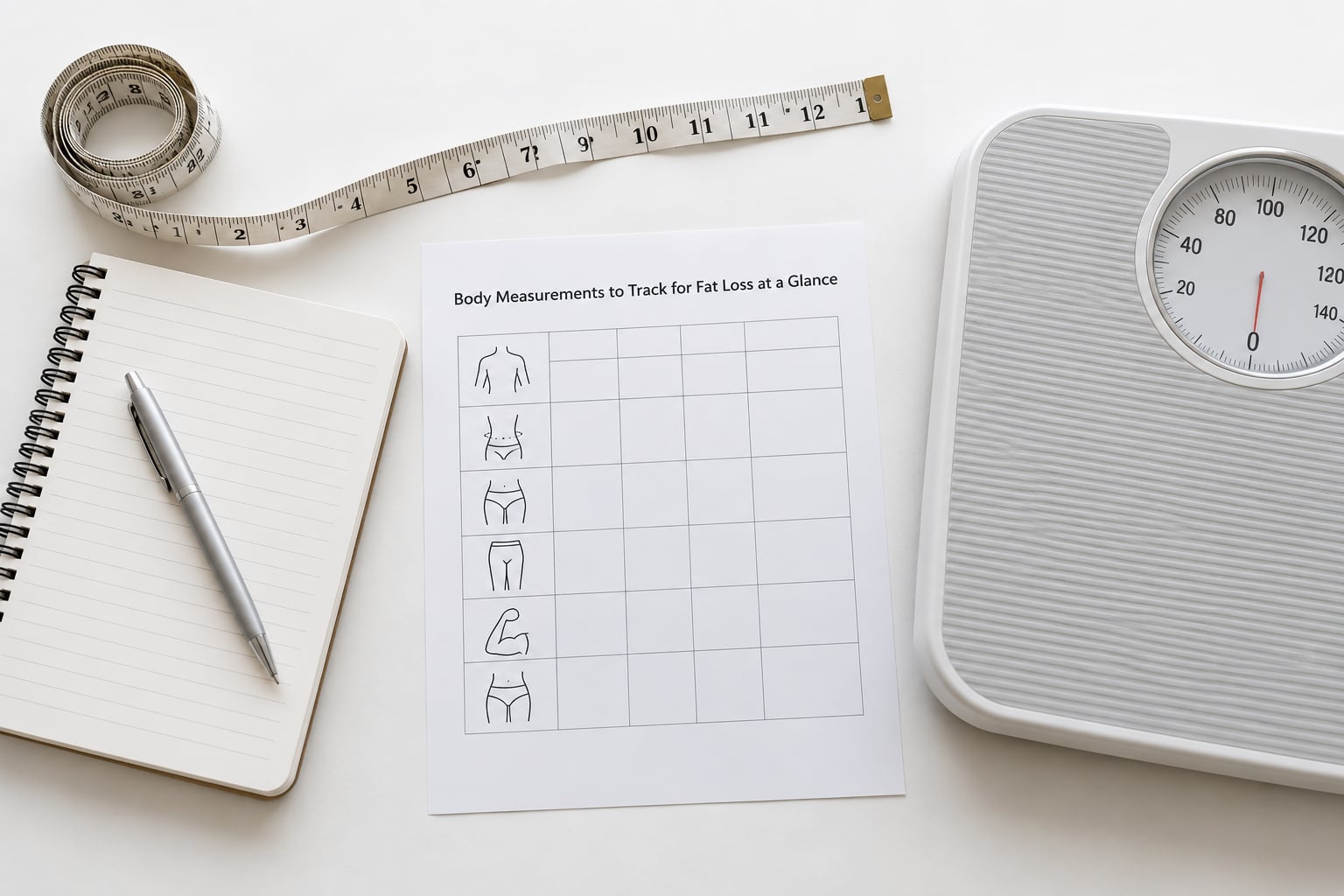
Here is the short version. The left column is what you measure, the middle is why it earns a spot on your chart, and the right is how often it is worth checking.
| Measurement | What it tells you | How often |
|---|---|---|
| Waist circumference | Central fat and one of the strongest simple health risk markers you can track at home | Every 1 to 2 weeks |
| Hip circumference | Lower-body change, and the denominator for your waist-to-hip ratio | Every 2 weeks |
| Chest or bust | Upper-body and posture change; often the first place a shrinking waist gets noticed | Every 2 to 4 weeks |
| Thigh circumference | Leg change, plus a useful read on whether strength work is adding lean mass | Every 2 weeks |
| Upper arm circumference | Arm definition and a spot that tends to shrink visibly before the scale catches up | Every 2 to 4 weeks |
| Calf circumference | Lower-leg change, and one of the first places water weight shows up and clears | Every 4 weeks |
| Neck circumference | Quick to read, changes early, and used in some health screening guidance | Every 4 weeks |
| Body weight trend | The only number that tells you the actual size of the energy change | Daily weigh-in, weekly average |
If you only have patience for three, take waist, hip and thigh, plus keep a weekly average weight. Those four cover the fat-loss question and the recomp question at the same time.
Which Measurements Are Most Useful?
Waist is the first one to take seriously, and it is not because it looks good in a mirror. Waist circumference above 35 inches in women or 40 inches in men is widely used as a marker of higher cardiometabolic risk, a threshold the National Heart, Lung, and Blood Institute uses in its waist circumference guidance.
Hips matter because they give you context. Two people can wear the same 32-inch jeans and have completely different waist-to-hip ratios, and the ratio is a better risk screen than waist alone. Your waist-to-hip ratio is simply your waist divided by your hips.
Waist-to-height ratio is a rough but popular shortcut: keep your waist under roughly half your height. Someone who is 5 foot 10 has a rough reference point of about 35 inches. It is a heuristic, not a diagnosis, but it is a fast way to notice a trend that is moving the wrong way.
Then there are the sites people skip. Neck is quick, needs no mirror gymnastics, and often changes early. Calves are dominated by water, so treat them as noise unless the change is large. Thighs are where recomp shows up most clearly, which is exactly why lifters watch them.
Men and women usually track different sites
Women tend to get the most signal from waist, hips, bust and calves. Men tend to get theirs from waist, neck, chest and arms, because those sites tend to move first during a cut. Tracking the set that suits your body keeps the chart short enough that you actually keep filling it in.
Reading weight and body measurements to track for fat loss together
No single number tells you what changed. Weight plus waist, read side by side, is the closest thing to an answer you can get at home. Many people on r/loseit say the same thing about their own logs: the before-and-after list of inches motivates them more than the scale did, especially during a water-retention week.
One limit worth stating plainly: you cannot pick where the inches come off. Spot reduction is not a real thing. Waist usually responds to overall fat loss, not to a targeted plan, and a shrinking thigh while the waist holds steady often means fat loss with muscle gain somewhere else.
How to Measure Your Body Accurately
The tape is cheap, but technique is what makes the numbers comparable. Most of the noise people blame on their body actually comes from the measuring.
Equipment
- A soft, flexible, non-stretch measuring tape. A retractable auto-lock tape works fine.
- A mirror, or a phone camera on a timer, for the back and side sites.
- A notebook or spreadsheet with one row per measurement site.
Posture and breathing
Stand tall with your feet together, arms hanging loosely, and weight even on both feet. Do not suck in your stomach or push your stomach out; breathe normally and let the tape sit where it falls. Keep the tape level and parallel to the floor, wrap it flat against the skin with no twists, and pull it snug without pinching or leaving a dent in the skin.
Landmarks
| Site | Where exactly | Notes |
|---|---|---|
| Waist | Level with the top of the hip bone on each side, usually just above the navel | Not the belly button and not the natural waist. Pick one and never switch |
| Hips | Widest point of the seat and upper thighs | Stand with feet together so the tape reads tighter |
| Chest | Around the fullest part, roughly the nipple line for most people | Breathe out normally first, do not hold your breath |
| Bust | Around the fullest part of the bust | Keep the tape at the back level too, not riding up |
| Upper arm | Midway between the acromion, the bony point of the shoulder, and the olecranon, the bony point of the elbow | Relaxed arm hanging down, not flexed |
| Thigh | About 2 inches below the crease at the top of the thigh | Front, side and back at the same height |
| Calf | Widest point of the calf muscle | Bend and straighten the leg gently to find the widest point |
| Neck | Just below the Adam’s apple in men, a little higher in women | Keep the tape level all the way round |
The two-reading rule
Measure twice and take the second number. If the two readings differ by more than a quarter of an inch, measure a third time and use the average of the two closest. Then write the number down before you move on. Recording eight sites from memory on your sofa never works.
Track to the nearest tenth of an inch if you are being thorough. One place over is fine as long as it is one place always.
Body Measurements to Track for Fat Loss: A Simple Routine
Here is a routine that survives a busy week. It takes about ten minutes and it covers everything in the table above.
- Same time, same conditions. Early morning, after using the bathroom, before eating or drinking, fasted if that is workable. Daytime water intake alone can add an inch of noise to a waist reading.
- Hang the tape somewhere fixed. Somewhere you can see both the front and the back of the tape, or set the phone up and take a photo of each site. Consistency of position beats careful technique.
- Do waist and hips first. Get the two most important numbers before you lose interest. They are also the two you will actually look at.
- Batch the rest into one pass. Chest or bust, thigh, arm, calf, neck in that order. Roughly three minutes for all six.
- Record as you go, not from memory. Note the date and any note that explains an odd reading, like a long walk, a flight, or a leg workout the night before.
- Compare to two weeks ago, never to yesterday. Single readings are weather; two-week gaps are weather systems.
If you want this to survive a year, do it in the same clothes or in your underwear. Measuring over a jumper is one of the fastest ways to invent progress that is not there.
How Often Should You Check Measurements?
Every 2 to 4 weeks is the useful range for circumference readings, and it is slower than most people expect. Real change of a quarter inch or more needs time to separate from noise, and measuring daily mostly feeds anxiety rather than information.
| Goal or stage | Measurement frequency | Why |
|---|---|---|
| Active fat loss cut | Every 2 weeks | Enough signal to see a trend, slow enough to stay calm |
| Recomposition or muscle gain | Every 2 weeks, more sites | You are watching for arms and thighs holding or growing while the waist drops |
| Maintenance | Every 4 to 8 weeks | The goal is catching a slow drift back up |
| Postpartum return, injury recovery, or coming off a restriction | Monthly, or on a clinician’s advice | Recovery timelines vary widely and daily scrutiny does more harm than good |
Weigh-ins work differently. Daily weight on the scale, but only look at the weekly average, and compare that average to the previous one. Water retention can hide a real deficit for days or even a couple of weeks, so the average is what smooths it out.
Most people in the same Reddit conversations keep a monthly habit during maintenance rather than weekly. That matches the biology: nothing meaningful moves that fast.
What Changes Should You Look For?
Read several measurements together, over at least a month, before you decide anything. This table is the shortest version of that logic.
| Weight trend | Waist trend | Most likely reading |
|---|---|---|
| Down | Down | Fat loss. The expected result |
| Flat | Down | Recomposition: fat down, lean mass holding steady |
| Down | Flat | Possible muscle loss alongside fat loss. Check protein intake and resistance training |
| Up | Flat or down | Likely muscle gain, or water retention from salt or a new training block |
| Up | Up | Gain across the board. Look at the last two weeks of food and training before changing anything |
How much change counts as real
Treat a quarter inch or more, sustained across two or three readings, as a real change. Anything smaller is inside measurement error. Poor technique alone can produce one to two inches of difference between two readings on the same day, which is why the two-reading rule matters so much.
On pace, a steady deficit of roughly half to one percent of your body weight per week usually shows up as about a quarter to half an inch per month on the waist, averaged over weeks. Bigger weekly swings are water, not fat. Fat does not appear and vanish on a short timeline.
When the tape stops moving
Run through this list before you change your plan. Re-measure with the tape flat and level, check you are not measuring at a different landmark than last time, look at your food and training log for the last fourteen days, and confirm your weekly average weight has not moved.
After that, if nothing has changed for four to six weeks with good adherence, that is a real plateau and a good moment to talk to a registered dietitian or your doctor about adjusting intake, training or sleep. The same applies if you notice symptoms such as dizziness, constant fatigue, feeling cold all the time, or menstrual changes. Those are reasons to stop self-managing and get advice from a professional.
Common Measurement Mistakes
Almost every misleading measurement comes from one of these. The fix is usually boring and takes ten seconds.
- Measuring over clothing. Fix: measure against skin, or wear the same thin layer every time.
- Using an elastic or stretchy tape. Fix: a fabric tape that does not stretch gives readings you can actually compare.
- Sucking in or pushing out. Fix: breathe normally and take the reading at the natural position, every time.
- Moving the landmark. Fix: the navel waist and the bone-level waist are different measurements. Pick one, mark it in your notes, and never mix them.
- Tape tilted or twisted. Fix: keep it parallel to the floor at every site, and check the back in a mirror.
- Pulling too tight or too loose. Fix: snug against the skin with no dent left behind. Loose reads will drift down every time.
- Comparing 8 a.m. to 8 p.m. Fix: measure at the same point in your day, ideally fasted in the morning.
- Reacting to one number. Fix: change has to survive at least two readings. One bad reading is a fact about the tape, not about you.
Measurements beyond the tape
Skinfold calipers give a better body fat estimate than a tape and need practice to use well. Bioelectrical impedance on a smart scale is fine for tracking change over time and poor for absolute numbers, because hydration swings it several percentage points in either direction. A DEXA scan is the most accurate option you can book, and it also reports visceral fat, which the tape cannot see. Progress photos catch what all of these miss and take ten seconds, so most serious trackers keep a set from the front, side and back.
None of these replace the tape. The tape is free, repeatable and good at answering one question clearly: is the trend moving?
Frequently Asked Questions
How often should I measure my waist when losing weight?
Measure your waist every two weeks, in the early morning before eating or drinking. Because day-to-day water retention can move a waist reading by an inch or more, weekly readings produce noise you will mistake for progress or for a plateau. Comparing each reading to the one two weeks earlier is what makes the trend readable.
How accurate is a body fat measuring tape?
A tape measure is very accurate for tracking change over time and only fair at estimating body fat percentage in absolute terms. Circumference formulas such as the Navy method use waist, hip and neck readings to estimate body fat, but their error is often several percentage points. Use the tape to follow direction and speed of change, not a single number.
What is the normal waist-to-hip ratio?
For women, a waist-to-hip ratio below 0.85 is generally considered lower risk, with 0.80 or below the lowest risk band. For men, below 0.90 is usually treated as lower risk. Divide your waist measurement by your hip measurement to get yours. These are screening guides rather than diagnoses, and they are most useful as a trend.
What is the ideal waist-to-height ratio?
A widely used rule of thumb is keeping your waist under half your height, or a ratio below 0.5. So a person who is 5 foot 10 would aim for roughly 35 inches or less. It is a rough screening heuristic rather than a medical cutoff, but it is a quick way to notice a trend that is heading the wrong way.
Can I lose 3% body fat in one month?
Three percent body fat in 30 days is an aggressive target that is realistic for some people early in a cut and unrealistic for most others. A rate closer to 0.5 to 1% of body weight per week is more typical and far more likely to hold up without muscle loss. Judge the plan by waist and weight trends over four to six weeks, not by a single month.
How much should my measurements change each week?
Expect very little week to week. Real fat-loss change usually shows as roughly a quarter to half an inch per month on the waist when you average across several readings. Anything larger in a single week is usually water from salt, carbohydrates, a new training block or a bowel movement, so never adjust your plan on one reading.
Conclusion
Pick one measurement this week, take your baseline properly, and then let it build. Waist is the strongest single choice, and adding hip plus thigh and a weekly average weight is enough to tell fat loss from muscle loss without buying anything.
Record every two weeks, compare trends instead of single numbers, and use this guide as data, not a verdict. Progress you can see on a chart is progress you will keep doing.