Last updated: October 2026
If you are wondering how to use a food journal for weight loss without turning it into a second job, the method is the same every time: write down each meal and snack within a few minutes of eating it, note how hungry you were and how satisfied you felt afterward, then read a full week of entries in one sitting and change one thing at a time. Most people spend two or three minutes per entry and about fifteen minutes on the review.
The writing is the easy part. What actually decides whether this works is doing it on the boring days when nothing interesting happened, which is exactly where the evidence points. A 2007 study in the Journal of the American Dietetic Association found that people who logged food on six or more days a week lost roughly twice as much weight as people who logged rarely. Research published in the journal Obesity put the daily time cost at about fifteen minutes, with logging three or more times a day correlating with more weight loss than a single end-of-day entry.
One more thing worth saying up front. A food journal does not have to be a calorie log. Counting numbers is optional and often the reason people quit within a fortnight. The columns that carry the most weight are the boring ones: hunger before, satisfaction after, and whatever was going on in your day.
Table of Contents
- What You Need Before You Start
- Step-by-Step: How to Use a Food Journal for Weight Loss
- How to Use a Food Journal for Weight Loss Tracking
- Look for Patterns Instead of Judging Yourself
- Make One Small Change at a Time
- Review Your Journal Weekly
- Common Mistakes and How to Fix Them
- Frequently Asked Questions
- How often should I write in a food journal?
- Should I count calories in my food journal?
- What if I forget to log meals?
- How long should I keep a food journal?
- What is a good food journal format to use?
- Will a food journal make me obsessive about food?
- What to Do First
What You Need Before You Start
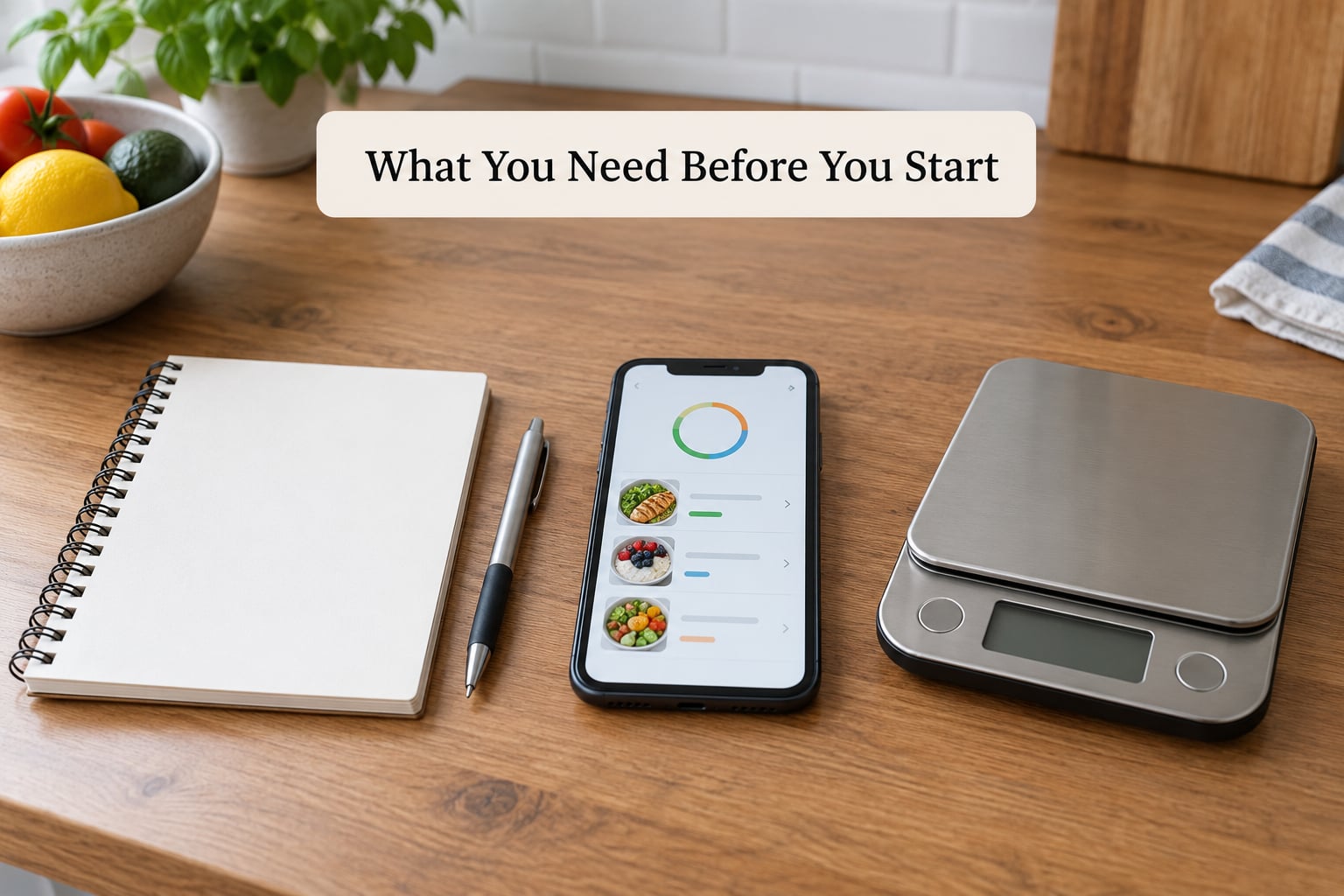
You need four things, and none of them expensive. A place to write, a way to remember to write, a rough idea of what you normally eats, and ten minutes a week set aside to read it back.
The first is a notebook, a notes app, or a spreadsheet. All three work, and the honest truth is that the format matters far less than whether you’ll actually use it. Here’s roughly who each one suits.
| Method | Best for | Downside |
|---|---|---|
| Paper notebook | People who eat while looking at a screen and want writing to slow them down | No totals, no filters, easy to lose in a bag |
| Phone app | People on the move who want a photo and a note in under a minute | Temptation to obsess over the numbers it shows you |
| Spreadsheet | People who like seeing a week laid out in columns | Setup takes an hour and most people never finish it |
If you cannot decide, start with paper for two weeks. Paper is the least likely format to turn tracking into a fixation, and you can always type it up later.
The second thing is a trigger. Tie the entry to something that already happens: the coffee maker finishing, sitting down at your desk for lunch, clearing the dinner plates. Habit stacking beats reminders because a cue that already fires does not need your phone to nag you.
The third is a short list of your usual meals and snacks, written once. Ten lines is plenty. This is what makes a fast entry possible, and a fast entry is the difference between a journal you keep and a journal you abandon in week two.
The fourth is optional but useful: a kitchen scale for the first fortnight, plus a hand-measure guide taped inside a cupboard door. A palm of protein, a fist of vegetables, a thumb of fat, a cupped handful of carbs gets you close enough without weighing anything forever.
Step-by-Step: How to Use a Food Journal for Weight Loss
How to Use a Food Journal for Weight Loss Tracking
Log each entry close to the meal, ideally before you start eating for what you plan to have and definitely within the hour after for what you actually had. Writing it from memory at 9pm produces a reconstruction, and reconstructions flatter you.
Seven columns cover almost everything worth knowing. Copy this into whatever you’re using.
| Column | What to record | Example entry |
|---|---|---|
| Time | Clock time, not meal name | 8:15am |
| Meal | Breakfast, lunch, dinner, snack | Breakfast |
| Food and rough portion | What you ate and roughly how much | 2 eggs, 1 slice toast, handful of berries |
| Hunger before | 1 to 10, where 1 is starving and 10 is not remotely hungry | 7 |
| Mood | One or two words | Rushed |
| Satisfaction after | 1 to 10, where 10 means properly satisfied | 4 |
| Context | Where you were, who with, any trigger | At desk, skipped lunch, deadline day |
That last column is the one people drop first and the one that explains the most. A 3pm snack that makes no sense until you see the word “deadline” next to it is a scheduling problem, not a willpower problem.
Give yourself three weeks before you add anything else. Weekly weight, water, sleep, steps and mood are useful, but a first-timer who tries to log twelve fields logs three days and quits. If you want prompts to write in the notes column, these are the ones that pay off: what did I eat most often when I was hungry, what could I have eaten instead that would have taken the same time, what was I doing with my hands, and what time did I last feel properly satisfied.
Look for Patterns Instead of Judging Yourself
A week of entries is data. Read it like data, not like a verdict on your character.
Skipped meals show up immediately. If there’s a 3pm entry three days running and nothing between breakfast and it, you’ve found your problem, and it’s a missing midday meal rather than a snacking issue.
Repeated choices at the same time point are the second pattern. Three identical 9pm fridge raids in one week isn’t four bad decisions, it’s one routine that hasn’t been planned yet.
Low vegetable intake is easier to spot in writing than in memory. If your week’s worth of entries has broccoli in it once, the entries are probably accurate, and that’s genuinely useful to know.
Portion drift is the sneakiest one. The toast gets bigger, the handful of nuts becomes a bowl, and because you’re not weighing anything, each individual meal looks normal. This is where the two-week scale habit pays for itself.
Distracted eating is the fifth. Entries marked “TV”, “driving” or “while cleaning” cluster at evening meals. You didn’t fail a craving; you ate a meal you barely tasted.
Make One Small Change at a Time
Turn one observation into one change for the following week. More than one change at a time is how journals turn into white-knuckle projects.
If you keep skipping lunch, add a protein source to breakfast so you aren’t ravenous by three. If your afternoons collapse, plan one deliberate snack with an actual time attached. If portions drift on rice or pasta, serve from a bowl and put the rest back in the cupboard rather than leaving it on the table.
If you eat while distracted, move one meal a week to a table with no screen. That single change tends to shrink the portion on its own, because you discover you were not as hungry as the packaging suggested.
Give each change a full week before judging it. Two days tells you nothing, because your weight and your appetite both move day to day for reasons that have nothing to do with what you ate on Tuesday.
Review Your Journal Weekly
Pick a fixed slot, Sunday morning or Monday evening, and put a fifteen-minute reminder in your calendar. A review that happens whenever you remember is a review that stops happening.
Start by counting days logged rather than reading the food. How many entries did you complete? If it’s under five, the problem is your format, not your eating, so simplify next week rather than trying harder.
Then read the context and satisfaction columns together. Entries with high hunger before and low satisfaction after are where your attention belongs. Anything at hunger 3 or below before a meal is a sign that the meal before it was too small, too late, or skipped.
Look at timing. If your last food is consistently eight hours before bed and you wake up hungry, move dinner later or add something small in the evening.
If you are weighing yourself, write down one number a week rather than daily. Daily weight swings of two or three pounds are usually water, salt and bowel timing, and reading them daily is the fastest route to giving up.
Finish with one written line: the single change for next week and the specific thing that will remind you. A change without a trigger attached tends not to survive Monday.
Keep going for three to four weeks, then taper. Plenty of people move to a lighter format once the habits have stuck: a weekly glance rather than a daily entry, or a photo of the evening meal only. Keeping a full journal indefinitely is not the goal, and treating it as a permanent condition is a good way to build an unhealthy relationship with food.
Common Mistakes and How to Fix Them
Logging from memory at night. Write within the hour, or at minimum before bed. People who reconstruct a day reliably forget the mid-afternoon handful of nuts, which is usually the point of the exercise.
Counting calories obsessively. If you log a number and then feel bad about it, stop logging the number. Portion words work fine: “two handfuls of crisps” tells you as much as an exact count and takes half the time. If tracking food triggers guilt, rigid thinking or urges to restrict, stop tracking and talk to a doctor or registered dietitian, particularly if you have a history of disordered eating.
Treating a missed day as a failure. One gap tells you nothing. People on weight-loss forums describe the week they stopped logging as the week they started again, which is the only metric that matters here. Frequency beats detail, every time.
Reading one day as a trend. A heavy dinner is a dinner. Weight changes on a weekly average reflect a few weeks of eating, not what happened on Saturday, and treating a single day as evidence is how people talk themselves into giving up a plan that was working.
Using the journal to restrict. A journal is a record. The moment entries become a list of what you’re not allowed to eat, it stops being a tool and starts being a rulebook. Food that appears in entries is food you eat.
Logging well when you’re not travelling, then abandoning it entirely. Restaurant meals, takeaways and parties get a single line: what you had, roughly, and the situation. Alcohol gets logged too. The purpose of those entries is pattern-spotting, so “three glasses of wine at a work dinner” is a useful data point while “calories” is not something anyone can estimate honestly at a table.
Adding ten fields in week one. Most journals die from over-instrumentation. Seven columns is the working set; everything else is optional and can be added in month two, one field at a time.
Never bringing it to a professional. Two weeks of honest entries is the single most useful thing you can hand a registered dietitian or doctor. It turns a vague conversation about “portion sizes” into a specific one, and it saves appointment time you would otherwise spend on recall.
Frequently Asked Questions
How often should I write in a food journal?
Aim for every meal and snack, at least six days a week. Research has consistently found that frequency matters more than detail, so a short entry on an ordinary Tuesday is worth more than a perfect one-off log. Log as you eat rather than reconstructing the day at night, and never let a missed day turn into a missed week.
Should I count calories in my food journal?
No, not unless you specifically want to. Portion words such as a palm, a fist or two handfuls give you the awareness you need without the arithmetic, and they take seconds to write. If counting numbers makes you anxious or guilty, drop it entirely. If you have a history of disordered eating or tracking triggers restrictive thoughts, stop tracking food and speak to a doctor or registered dietitian instead.
What if I forget to log meals?
Write it in later the same day with a note that it is from memory, or simply note the gap and carry on. What matters is the pattern across a week, not the completeness of a Tuesday. People quit journaling the first time they break the streak; the habit survives only if a bad day costs you nothing.
How long should I keep a food journal?
Three to four weeks of daily entries is usually enough to see your patterns and make two or three changes that stick. After that, taper rather than stop cold: check the page once a week instead of logging each meal. A full daily journal is a training tool, and once the habits are in place most people find the weekly glance gives them the same information in a fraction of the time.
What is a good food journal format to use?
For most beginners, a paper notebook or a phone notes app beats a calorie-counting app. Apps are fast and photograph well, but the numbers they display tend to pull attention away from the columns that matter: hunger before, satisfaction after and context. A spreadsheet suits people who enjoy seeing a week laid out in columns. Pick the one you will still be using on a busy Friday.
Will a food journal make me obsessive about food?
It can, and the warning signs are worth knowing: anxiety before writing an entry, guilt over a logged number, rigid rules about what you are allowed to eat, or skipping meals because of what you wrote. If any of that shows up, drop the numeric columns, switch to noting hunger and fullness only, or stop tracking and talk to a healthcare professional.
What to Do First
Tomorrow morning, pick a notebook and write three columns: what you ate, how hungry you were, and what was going on. Do that for seven days without changing anything about your eating. On day eight, read the week once and change one thing.
If weight loss is part of your plan, treat the journal as a diagnostic tool and check in with a doctor or registered dietitian before changing how much you eat, particularly if you have a medical condition, take medication, or have a history of disordered eating.