A food pusher is someone who keeps offering you food or seconds until you accept, usually out of hospitality, affection or anxiety rather than malice. They often do not notice that the offers feel like pressure, which is why a warm, short, unmoving no works better than a long explanation.
That is the whole method. Learning how to deal with food pushers comes down to four moves: name what you are protecting, pick one boundary, say four or five words, and move on. Everything below is built around that, in the order you actually need it.
Table of Contents
- What You Need to Handle Food Pushers
- Name the goal you are protecting
- Pick one boundary, not five
- Write your neutral phrase down
- Choose one person who will back you up
- Step-by-Step: How to Deal With Food Pushers
- Step 1: Recognize the pressure without reacting instantly
- Step 2: Decide on your boundary and one clear phrase
- Step 3: How to deal with food pushers in the moment
- Step 4: Redirect the conversation or move away
- Step 5: Prepare for the next gathering
- Common Mistakes
- Giving a reason
- Overexplaining
- Getting defensive or returning the comment
- Pretending the food is acceptable
- Letting comments about your body slide
- Apologising every time
- Quick tips for protecting your goal and the relationship
- Frequently Asked Questions
- How do I say no to food without hurting someone’s feelings?
- What if a food pusher keeps insisting after I say no?
- How can I handle comments about my weight at a family gathering?
- Should I explain why I am eating differently?
- What if I am invited to bring a dish but do not want to make food?
- Conclusion
What You Need to Handle Food Pushers
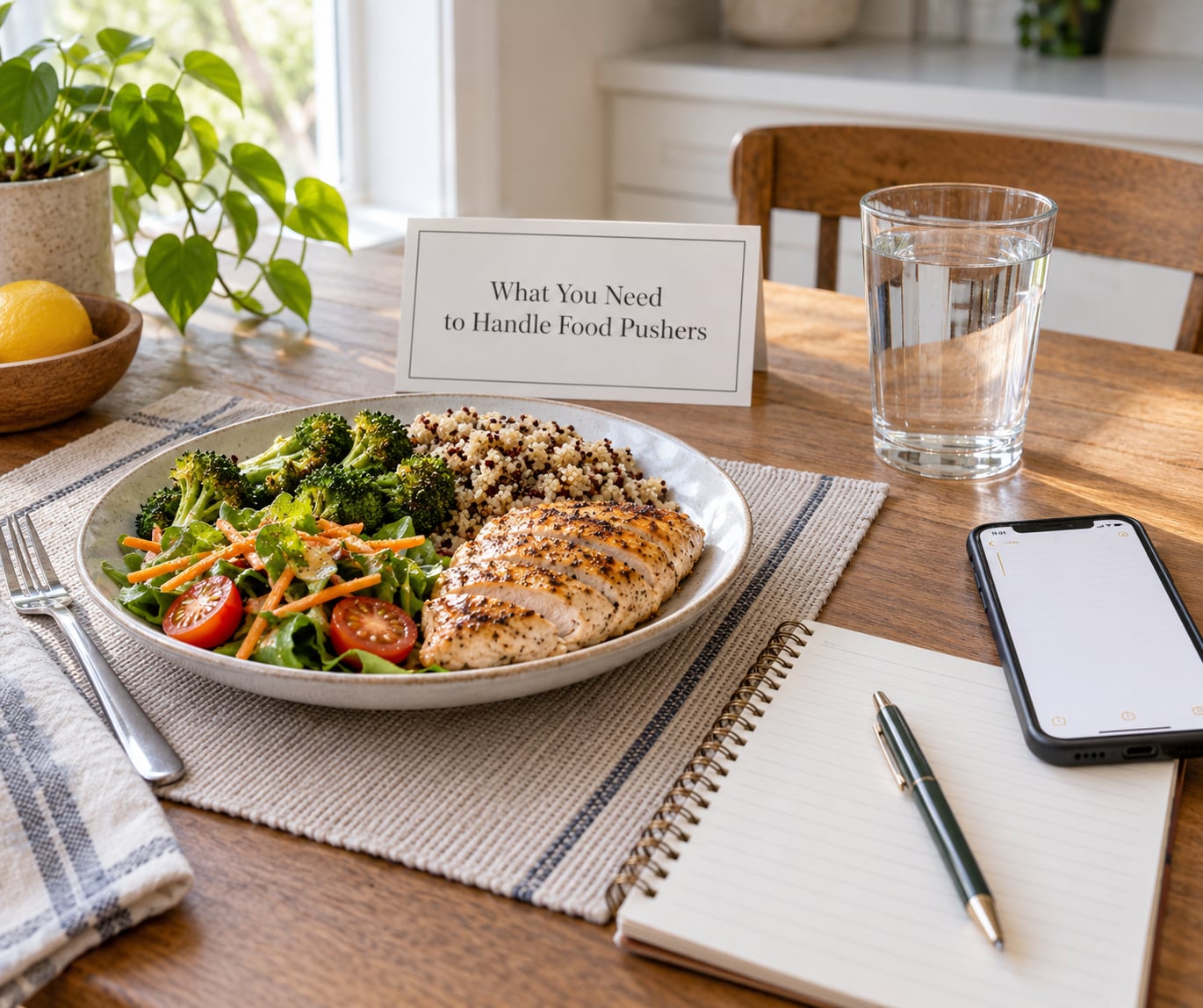
None of this costs money and none of it takes more than five minutes before you leave the house. It is preparation, not equipment.
Name the goal you are protecting
Decide what you are actually defending before anyone offers you anything. Blood sugar after a GLP-1 medication injection, a sodium limit, an allergy, cholesterol, a weight-loss goal, or simply wanting to enjoy dinner without feeling stuffed.
The reason matters more than people expect. When you know the real reason, a vague no does not feel like a lie, and you stop inventing justifications on the spot.
Pick one boundary, not five
The most reliable version is a single line: no second helpings tonight. Not no dessert, no second helpings, no drinking, all at once, because a person who is managing one limit well is far more likely to hold it.
Write your neutral phrase down
Put the exact words in your phone notes so you do not have to build them mid-sentence. The highest-upvoted advice in weight-loss communities is blunt and consistent: keep saying no, skip the explanation, because every reason gives someone new points to argue with.
Choose one person who will back you up
Tell one ally before you go. A sibling, a partner, a friend who is also eating differently. Most people caving in the moment do it to end an uncomfortable pause, and knowing one person has your back shortens that pause a lot.
Step-by-Step: How to Deal With Food Pushers
Step 1: Recognize the pressure without reacting instantly
There are four kinds of food pushing, and they need different responses. Genuine hospitality is one offer plus a compliment, and it needs nothing more than a thank you. Repeated encouragement is the same offer three times, which needs a short repeated no. Personal comments about your body are a different conversation entirely. Deliberate pressure, where someone keeps going after you have answered, is a boundary problem, not a food problem.
The tell is what happens after your first polite no. If they smile and move on, it was hospitality. If they circle back, you are dealing with pressure.
Step 2: Decide on your boundary and one clear phrase
A good boundary is specific and free of judgement about the other person. This is the pattern most readers share online: acknowledge the offer, accept the effort, decline the food. It is a three-part technique that circulates widely in Reddit threads.
- Acknowledge the offer: “That looks wonderful.”
- Accept the effort: “Thank you for making it.”
- Decline the food: “I am all set, but it looks amazing.”
Accepting the effort is the part people skip, and it is the part that keeps the relationship intact. You are not refusing the person, you are refusing the portion.
Keep the whole thing under about eight words and deliver it in a normal tone. A warm flat sentence works far better than an apologetic one, because apologising signals that you think you are in the wrong.
Step 3: How to deal with food pushers in the moment
These are the lines that come up again and again in real family accounts, and they are meant to be copied word for word until they feel ordinary.
| Situation | What to say |
|---|---|
| Second helping offered | “No thank you, that was a really big plate. I am full.” |
| “Try this, I made it for you” | “I would love to, but I am saving room. Thank you for cooking.” |
| Dessert circle going round | “I am going to skip it, but tell me about your week.” |
| A drink being poured | “Water for me, thanks. I am the designated driver tonight.” |
| They cooked specifically for you | “That means a lot. I am going to eat it later so I can actually taste it.” |
| “Take a plate home” | “I would love some. Can I take a small one for tomorrow?” |
| They insist after you said no | “I am sure, thank you. Same answer as a minute ago.” |
| Leftovers pushed toward you | “Not this time. Enjoy it, it sounds wonderful.” |
Two details do most of the work. Say thank you, because it separates the person from the plate, and keep your hand off the serving spoon, because a plate you never touched is much easier to refuse.
For a partner who cooks, this needs its own conversation rather than a dinner-table script. Say it when you are not eating: thank them for the effort, tell them plainly that turning down seconds is about your health, and ask them to stop offering. People report that being told in advance, rather than refused in front of the guests, is what makes the difference at the table.
Step 4: Redirect the conversation or move away
When the first no does not land, the pressure is about ending the social discomfort, not about the food. Change the subject, hand the plate to somebody else, or step away with a reason.
- Ask about them: “How is your sister doing now?”
- Pass the dish along: “Try the green one, it is the best one there.”
- Give a chore: “Can you get me a water? I am parched.”
- Stand up: you cannot be offered seconds from a different room.
Humor works well with grandparents and in-laws, where firmness reads as cold. “My stomach has filed a restraining order” is the most shared one-liner in weight-loss threads because a joke gives everyone an exit that nobody has to win.
Step 5: Prepare for the next gathering
Eat a normal meal beforehand when that fits your plan, so you are not arriving at the table genuinely hungry. Bring your own dish when the gathering involves a shared meal, because a potluck contribution buys you a plate and a topic, and both help.
Decide in advance when you are leaving and tell someone what time, so leaving is not a negotiation at the door. Most readers describe the hardest moment as the one where an offer lands, not the meal itself, and that is what the rehearsal is for.
Do not defend your choices before you get there. Explanations given early turn into a debate you then have to win, which is exactly backwards.
Common Mistakes
Giving a reason
A reason is an invitation to argue, and it is the most common mistake people make. “I am watching my carbs” invites “just one bite, it has nothing in it.” “I am full” invites “you have barely eaten.” The no holds up much better on its own.
If someone does ask directly, keep it short and non-negotiable. “I am working on my blood sugar, so that is the rule now.” One sentence, said warmly, ends the medical version of the conversation faster than any detail would.
Overexplaining
Long explanations sound defensive and turn a small moment into a discussion about your weight. Every extra sentence is another opening. Keep it to a thank you and a no.
Getting defensive or returning the comment
Snapping back at someone who is being persistent makes the gathering about the argument, not your plate. A flat tone and a change of subject ends it faster than a retort ever will.
Pretending the food is acceptable
Taking a plate you did not want so nobody is offended tends to backfire twice. You eat it, and then you feel the decision was not really yours. A clear no keeps you in charge of your own portion.
Letting comments about your body slide
“You are too thin now” and “just eat something” are not hospitality, even when they are delivered with a smile. That is body shaming, and the response is different. Put it back on them plainly: “I am the only one who can decide that, but thanks for noticing.” Then change the subject and do not keep debating it.
It is also worth telling the people closest to you what this kind of comment does, so it does not keep happening at every meal.
Apologising every time
Sorry, sorry, sorry tells the room that you believe you are doing something wrong. One polite decline, delivered without apology, is all a boundary sounds like.
Quick tips for protecting your goal and the relationship
- Thank the cook every single time, and keep the food boundary separate from the appreciation.
- Stay consistent. A no you repeat politely is far easier to accept than one that appears only sometimes.
- Have your own food nearby. A snack you brought with you is the quietest solution available.
- Take leftovers when you genuinely want them, which buys goodwill and costs nothing now.
- At work, move the plate to the shared dish and step away from the food cluster. It is the least awkward tactic in an office.
- If eating this way is causing real distress, or you have a history of disordered eating, talk to a registered dietitian or your doctor. Personal guidance beats any script.
Frequently Asked Questions
How do I say no to food without hurting someone’s feelings?
Acknowledge the offer, accept the effort, decline the food. Say something like that looks wonderful, thank you for making it, but I am full. You are refusing the portion, not the person, and the thank you is what keeps the tone warm. Keep it under about eight words and do not explain further, because reasons turn into arguments.
What if a food pusher keeps insisting after I say no?
Repeat the same answer in the same tone. There is no need to argue or justify anything again, because changing your words invites a fresh round of discussion. Say something like I am sure, thank you, same answer as a minute ago, then change the subject or move to another room. Consistency, not volume, ends the pressure.
How can I handle comments about my weight at a family gathering?
Put the comment back to the person calmly and briefly. You could say I am the only one who can decide that, then thank them for noticing and change the subject. Comments like you are too thin now are body shaming rather than hospitality, and they need a different response from a simple second-helping offer. Tell the people closest to you how it lands so it stops repeating.
Should I explain why I am eating differently?
Only once, briefly, and only when it ends the conversation. A medical reason such as allergies, type 2 diabetes or a post-surgery restriction is the hardest one to argue with, so keep it to a single sentence and then stop. For ordinary weight-loss goals, no explanation works better, because every reason you give becomes a point someone can argue with.
What if I am invited to bring a dish but do not want to make food?
Bring something and stay in control of what is in it. A salad, a fruit tray, bread you sliced, or a low-sugar dessert lets you eat at the gathering without managing anyone else’s expectations. You still get a plate and a topic, which is most of what a potluck invitation is about. Store-bought is fine too, nobody is checking.
Conclusion
Start with one thing. Pick a single boundary you can actually hold tonight, write down four words that say it kindly, and say them out loud twice before the gathering so the words are already in your mouth.
Then aim for consistency, not a clean sweep. Nobody wins every exchange at a holiday table, and you do not have to. One clear no at the first offer, repeated in the same tone each time it comes back, protects your plan without costing you the people sitting beside you.