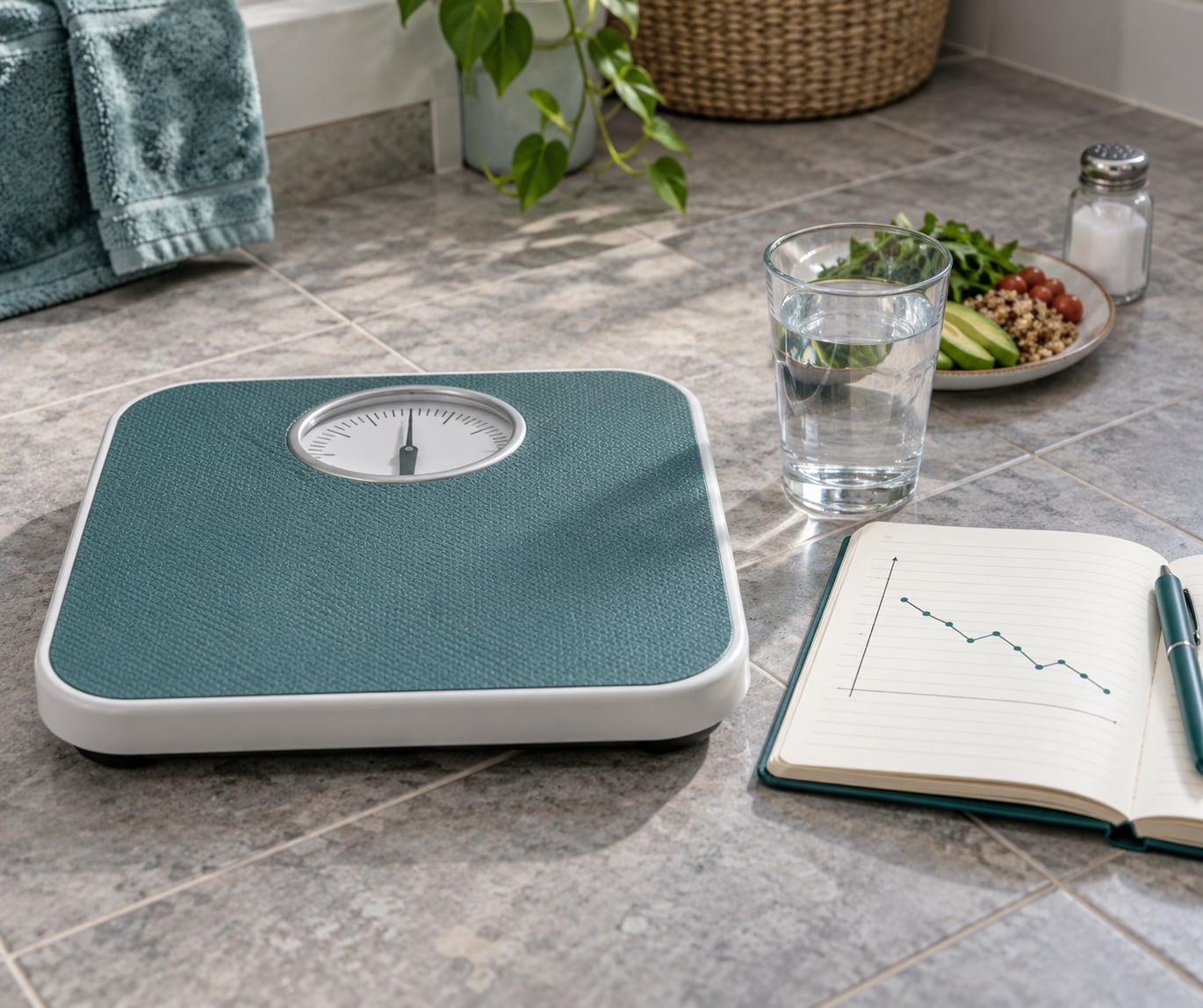
Weight fluctuates daily because a bathroom scale measures total body mass, not fat. Most of that mass is water, and your body shifts water in and out of its tissues hour by hour in response to salt, carbohydrates, digestion, hormones, activity and heat. A rise of 2 to 6 pounds overnight is usually fluid moving around, not new fat.
Your body is somewhere between 55% and 75% water, and that balance never sits still. Anyone who has wondered why does weight fluctuate daily stops worrying once they see it explained. When you weigh in on a consistent schedule and compare the trend over several weeks, the noise averages out and you can see what is really happening.
Table of Contents
- Why Does Weight Fluctuate Daily?
- How much weight can change in one day?
- What causes the scale to change from morning to night?
- Why your weight is lowest in the morning
- Fluids and drinks
- Sodium
- Carbohydrates and glycogen
- Food volume, gas and bowel contents
- Exercise, heat and sweat
- How do water and salt affect daily weight?
- Can digestion, constipation, or a larger meal change the scale?
- How do hormones, sleep, and stress influence weight?
- Menstrual cycle
- Stress and cortisol
- Sleep
- Medications
- How much weight change comes from exercise?
- What can make your scale reading inaccurate?
- What is a normal weekly weight-change trend?
- How should you weigh yourself for consistent results?
- When should daily weight changes concern you?
- Frequently Asked Questions
- Should I weigh myself every day?
- Why is my weight lower in the morning?
- What is the most accurate weight on the scale?
- Can weight gain from salt or carbohydrates last several days?
- How much water weight can you gain in a day?
- Conclusion: Focus on the trend, not one number
Why Does Weight Fluctuate Daily?
The short answer: your scale is a mass meter. It does not know what the mass is made of.
Fat tissue is one component of that mass, and it changes slowly. To gain even one pound of actual fat you would need to eat roughly 3,500 calories more than you burn, which takes days or weeks to accumulate. Water, by contrast, can move several pounds in a few hours. It follows your salt intake, your carbohydrate intake, what you drank, what you sweated, and what happened in your gut overnight.
That is why an evening reading and a next-morning reading can differ by several pounds on the same body. Nothing changed about your fat. Everything changed about the water sitting in and around your cells.
The practical consequence matters more than the physiology. A single number tells you almost nothing about progress. A line of seven numbers tells you a great deal.
How much weight can change in one day?
Most healthy adults swing between roughly 1 and 5 pounds across a day, with 2 to 6 pounds a common reported window. That range is largely water, food in the digestive tract and urine.
| Change | What it usually is | How long it lasts |
|---|---|---|
| 1 to 3 lb overnight | Sodium, carbohydrate and fluid shifts | 1 to 3 days |
| 3 to 5 lb overnight | Large or salty late meal, alcohol, hard training | 2 to 4 days |
| 5 to 7 lb overnight | Big meal plus high sodium plus bowel contents | 2 to 5 days |
| 1 lb per week, sustained | A genuine change in body fat | Ongoing |
A one or two pound change is never automatically fat gain or loss. To gain one pound of fat in a day you would need a surplus of about 3,500 calories, which is far beyond what one meal adds.
Why the same change affects people differently: sodium handling varies with aldosterone, carb stores vary with how much you recently ate, and gut transit times differ. A 4 lb swing is unremarkable for one person and a full stomach for another.
What causes the scale to change from morning to night?
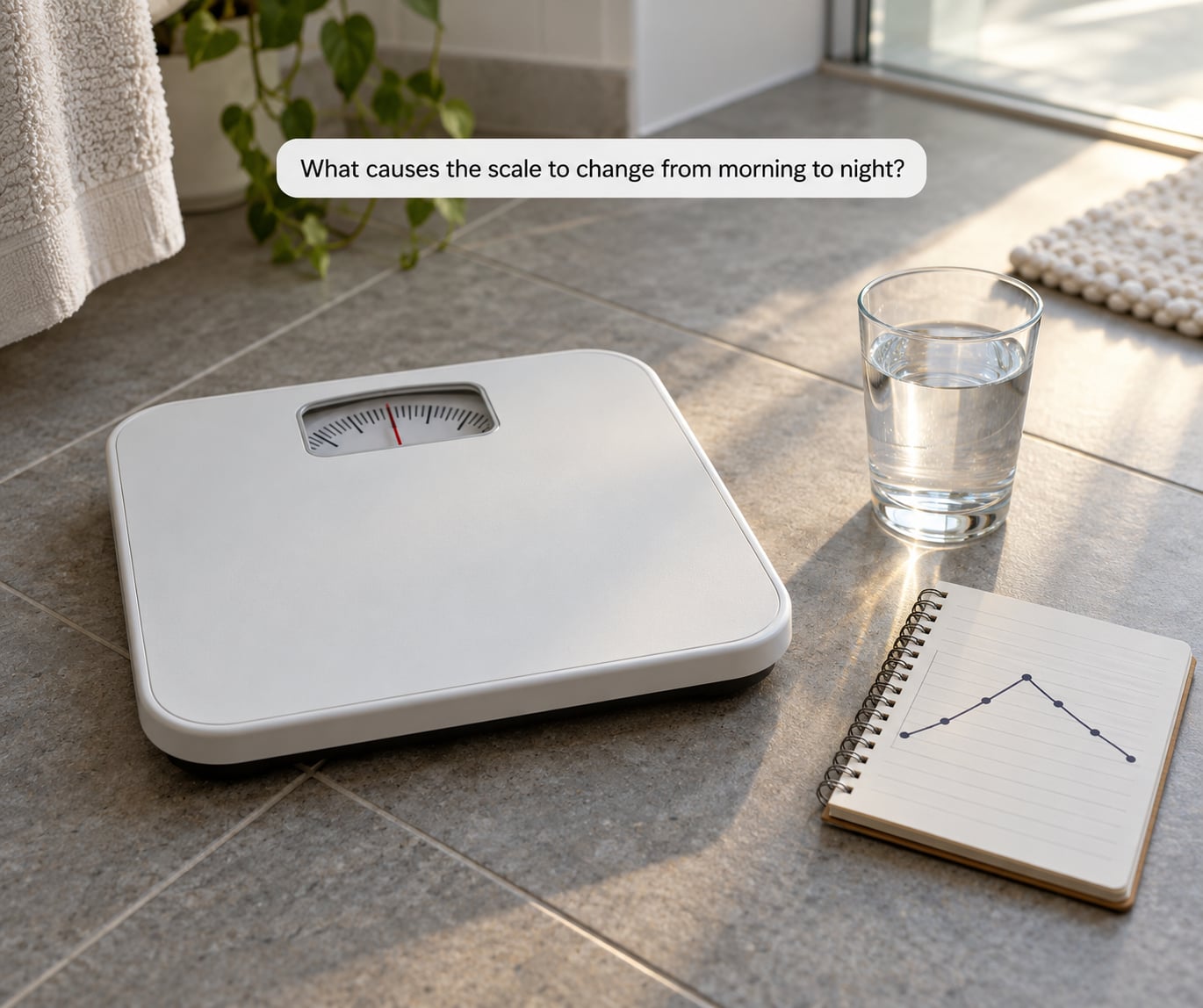
The same person can be 4 pounds heavier at 9pm than at 7am, with no change in body fat at all. Here is what does it.
Why your weight is lowest in the morning
Overnight you breathe out water vapour, sweat a little, urinate, and your body finishes processing yesterday’s meal and clearing yesterday’s fluid. By early morning you are at your most depleted, which makes the morning reading the most useful one to standardise on.
Fluids and drinks
Water has mass. A quart of it weighs about 2 pounds, so a few glasses add up on the scale within minutes of drinking them. Caffeine is a mild diuretic, but it does not erase the water you just consumed.
Sodium
Sodium makes your body hold water in order to keep blood solute levels stable. A salty restaurant dinner or a takeaway the night before can account for a couple of pounds by morning.
Carbohydrates and glycogen
Each gram of stored glycogen binds 3 to 4 grams of water. Eat more carbs and your glycogen stores swell along with the water attached to them. Cut carbs and both come down together, which is why low-carb dieters often see a fast drop in the first few days that has nothing to do with fat.
Food volume, gas and bowel contents
A large meal physically adds mass while it is still inside you, and stomach and intestinal contents keep doing that for hours afterward. Bloating and gas add more.
Exercise, heat and sweat
Sweating removes water, so the scale dips right after a hard session, then rebounds as you rehydrate. Hot weather and saunas do the same on demand. Salt in sweat means you can end up heavier after a sweaty workout, not lighter.
How do water and salt affect daily weight?
Your body regulates fluid balance minute by minute through hormones, thirst and the kidneys. It does not hold a fixed amount of water, so anything that changes the solute concentration of your blood changes how much water your tissues keep.
Sodium is the biggest everyday lever. After a high-sodium meal the kidneys retain water to dilute sodium, the volume in your extracellular fluid rises, and the scale climbs. Most people notice this and call it water weight, which is exactly what it is.
Carbohydrates work through the glycogen pairing described above. A person eating a high-carb diet holds several pounds more water than the same person on a low-carb diet, and that water appears and disappears over a week, not a day.
There is a counterintuitive twist worth knowing. Being mildly dehydrated makes the body conserve water, so you can weigh less after heavy sweating and then rebound upward as you drink, sometimes ending up heavier the next day than before the workout. Cutting fluids to chase a lower number is not a strategy.
Can digestion, constipation, or a larger meal change the scale?
Yes, and this is one of the most underappreciated swings. Transit through the digestive tract is not on a fixed schedule, and stool content alone can vary the scale reading by a pound or more.
Constipation adds mass that has nothing to do with tissue. Bloating from gas, a fibre-heavy meal or a food your gut tolerates poorly does the same, sometimes for a day or two. A slow rise in scale weight over a few days of low-fibre eating is often gastrointestinal rather than metabolic.
The distinction that matters: anything still inside your digestive tract is contents, not body composition. Undigested food is not muscle and it is not fat. Once it is processed and cleared, it does not count toward either.
Alcohol deserves its own line because it does two things at once. It adds calories, and it suppresses the hormone that helps you release water, so a heavy night often produces a morning scale spike that takes two or three days to fall away.
How do hormones, sleep, and stress influence weight?
Hormones move both appetite and fluid balance, so the scale can shift with no change in what you ate.
Menstrual cycle
Many women see a gradual 1 to 3 pound rise through the luteal phase, the stretch after ovulation and before a period starts. It typically appears in the second half of the cycle and drops once bleeding begins. Tracking your weight against cycle phase makes the pattern obvious instead of alarming.
Stress and cortisol
Cortisol and aldosterone encourage the body to hold sodium and water, so a stressful week can add a pound or two that is not fat. Cortisol also raises appetite and makes cravings more likely, which affects the inputs as well as the fluid.
Sleep
One or two short nights affect ghrelin and leptin in a way that increases hunger the next day. More immediately, poor sleep raises cortisol, which pushes toward water retention. People who travel or shift their sleep schedule often see the scale move for reasons that have nothing to do with their food choices.
Medications
Some drugs change weight by design, including certain antidepressants, insulin, steroids and GLP-1 medicines. Others shift fluid, including antihistamines and anti-inflammatories. A new prescription is a reasonable reason to expect a different trend line rather than a failure of effort.
General information like this only goes so far. If your weight changes in a way that is persistent, unusual or worrying, talk to a doctor or a registered dietitian rather than adjusting your plan yourself.
How much weight change comes from exercise?
Most of the scale movement after exercise is water, and it goes in both directions.
Sweat is water, so a hard session produces a temporary drop. You replace it by drinking, sometimes along with sodium, and the number comes back. A single workout can move 6 to 10% of body weight in fluid on a hot day. That is not fat loss.
New training also causes soreness, and sore muscle tissue holds water while it repairs. So beginners in a strength program often gain a pound or two in the first weeks while their waist measurement improves, which is exactly the confusion this site exists to untangle.
Fat loss from exercise is real but slow, and it shows up as a downward drift in your weekly average rather than as a drop the morning after a session.
What can make your scale reading inaccurate?
Measurement error is separate from real fluctuation, and it is common enough to explain a surprising reading on its own.
- Soft flooring. Carpet compresses underfoot and a scale can read a pound or more high. Hard tile or wood is the standard.
- Placement. A scale sitting on a slightly uneven floor can misread. Push it back against a wall each time.
- Batteries. A tired battery causes erratic numbers. Replace them when readings become inconsistent.
- Different scales. Two scales in two rooms rarely agree. Use one scale and never compare readings across devices.
- Clothing. Thick sweaters and shoes add mass. Wear the same minimal clothing each time.
- Timing. Weighing after a meal, after a workout or late in the evening will not match a morning reading.
This is also why the doctor’s office reading can look like a different person. Different scale, different flooring, different time of day.
What is a normal weekly weight-change trend?
Individual needs differ, but looking at seven days at a time is where the signal becomes readable. Here is a worked week of morning readings and what the average does to them.
| Day | Morning reading | 7-day average |
|---|---|---|
| Mon | 182.4 lb | 182.4 |
| Tue | 183.1 lb | 182.6 |
| Wed | 181.9 lb | 182.3 |
| Thu | 181.5 lb | 182.1 |
| Fri | 183.6 lb | 182.3 |
| Sat | 184.2 lb | 182.6 |
| Sun | 180.8 lb | 182.5 |
Read the daily column on its own and it looks chaotic, like a 3.4 lb swing with no direction. Read the average column and it is a steady drift of about 0.3 lb across the week. That is what progress actually looks like.
Three patterns are worth recognising. A gradual decline means the plan is working. A stable line across three or four weeks usually means intake and expenditure have matched. A temporary pause that lasts one or two weeks is common and is not automatically a plateau.
Expressing change as a percentage also helps. Someone starting at 250 lb and someone at 140 lb can both be losing one lb a week, and their progress rates are nowhere near the same. Percent change per week gives a fairer comparison.
How should you weigh yourself for consistent results?
Consistency beats perfection. Conditions do not need to be ideal, only repeatable.
- Pick a time and keep it. Morning is best, because you are at your most depleted and the reading is the most repeatable.
- Use the bathroom first. Empty bladder and bowels before stepping on, and follow the same pattern daily.
- Weigh before eating or drinking. Nothing but water in the way.
- Wear the same clothing. Ideally the same minimal clothing every time.
- Use one scale on a hard floor. Same scale, same spot, hard surface, batteries fresh.
- Record it and stop looking. Write the number down, then judge progress on the 7-day average a week at a time, not the reading from this morning.
You do not have to step on the scale every day. Plenty of people do better weighing once a week under the same conditions and judging progress with a tape measure or progress photos instead. If daily weigh-ins make you reactive, weigh less often. The method has to be one you can keep.
One warning, because it is the most common self-sabotage in this whole topic. Do not cut calories harder in response to a one-day rise. Cutting harder makes the next low lower and guarantees a rebound, and an aggressive cut triggered by a single reading is a real health risk. If your calorie tracking is sound, leave it alone and wait it out.
If your scale also reports body fat percentage, treat those numbers as entertainment rather than data. Bioelectrical impedance estimates run a current through your body and infer body fat from how it responds, and hydration dominates that response. Drink a glass of water and the percentage can move more than a point. Weight, waist measurement and photos of the same angles tell you more.
When should daily weight changes concern you?
Normal fluctuation is symmetrical-ish, resolves in a few days and fits the causes above. Changes outside that pattern deserve a conversation with a clinician rather than a self-diagnosis from a scale.
- Rapid unexplained change over days, especially more than 5% of body weight.
- Rapid change with swelling in the legs, abdomen or face, or sudden shortness of breath. Seek prompt care.
- Ongoing weight change alongside fever, night sweats, thirst, frequent urination or fatigue.
- Persistent fluid retention that does not settle after the trigger passes.
- Major changes that begin around a new medication or alongside a change in thyroid symptoms.
I am not able to diagnose any of the above, and this article is general information rather than medical advice. If something fits, book an appointment with a doctor. If your weight is changing while you diet and you want a plan, a registered dietitian can look at your intake and history properly.
Frequently Asked Questions
Should I weigh myself every day?
Daily weighing can reveal trends, but it is not necessary for everyone. Weigh yourself at a consistent time if it keeps you engaged, then judge progress on weekly averages or multiweek trends rather than a single number. Many people find daily weigh-ins make them reactive and decide to weigh once a week under the same conditions instead. The method that keeps you consistent beats the one that feels rigorous.
Why is my weight lower in the morning?
Your weight tends to be lower in the morning because overnight changes in breathing, sweating, urination and digestion reduce total body mass. You also stop drinking several hours before you wake, so nothing new is added. Nothing about your fat changes overnight. That is why the morning reading is the most repeatable one and the one to standardise on.
What is the most accurate weight on the scale?
No single reading is always the most accurate. A reading taken under consistent conditions on a hard floor is useful, and several readings across a week reveal your true trend far better than any single number. If you have also been weighed at a clinic, expect a different figure because the scale, flooring and time of day were all different.
Can weight gain from salt or carbohydrates last several days?
Yes. Changes in sodium and carbohydrate intake shift how much water your body stores, and water gained this way usually clears in two to three days once the trigger passes. The scale can rise while body fat barely moves. A few high readings in a row after a salty or high-carb stretch are a reason to keep going, not to change your plan.
How much water weight can you gain in a day?
A single day can add several pounds of water, especially after a large salty and high-carbohydrate meal, alcohol, hard training or heat. Double-digit water gain in one day is unusual for most people and more likely to involve a very large sodium load or an underlying medical issue. Water weight of 3 to 5 pounds overnight is well within the range people report.
Conclusion: Focus on the trend, not one number
Weight fluctuates daily because your scale measures water, food and tissue all at once, and the water moves constantly in response to salt, carbohydrates, digestion, hormones, activity and even the weather. None of that is fat. That is the short answer to why does weight fluctuate daily, and it is a much less dramatic thing once you see it that way.
Start with one thing: weigh yourself in the morning, after the bathroom, on the same hard floor, and write the number down without reacting to it. Then compare this week’s average to last week’s. That single habit removes most of the confusion the scale creates, and it is what this whole topic keeps circling back to.