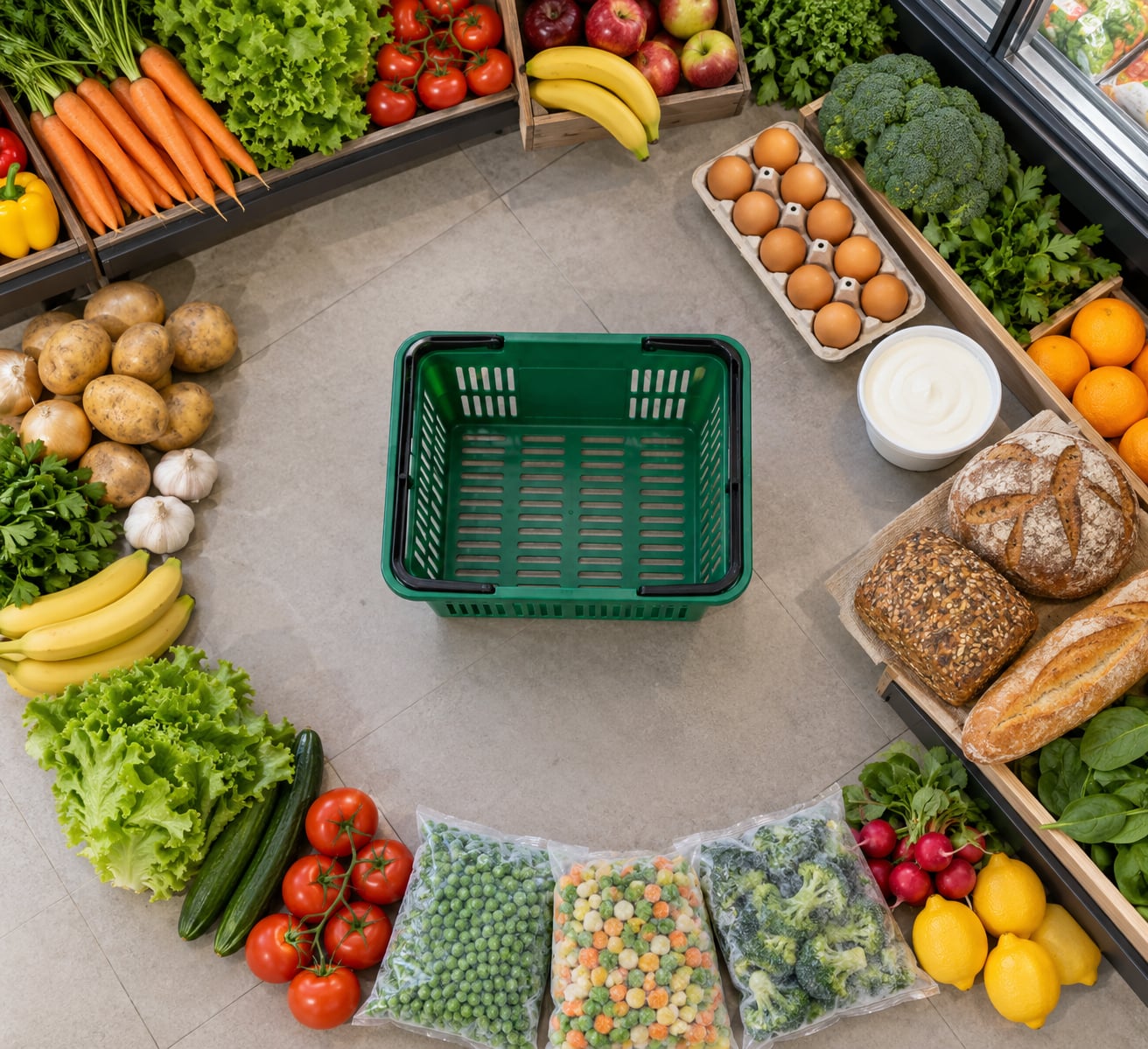
To shop the grocery store perimeter, start at produce, walk the outer loop through protein, dairy, grains and frozen, and step into the center aisles only for a handful of items you wrote down beforehand. Aim for about four-fifths of your cart coming from the perimeter and the rest chosen on purpose. It takes 20 to 30 minutes and works in almost any store layout.
The idea is simple. Fresh, minimally processed food tends to live along the walls, while most of the packaged snacks, sodas and frozen meals sit in the middle. If you fill the cart from the outside first, whole foods are already in it before the displays start working on you.
It is a useful default, not a law. The outer walls also hold frozen pizza endcaps, macaroni salad at the deli counter and frosted cupcakes by the bakery door, and the center aisles hold black beans, brown rice, canned salmon and jars of olive oil. If you learn how to shop the grocery store perimeter as a route with a purpose rather than a rule you obey blindly, it is one of the easiest changes you can make to how you eat and what you spend.
Here is how the outer loop breaks down, what belongs at each stop, and what to pick up on the way through:
| Perimeter zone | What to pick up | Easy to overbuy |
|---|---|---|
| Produce | Fresh fruit and vegetables for snacks, salads and cooking; bulk and frozen versions of the same | Seasonal fruit and greens nobody in the house eats |
| Meat, seafood and eggs | Chicken, fish, eggs, ground meat, and beans or lentils if you eat them | Perishable deli salads and prepared dips |
| Dairy and eggs | Plain yogurt, milk, cheese, and fortified plant milks with real protein | Flavored yogurt and drinkable shakes |
| Bakery and bread | Whole-grain loaves, tortillas, bagels, English muffins | Sweet breads, danishes, and large loaves that go stale |
| Frozen cases | Frozen vegetables, fruit, fish, and plain frozen meals | Pizza, ice cream, and the stacked endcap deals |
Table of Contents
- What You Need
- Step-by-Step: How to Shop the Grocery Store Perimeter
- Start With Produce
- Add Protein and Dairy
- Choose Whole Grains and Bread
- Use the Frozen and Refrigerated Sections
- Handle the Center Aisles Selectively
- Check Your Cart Before Checkout
- Common Mistakes
- Treating the perimeter as automatically healthy
- Buying only raw ingredients that take time to cook
- Overlooking the convenient alternatives
- Shopping without a list
- Assuming every center-aisle product is unhealthy
- Shopping hungry and slow
- Frequently Asked Questions
- Does shopping the grocery store perimeter mean avoiding all packaged food?
- How do I use the perimeter method for weight loss?
- What should I buy on the perimeter for quick weeknight meals?
- How do I shop the perimeter on a budget?
- Should people with special nutrition needs follow the perimeter method?
- A Simple Perimeter-Shopping Routine
What You Need
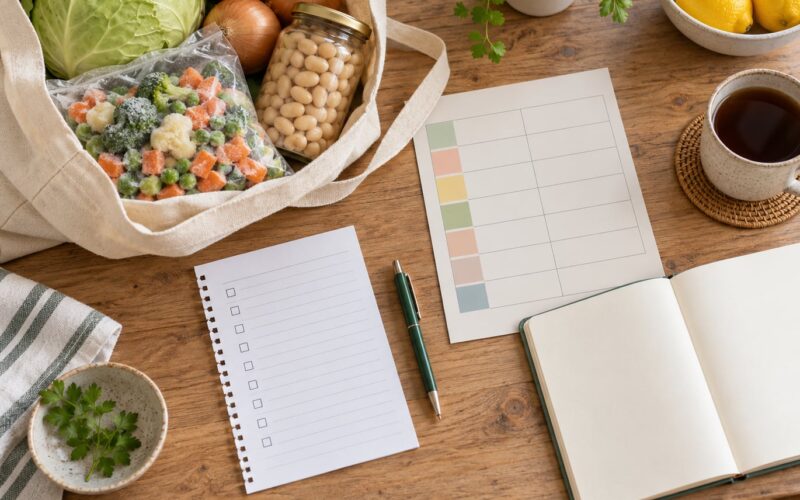
You need three things, and none of them cost money.
- Something to carry. A basket if you are shopping for one or two people, a rolling cart if you are feeding more. Bags at the door are fine if that is what you have.
- A list on your phone or a scrap of paper. The list matters more than the bag. Researchers who study this stuff have found that a large share of what ends up in a cart was never on the shopping list in the first place.
- Five minutes to decide meals. Not a month of meal prep. Two or three meals you will actually cook this week is enough to build a list that fills a cart.
The meal plan is what makes the route work. Without it, the perimeter becomes a slow wander and you end up buying whatever produce looks good, which is how a family ends up with three kinds of salad dressing and no dinner.
Neither the plan nor the list is mandatory, so if you are heading into a corner store with four minutes and no phone signal, the method still holds. Grab the freshest produce you see, a protein, a bread and a frozen vegetable. That is a better cart than one built from the snack aisle.
Step-by-Step: How to Shop the Grocery Store Perimeter
Start With Produce
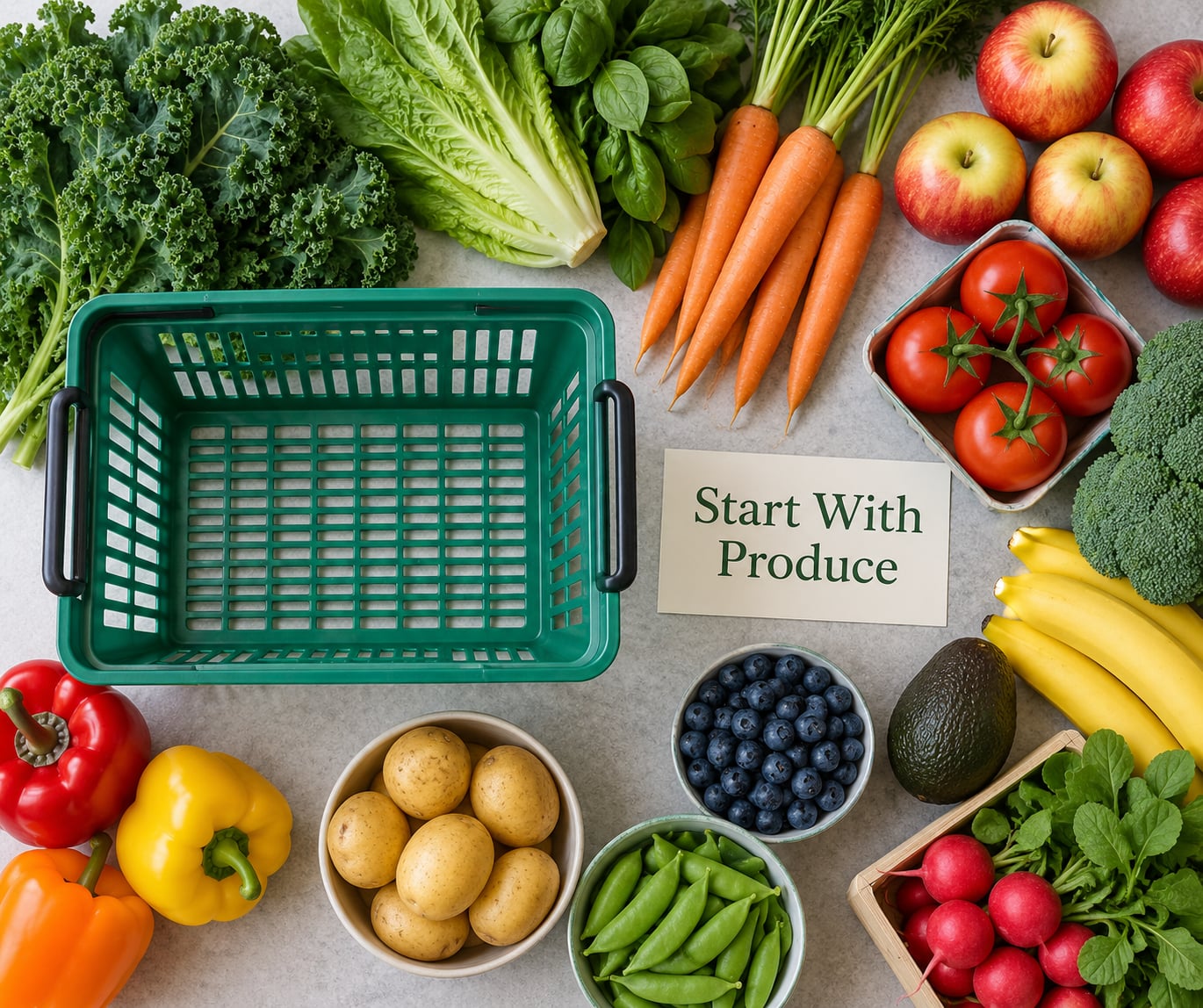
Produce is where the grocery store perimeter method pays off most, and where most people get it wrong. Buying one impressive vegetable and skipping everything else is how a good habit becomes a salad nobody eats.
Buy by use rather than by trend. Leafy greens, tomatoes and cucumbers for salads. Carrots, onions, peppers and squash for cooking all week. Fruit that travels well to work or in a bag. Broccoli, cauliflower, green beans and peas for the freezer. Variety matters less than repetition, because the vegetable you will actually cook is worth more than the kale you used to feel guilty about wasting.
Fresh does not always win. Frozen vegetables are picked at peak ripeness and frozen, so they hold their nutrients well, and they do not turn into compost in the crisper drawer. If you eat vegetables twice a week, buy frozen. If you eat salad most nights, buy fresh.
Add Protein and Dairy
Protein is the part shoppers skip, and skipping it is why perimeter carts feel unsatisfying by Wednesday. Aim for something on three or four days a week and rotate the sources instead of eating the same chicken breast every night.
- Cheap and fast: eggs, canned beans, lentils, tofu, plain Greek yogurt.
- Middle of the price range: canned tuna or salmon, frozen fish fillets, chicken thighs, ground turkey.
- Higher cost: fresh fish, steak, chicken breast, and larger cuts you can cook once and freeze in portions.
Canned fish and canned beans count here, not in the center aisles. They are among the best nutrition-per-dollar options in the store and they keep for months, which makes them the backbone of a shop that happens once a week.
For dairy, plain yogurt, cottage cheese, milk and hard cheese are the useful picks. If you drink plant milks, compare the nutrition labels and choose one with a meaningful amount of protein and calcium rather than one that is mostly sugar and water. Anyone with specific nutrition needs, or who is managing a medical condition, should get personalized advice from a registered dietitian instead of guessing from a label.
Handle raw poultry, ground meat and seafood with care, and cook to the safe internal temperature: 165 degrees Fahrenheit for poultry, 160 for ground meat, and 145 for whole cuts of meat and fish. A cheap instant-read thermometer at the meat counter removes all guesswork.
Choose Whole Grains and Bread
Whole grains are the second biggest gap for perimeter-only shoppers. Bread and tortillas often sit on the outer wall, but oats, rice, pasta and cereal are all in the center, and skipping them is how a cart ends up with no carbohydrates at all.
The ingredient list tells you more than the front of the package. If the first ingredient is a whole grain such as whole wheat, oats, brown rice or whole barley, you are looking at the real thing. If the first ingredients are refined flour, sugar or a long list of oils and starches, the words on the front are decoration.
Useful swaps that need no specialty diet:
- White tortillas for whole wheat or corn tortillas, and check the label since many are partly refined flour.
- Sugared cereal for plain rolled oats, which cook in three minutes and cost a fraction of the boxed version.
- White rice for brown rice or a bag of plain lentils that you cook while you do something else.
- Regular pasta for whole wheat pasta, or keep the regular pasta and add a side of beans instead.
- White sandwich bread for a loaf labeled whole wheat with whole wheat as the first ingredient.
Portion size matters more than the label at breakfast. A large portion of anything, whole grain or not, is still a large portion.
Use the Frozen and Refrigerated Sections
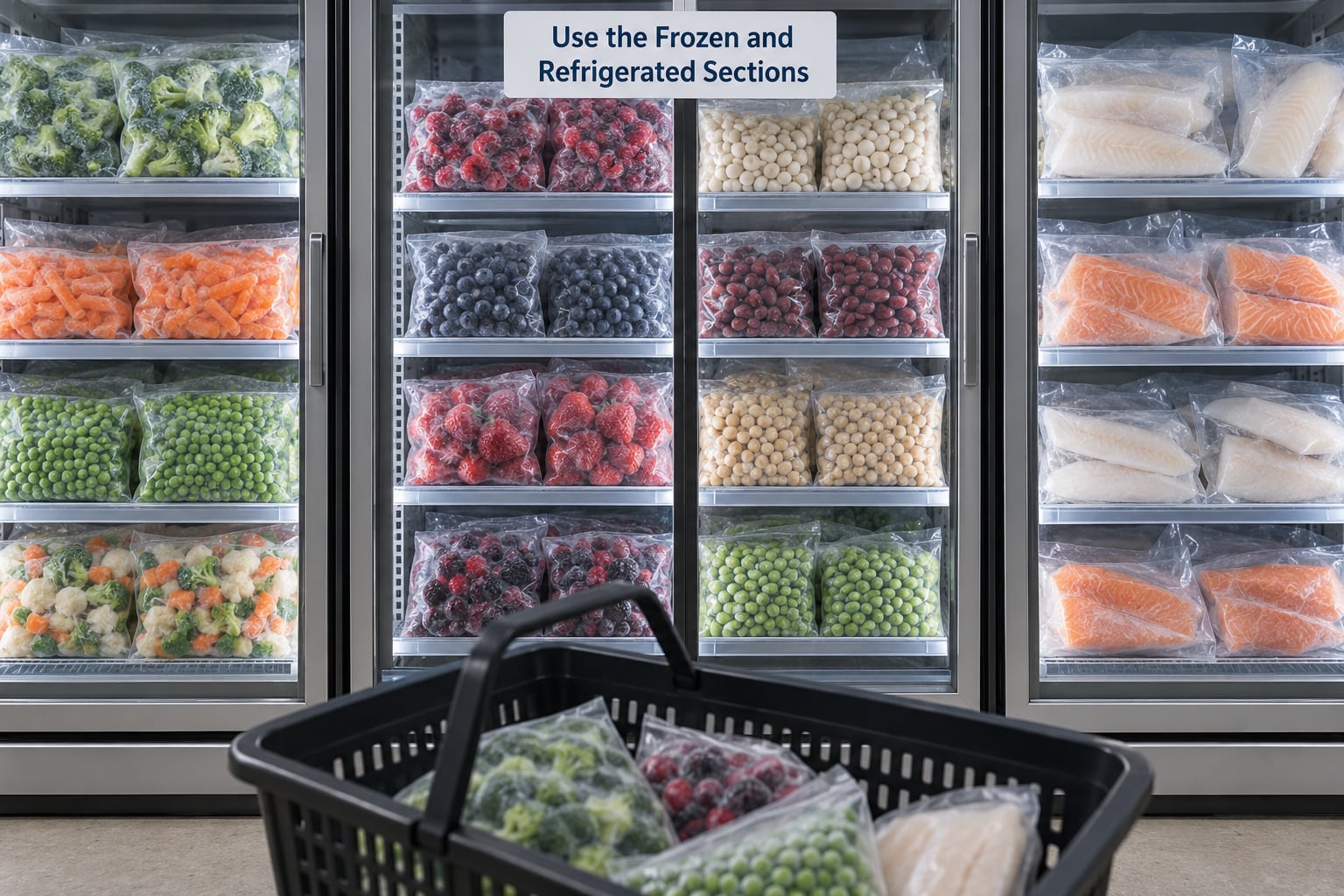
Frozen is where perimeter shopping saves the most food. Frozen vegetables, berries, beans and fish cost roughly the same as fresh, last for months, and produce very little waste. When you shop the grocery store perimeter, treat the frozen case as part of the perimeter rather than an exception to it.
Frozen also solves the cooked-vegetable problem. Steam bags, frozen stir-fry blends and plain cut vegetables go from freezer to pan in under ten minutes, which is the difference between buying broccoli and actually eating it.
Prepared frozen meals are a mixed bag. Some are plain fish, vegetables and a starch with a short ingredient list. Others are breaded, sauced and high in sodium. The same label-reading rules apply as anywhere else: check the serving size, the added sugars, the sodium and the fiber, and compare the per-100-gram column when two similar products are close.
For refrigerated items, look for plain yogurt, tub salad dressing, hummus, eggs and pre-washed greens. Skip the tubs of dip positioned right at eye level, and skip pre-cut fruit that costs several times what the whole fruit does.
Handle the Center Aisles Selectively
Center aisles are not forbidden ground. They hold some of the best food in the building, and shoppers on tight budgets rely on them heavily. People in budget communities like r/povertyfinance and r/personalfinance tend to recommend the perimeter as a money discipline, pointing out that the freshest food is usually there and that skipping the middle cuts impulse spending.
Enter the center aisles with a specific item in mind. The ones worth walking in for:
- Canned and dried beans and lentils
- Canned fish, including tuna and salmon
- Plain oats, brown rice, quinoa and whole wheat pasta
- Nuts, seeds and nut butters with no added sugar
- Olive oil, vinegar and other basics for cooking
- Spices, garlic and canned tomatoes
- Frozen vegetables and plain frozen fruit
When you do pick up a packaged item, use a three-question filter and move on. Can I name the first three ingredients? Are there fewer than five ingredients I cannot identify? Could I make this at home with about the same effort? A bag of dried beans passes all three. A snack with a paragraph of the ingredient list does not.
Do not shop by package size, color, or a discount sign. A large bag of chips at a good price is still a large bag of chips, and endcap displays are placed there to slow you down.
Check Your Cart Before Checkout
Stand at the end of the aisle and look at what you have. A quick read of the cart tells you whether the route worked.
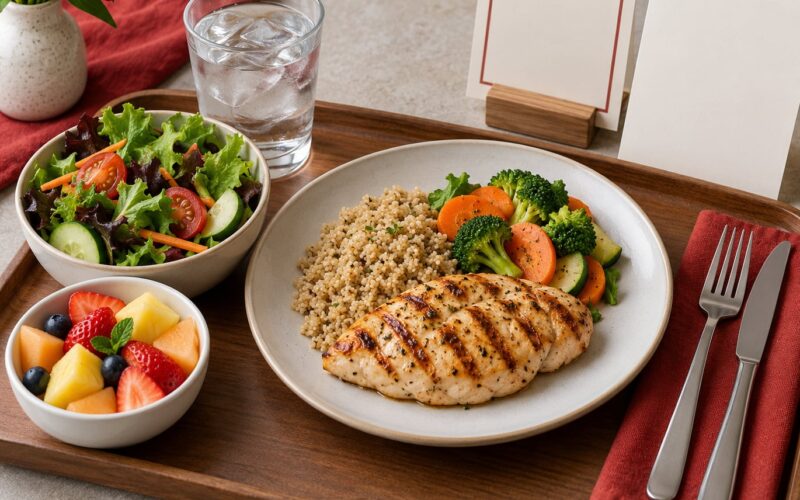
Use a rough balance check: about half produce, about a quarter protein, about a quarter grains and fats. You do not need scales for this. If the cart is mostly packages, the center aisles got ahead of you somewhere.
Then ask one yes-or-no question about each item: does this belong to a meal I am actually going to cook this week? Foods that fail that test go back on the shelf, and duplicates go home or get eaten first.
The final check is use. If the household will not eat it, the perimeter does not make it a good purchase. Fresh produce that spoils is not a win, however healthy it looked on the shelf.
Common Mistakes
Treating the perimeter as automatically healthy
The outer walls hold frozen pizza stacks, deli pasta salad and frosted bakery goods. Being on the perimeter tells you a product is perishable or fresh, not that it is good for you. Read the label on anything with a label, wherever it sits.
Buying only raw ingredients that take time to cook
Raw everything fails on a Wednesday. If your cart has no quick option, you will order out. Keep one or two things that go from package to plate in under fifteen minutes, whether that is frozen vegetables, canned beans, eggs or a plain frozen meal.
Overlooking the convenient alternatives
Pre-washed greens, pre-cooked grains, canned beans and microwaveable brown rice are not failures of discipline. They are what makes the method survive a busy week. Buying them is often what keeps you from abandoning perimeter shopping by Friday.
Shopping without a list
This is the mistake that costs the most money and produces the most waste. Write five to ten items tied to meals before you leave the house. Shoppers who go in cold wander, and wandering is when the endcaps get you.
A small guardrail helps: order produce and meat first, then the rest of the list. If the list is done, you are done, even if you are standing in an aisle you like.
Assuming every center-aisle product is unhealthy
Dried beans, canned fish, plain oats, olive oil and nut butters are center-aisle foods that most people benefit from eating. Leaving the middle aisles entirely is a budget mistake as much as a nutrition one. Go in with a purpose and buy the staples.
Shopping hungry and slow
People who shop hungry tend to leave with more sugary, salty and highly processed food, partly because they linger and partly because everything looks better when you are tired. A snack and a drink before you go fixes most of it.
Frequently Asked Questions
Does shopping the grocery store perimeter mean avoiding all packaged food?
No. Packaged food is fine when it earns its place in a planned meal. Canned beans, canned fish, plain oats, frozen vegetables, nut butters and olive oil are all packaged and all useful. The point of the perimeter route is that whole foods go in the cart first, so packaged items fill remaining gaps rather than driving the trip.
How do I use the perimeter method for weight loss?
It helps because the cart fills with foods that are filling and high in fiber before anything else goes in, so portion control happens without counting calories. Most weight change still comes down to total intake and activity over weeks, not store layout. Treat the route as a way to make good choices easier, and talk to your doctor before making significant dietary changes.
What should I buy on the perimeter for quick weeknight meals?
Grab protein you can cook in minutes, a bag of frozen vegetables or a steam bag, quick-cooking grains such as rice or couscous, eggs, plain yogurt, tortillas and pre-washed greens. Most combinations turn into a bowl, a sheet pan or a wrap in under fifteen minutes with one pan to wash afterward.
How do I shop the perimeter on a budget?
Use store brands, compare the unit price rather than the sticker price, buy produce in season when it is cheapest and plentiful, choose dried beans and rice over ready-made versions, and buy meat in larger portions to freeze. Frozen vegetables and canned fish cost less per serving than the fresh equivalent and waste nothing.
Should people with special nutrition needs follow the perimeter method?
It can still be a useful structure, but the specifics matter more. Gluten-free, dairy-free, low-sodium and kidney-friendly shopping each require reading labels carefully, and some perimeter foods will not work for you. Ask a registered dietitian or your doctor to help you build a list that fits your specific situation.
A Simple Perimeter-Shopping Routine
Start with the smallest version of this. Decide two or three meals before you leave the house, walk the perimeter in one direction starting at produce, and let most of the cart fill itself. Add a few center-aisle items on purpose: canned beans, a grain, olive oil, spices. Then read the cart at the end and take out anything that does not belong to a meal.
That is the whole method. How to shop the grocery store perimeter is not about memorizing a food list, and it is not a pass-or-fail test you can fail in aisle nine. The perimeter is a way of ordering your trip so the good food goes in first, and the list is what keeps the trip honest.
If one habit is worth keeping this year, make it the three-minute meal plan before the car keys come out. Everything else follows from it.