What is a balanced plate for weight loss? It is a 9-inch plate where half holds non-starchy vegetables, one quarter holds lean protein, and one quarter holds a fiber-rich carbohydrate like whole grains, plus a small amount of healthy fat. You build it with your eyes and your hands, no scale, no app, no food logs.
That sounds almost too easy for something that moves the scale. It works, but not because the plate is magic. It works because half the plate is low-calorie, high-fiber food that fills you up, and a quarter is protein that keeps you full for hours and protects muscle while your body burns fat.
Below is the whole method: the four sections, real portion sizes, a full day of meals, what to do at restaurants, and where it quietly falls apart. Most people get the proportions right but then pile three extra scoops onto the protein quarter, which undoes a lot of the work.
Table of Contents
- What Is a Balanced Plate for Weight Loss?
- The Four Sections of a Balanced Plate
- Half the plate: non-starchy vegetables
- One quarter of the plate: lean protein
- One quarter of the plate: fiber-rich carbohydrates
- The add-on: healthy fat and something calcium-rich
- Portion Guide: How Much Food Goes in Each Section
- Why a Balanced Plate Works for Weight Loss
- It fills you up before you run out of calories
- It steadies blood sugar between meals
- It cuts calories without asking you to count them
- It protects the muscle you already have
- Where the Plate Method Came From
- How to Build a Balanced Plate Step by Step
- Step one: get a 9-inch plate
- Step two: fill the vegetable half first
- Step three: add a palm of protein
- Step four: add one fist of carbohydrate
- Step five: finish with fat and eat slowly
- What a Balanced Plate Looks Like at Breakfast, Lunch and Dinner
- Breakfast
- Lunch
- Dinner
- Snacks
- How to Use the Plate Method When Eating Out
- How Quickly Does the Plate Method Work?
- Common Mistakes to Avoid With the Plate Method
- When the Plate Method Is Not Enough
- How to Adapt the Plate Method for Different Diets
- Frequently Asked Questions
- What does a balanced plate for weight loss look like?
- What is an example of a balanced meal?
- Will I really lose weight if I eat less?
- Should you eat 3 or 4 meals a day?
- How do I stop feeling hungry two hours after eating?
- What is the fastest way to overcome a weight loss plateau?
- Where to Start This Week
What Is a Balanced Plate for Weight Loss?
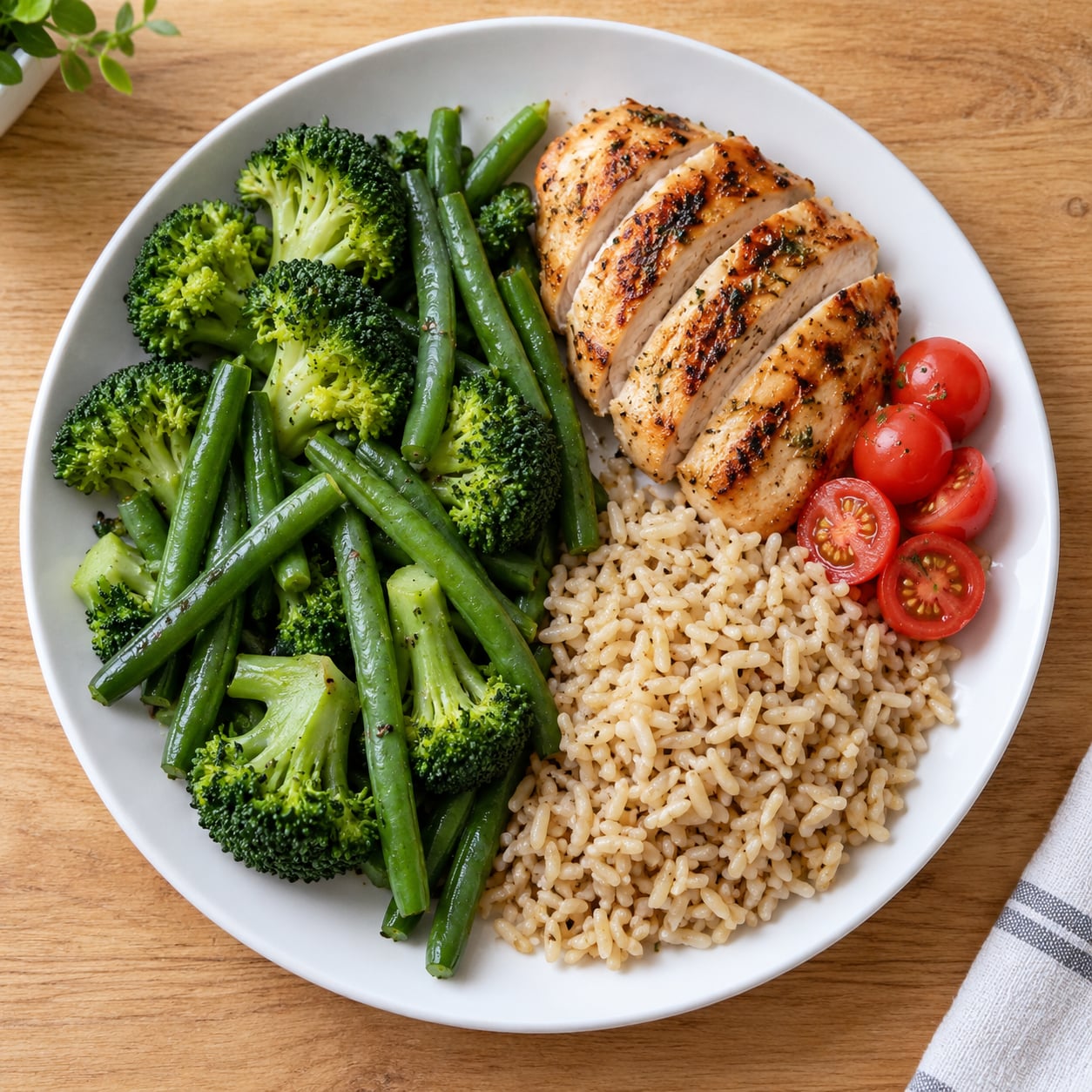
A balanced plate for weight loss is a visual portioning system: half your plate is non-starchy vegetables, one quarter is lean protein, one quarter is a fiber-rich carbohydrate such as brown rice or whole-grain pasta, and a thumb-sized portion of healthy fat to round it out.
It is a portion-control system, not a diet. There is no food on the banned list, no point system, and nothing to count. The plate just tells you how much of each food group goes where, and it happens to lower your daily calorie intake without you ever tracking it.
The idea is not new. The USDA turned it into MyPlate in 2011, replacing the old food guide pyramid, and the Dietary Guidelines for Americans describe the same half-and-quarter split for a balanced meal. Dietitians use it with clients who find calorie counting exhausting, which is most of them.
One detail worth knowing: the plate size matters. Serving the same food on a 9-inch plate instead of a 12-inch plate has been shown to cut how much people eat, sometimes by a lot, simply because a portion that looks modest on a small plate looks scanty on a big one.
The Four Sections of a Balanced Plate
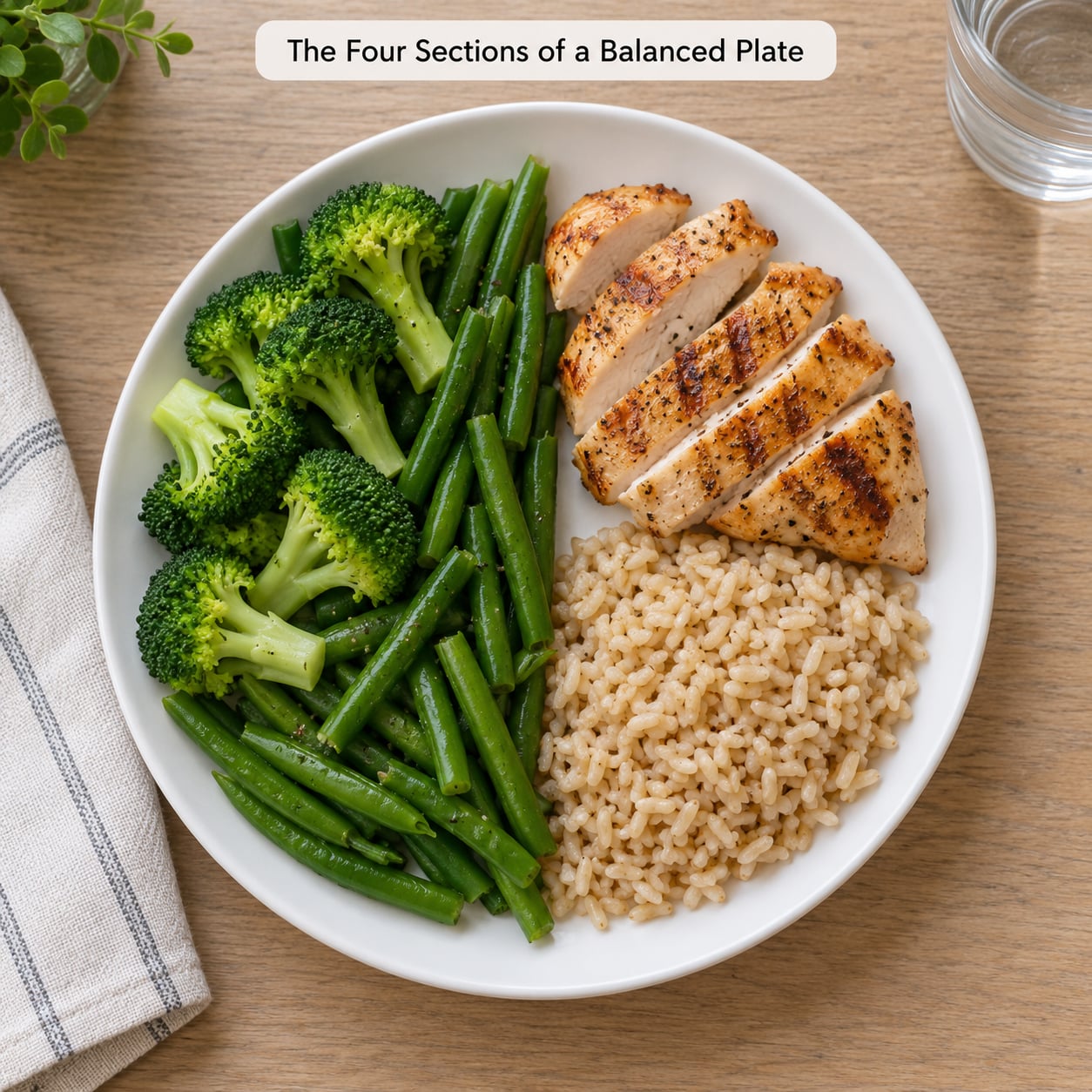
Split the plate in half, then split the half in two. That gives you three zones and a spot for fat. Here is what goes in each one.
Half the plate: non-starchy vegetables
This is the biggest section and the lowest-calorie one, and it is where most people are undershooting. Aim for 1 to 2 cups, which is roughly two handfuls or the size of your closed fist.
Non-starchy means vegetables that are not mostly starch: leafy greens, broccoli, cauliflower, zucchini, green beans, asparagus, bell peppers, cucumber, cabbage, spinach, mushrooms, tomatoes. These are the everyday workhorses of the method.
Starchy vegetables count as your carbohydrate quarter instead. That means potatoes, corn, peas, butternut squash, plantain and sweet potato go there, not in the vegetable half. Same for fruit: an apple is a carbohydrate serving, not a vegetable serving.
One quarter of the plate: lean protein
Think 3 to 4 ounces cooked, about the size and thickness of your palm or a deck of playing cards. That covers chicken breast, turkey, lean ground meat, fish, shrimp, eggs, tofu, tempeh and beans.
Protein is the section people skip, and skipping it is why they get hungry again two hours later. A plate without a real protein serving digests fast, no matter how much broccoli is on it.
If you eat plant-based, this is the hardest section to fill honestly. Beans, lentils and chickpeas are a genuine problem, because they are both protein and carbohydrate. Counting them in the protein quarter and then also eating a quarter plate of rice means you have quietly built a plate that is half starch. A common fix is to use tofu, tempeh or seitan for one meal and treat beans as the carbohydrate section on another.
One quarter of the plate: fiber-rich carbohydrates
One fist-sized serving, no bigger than one cup cooked. Brown rice, quinoa, barley, oats, whole-wheat pasta, sweet potato, whole-grain bread, corn or a baked potato all work.
The word fiber-rich does the heavy lifting. White bread and white rice are the same volume but they raise blood sugar faster and bring back hunger sooner, so pick the wholegrain version whenever you have a choice.
The add-on: healthy fat and something calcium-rich
A small amount of fat makes the vegetables taste good and slows digestion further: one or two teaspoons of olive oil, a quarter avocado, a small handful of nuts, or a spoonful of seeds.
Most versions of the method also add one serving of dairy or a fortified alternative, and one piece of fruit, either at the meal or as a snack. Skip either freely if you do not want it. The plate works without them.
Portion Guide: How Much Food Goes in Each Section
This is the table to print. The hand guides are the fastest version, and they travel with you to restaurants and to other people’s houses.
| Plate section | What it covers | Hand guide | Example portions |
|---|---|---|---|
| Half the plate | Non-starchy vegetables | Two open handfuls, or a closed fist | 1 to 2 cups: broccoli, salad greens, green beans, zucchini, peppers |
| Quarter plate | Lean protein | One palm, or a deck of cards | 3 to 4 oz: chicken breast, fish fillet, 3 eggs, 5 oz tofu, half a cup of beans |
| Quarter plate | Fiber-rich carbohydrate | One closed fist | 1 cup cooked rice, quinoa or pasta, 1 medium baked potato, 2 slices wholegrain bread |
| Add-on | Healthy fat | One thumb | 2 tsp olive oil, quarter avocado, 1 tbsp seeds or nuts |
| Add-on | Dairy or fortified alternative | A small glass | 1 cup milk or yogurt, fortified soy milk |
| Add-on | Fruit | One fist | 1 medium apple, orange or pear, half a cup berries |
Notice how little arithmetic that is. Six visual anchors cover an entire day of eating, and on r/loseit the most common advice from long-term members is exactly this: palm for protein, fist for grains, hands for vegetables. It is the one measuring tool nobody has to buy.
Why a Balanced Plate Works for Weight Loss
Four mechanisms do the work, and they only matter when you eat them together.
It fills you up before you run out of calories
Vegetables are bulky and low in energy, so half a plate of them adds real volume for very few calories. Fiber slows how fast food moves through the gut, and protein is the macronutrient the body spends the most energy processing. Together they mean you finish a meal fuller than a plate of the same size built from refined carbs.
It steadies blood sugar between meals
When a meal is mostly refined carbohydrate, blood sugar climbs and drops, and that drop is what you feel as an afternoon slump plus a cookie run at 3pm. Pairing carbohydrate with protein and fiber flattens that curve. Most people notice the difference in their energy, not their scale, within about two weeks.
It cuts calories without asking you to count them
This is the honest part. The plate does not create weight loss on its own; a calorie deficit does. What the plate does is make the deficit happen almost by accident, because it removes the large, calorie-dense servings you were not tracking. Restaurant pasta that filled a bowl now fits in a quarter plate.
It protects the muscle you already have
Protein at every meal, rather than a big protein spike at dinner, gives your body a steady reason to keep lean tissue during a deficit. On a diet built mostly from refined carbs, a meaningful share of what you lose is muscle along with fat. If you have ever seen the scale drop fast in the first month and then stall, this is often the reason.
Where the Plate Method Came From
The plate idea predates MyPlate. Harvard’s Healthy Eating Plate has taught half the plate vegetables and fruit, a quarter whole grains, a quarter healthy protein since the early 2000s, and dietitians had been recommending divided plates long before that.
In 2011 the USDA retired the food pyramid and introduced MyPlate, a plate divided along similar lines. Later editions of the Dietary Guidelines for Americans leaned into the visual approach because it survives contact with real life. No math, no measuring cups, no barcode scanning.
That matters if you have been turned off by nutrition advice before. This is not a new diet with a founder and a supplement list. It is the federal government’s own visual shorthand for a balanced meal, which is why registered dietitians keep handing it to people who refuse to track calories.
How to Build a Balanced Plate Step by Step
Five steps, and you can do the first one tonight with what is already in your fridge.
Step one: get a 9-inch plate
This is the single highest-leverage minute in the whole method. If you only own 12-inch dinnerware, use a side plate or a shallow 9-inch bowl for your main meal. Everything downstream follows from the size.
Step two: fill the vegetable half first
Before anything else, put 1 to 2 cups of non-starchy vegetables on half the plate. Doing it first means the vegetables are decided rather than negotiated, and it leaves you visually less room for everything else.
Step three: add a palm of protein
Cooked, this is 3 to 4 ounces. Season it with herbs, garlic, lemon and spices rather than sauces, because a sugary glaze on a palm-sized piece of chicken quietly doubles the calories.
Step four: add one fist of carbohydrate
Fill the last quarter with a fiber-rich option. A fist is roughly a cup cooked. Rice, quinoa, pasta and potato all fit; a heaped bowl of them does not.
Step five: finish with fat and eat slowly
A thumb of olive oil, seeds or nuts. Then eat at the table, without a screen, and give the meal at least 15 to 20 minutes. The method only works if you actually notice you are full, and most people eat faster than they feel full.
What a Balanced Plate Looks Like at Breakfast, Lunch and Dinner
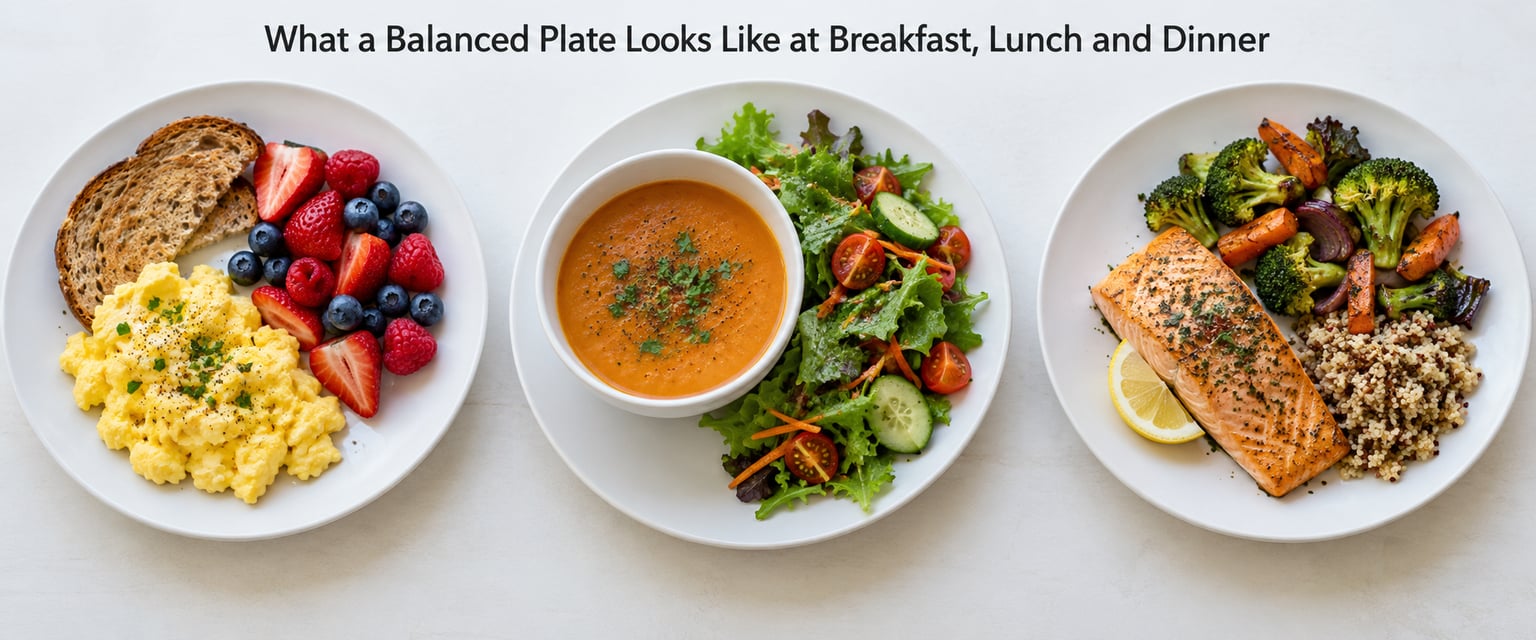
Most plate-method articles stop at dinner, which is a shame, because breakfast is usually where the worst portioning happens and the easiest win is available.
Breakfast
Two eggs plus a handful of spinach or tomato on the protein half, one slice of wholegrain toast or half a cup of oats on the carb quarter, and a fist of berries or a small handful of fruit. If you are hungry by 10am, add half an avocado or a handful of spinach to the vegetable half rather than another slice of toast.
Lunch
The easiest lunch to get right is a salad built with intention: two cups of greens and raw vegetables, a palm of protein such as grilled chicken, tuna, tofu or chickpeas, and a quarter cup of whole grains so you actually get a carbohydrate serving. Dress it with two teaspoons of olive oil and vinegar rather than a heavy pour.
Dinner
Half a plate of roasted vegetables, a palm of salmon, chicken or lentils, a fist of quinoa or sweet potato, and a thumb of olive oil to finish. This is the meal most people get right by accident, which is why the method works best if you start here and work outward.
Snacks
Snacks do not need a plate. A piece of fruit with a handful of nuts, plain yogurt with berries, or a small handful of raw vegetables roughly rebuilds the missing protein and fiber without a lot of thought.
How to Use the Plate Method When Eating Out
Restaurants serve plate-method-violating food by default. A typical pasta entrée arrives as three-quarters carbohydrates with protein somewhere in the middle. Four habits fix most of it.
- Order two vegetables sides and one protein, no starch. You get the plate balance handed to you and you skip the carb entirely.
- Ask for the to-go box before you start eating. Box a third of the meal at the table, before you are full and before the conversation has moved on.
- Send the entrée back half-finished. Some servers will split a large portion into two smaller plates, which converts a single oversized plate into two correct ones.
- Use the appetiser as the main. A salad with shrimp, a soup and a small side is a plate method meal in a restaurant.
The 9-inch plate trick does not travel, so the hand guides matter more here than at home. Ask for sauces on the side, and remember that the size of a restaurant fist is roughly twice yours.
How Quickly Does the Plate Method Work?
Realistically, expect 0.5 to 1 pound per week for someone in their 30s and 40s, assuming most meals are built this way and your activity level has not dropped to compensate.
The first two weeks are usually water, not fat, especially if you are cutting refined carbohydrates and eating more vegetables. People often see a fast drop, feel great, then watch it flatten out, which is where a lot of the disappointment comes from.
Anything faster than that is mostly water and glycogen unless you are in a supervised medical program. Slower than a pound a week for several weeks means your portions are not actually where you think they are, which is the subject of the next section.
Common Mistakes to Avoid With the Plate Method
Each of these quietly breaks the method while still looking like it is working.
- Filling the plate too large. The ratio only works on a 9-inch plate. On a 12-inch plate, the same proportions give you roughly twice the food.
- Stacking the protein quarter. Three palm-sized pieces of chicken in a quarter-plate space is no longer a quarter plate. Measure the palm once and get used to how small it is.
- Treating the vegetable half as anything green. A pile of potato salad, a large serving of fries or creamed spinach is not the vegetable half. Starchy and prepared-with-fat vegetables belong in the carb quarter.
- Adding fat without counting it. Olive oil, cheese, nuts and dressings are dense. Two tablespoons of dressing is a whole quarter of calories sitting invisibly on your vegetables.
- Not adjusting for the liquid calories. A large sweet coffee or an alcohol-heavy dinner can undo an otherwise perfect plate without you noticing.
- Expecting it to fix everything on its own. If you build a perfect plate and then have a biscuit at the bakery afterwards, the plate never stood a chance. It works at meals, not around them.
When the Plate Method Is Not Enough
It is worth being straight about the limits, because the people most drawn to this method are usually the people who most need the honest version.
It is a structure, not a calorie target. If you are portioning correctly and your weight is not moving for three or four weeks, something outside the plate is doing it: portions that drift large, liquid calories, weekend food that has no structure at all, or simply a body that has settled. Only one of those is a plate problem.
Plateau troubleshooting, in order: check the drinks, then the sauces and dressings, then the snacks between meals, then the weekend. Almost everyone finds the answer in the first two. People who are already tracking intake accurately do better by adjusting portions deliberately than by rebuilding their whole system.
There is also a reason to be thoughtful if you have a history of disordered eating, have been told to track your intake by a clinician, or are in recovery. Any method built around portion sizes asks you to look at food in a particular way, and for some people that looking is the problem itself. A registered dietitian or doctor is the right person for that conversation, not a website. The same goes for any weight change that comes with unusual fatigue, dizziness or hair loss.
How to Adapt the Plate Method for Different Diets
The proportions hold; what fills each section changes. These are the swaps that matter.
| Eating style | Vegetables half | Protein quarter | Carbohydrate quarter |
|---|---|---|---|
| Keto or low-carb | Keep it, and go heavier on leafy greens and cruciferous vegetables | Double it to 4 to 6 oz, add extra fat | Swap for non-starchy vegetables, a small serving of nuts, or skip it |
| Plant-based or vegan | Keep as is | Tofu, tempeh, seitan, edamame, or lentils as the main protein | Brown rice, quinoa or potatoes, and treat beans here rather than counting them twice |
| Gluten-free | Keep as is | Keep as is; fish, poultry, eggs and tofu are naturally gluten-free | Quinoa, brown rice, buckwheat, corn or potato instead of bread and pasta |
| Diabetes-friendly | Keep as is; add more non-starchy vegetables | Keep as is, and eat protein before the starch | Smallest fist, wholegrain or legume-based, eaten after the protein and vegetables |
| Family dinners | Put two or three vegetables on the table as default sides | One protein everyone shares, plus a plant protein for non-meat eaters | One starch, served in smaller bowls rather than on the plate |
If you want the shopping side of it, build the list around protein you actually like cooking, a starchy grain you will eat without resentment, and eight or nine vegetables that survive a week in the fridge. A method built on foods you dislike is a method that lasts about eleven days.
Frequently Asked Questions
What does a balanced plate for weight loss look like?
It is a 9-inch plate with non-starchy vegetables filling one half, lean protein filling one quarter, and a fiber-rich carbohydrate such as brown rice, quinoa or a baked potato filling the last quarter, finished with a small amount of healthy fat. In practice that is roughly 1 to 2 cups of vegetables, a palm-sized 3 to 4 ounce protein serving, and one cup or a closed fist of grains or starch. Fruit and dairy are optional add-ons rather than part of the main structure.
What is an example of a balanced meal?
Two grilled chicken breast fillets are one example, but so is almost any meal built from the three sections: a palm of salmon, a fist of quinoa and a big half plate of roasted broccoli and peppers is the same structure. For breakfast, two eggs with spinach, one slice of wholegrain toast and a handful of berries follows the same split. The specific foods matter less than the proportions being roughly half vegetables, a quarter protein and a quarter carbohydrate.
Will I really lose weight if I eat less?
Only if eating less creates a calorie deficit, and the plate method is a tool for making that happen without counting. Because half the plate is low-calorie vegetables and another quarter is protein, the same meal you used to eat shrinks quietly. Most people lose roughly 0.5 to 1 pound a week when most meals are built this way. If nothing moves after three or four weeks, the problem is usually drinks, dressings, snacks or weekend meals rather than the plate.
Should you eat 3 or 4 meals a day?
For most people using the plate method, three meals works well because the protein at each one keeps them full for four to five hours. The research on meal frequency itself is thin, and total intake matters far more than the number. Four smaller meals make sense if you are genuinely hungrier on three, or if you are training later in the day. Just keep each one built from the same three sections instead of turning two of them into snacks.
How do I stop feeling hungry two hours after eating?
Hunger that fast almost always means the meal was short on protein or fiber, not that you lack willpower. Check three things: that the protein quarter was a real palm of food, that half the plate was vegetables rather than a small salad, and that the carbohydrate was wholegrain instead of white bread or white rice. Eating more slowly and finishing with some fat also helps, since all three slow gastric emptying. If hunger persists despite a correctly built plate, raise your overall intake rather than shrinking portions further.
What is the fastest way to overcome a weight loss plateau?
Audit the calories the plate cannot see, in this order: drinks, then dressings and sauces, then snacks between meals, then weekend meals. A large latte or two tablespoons of dressing can quietly add more than your protein portion does. Make one change, hold it for two to three weeks, and change only one thing at a time so you know what worked. A registered dietitian can help you adjust portions deliberately if your intake is already accurate, and a doctor should rule out anything medical.
Where to Start This Week
Start with dinner and one plate size. Use a 9-inch plate, fill half of it with vegetables you already cook, add a palm of protein and a fist of whatever grain is in the cupboard, and eat it away from a screen for three meals.
That is it. Most people who stick with it report the noticeable change within a couple of weeks is hunger, not weight: they stop reaching for something at 4pm because lunch actually held them.
If you have a medical condition, take any pregnancy, are under 18, or have a history of disordered eating, talk to a doctor or registered dietitian before changing how you eat. And if three or four weeks of solid plate-method eating produce no movement at all, that is worth raising with them too.
Last reviewed October 2026.