Weight loss is any drop in total body mass, and that mass can be fat, muscle, water, bone or the contents of your digestive system. Fat loss is narrower: it means your body fat stores are shrinking while your lean mass stays put. Two people can lose the same ten pounds and end up in completely different places.
I see the confusion in this question constantly, mostly from two camps at once. One person is riding the scale down 20 pounds and feeling great about it. Another has not moved a pound but their waistband is loose, and they assume something is broken. Neither one is wrong. They are just tracking different things.
This guide walks through what actually changes in the body for each, how to work out which one is happening to you without a laboratory, and when plain old weight loss is genuinely the right goal. It is general information, not individual medical advice. If you have a health condition, take medication, or are pregnant, talk to your doctor or a registered dietitian before making big dietary changes.
Table of Contents
- Difference Between Fat Loss and Weight Loss at a Glance
- What Is Fat Loss?
- What Is Weight Loss?
- What Changes in the Body?
- How Do Fat Loss and Weight Loss Happen?
- What tends to cause fat loss
- What tends to cause weight loss that is not fat loss
- How Can You Tell Which One Is Happening?
- Five ways to track fat loss and weight loss at home, cheapest first
- Is that water weight or fat?
- Which Should You Choose?
- Frequently Asked Questions
- Which one is better, fat loss or weight loss?
- How do you know if you are losing water weight or fat?
- Can I lose fat without losing weight?
- What is the 3-3-3 rule for fat loss?
- How long until I see fat loss results?
- Why do I look slimmer but weigh the same?
- Conclusion
Difference Between Fat Loss and Weight Loss at a Glance
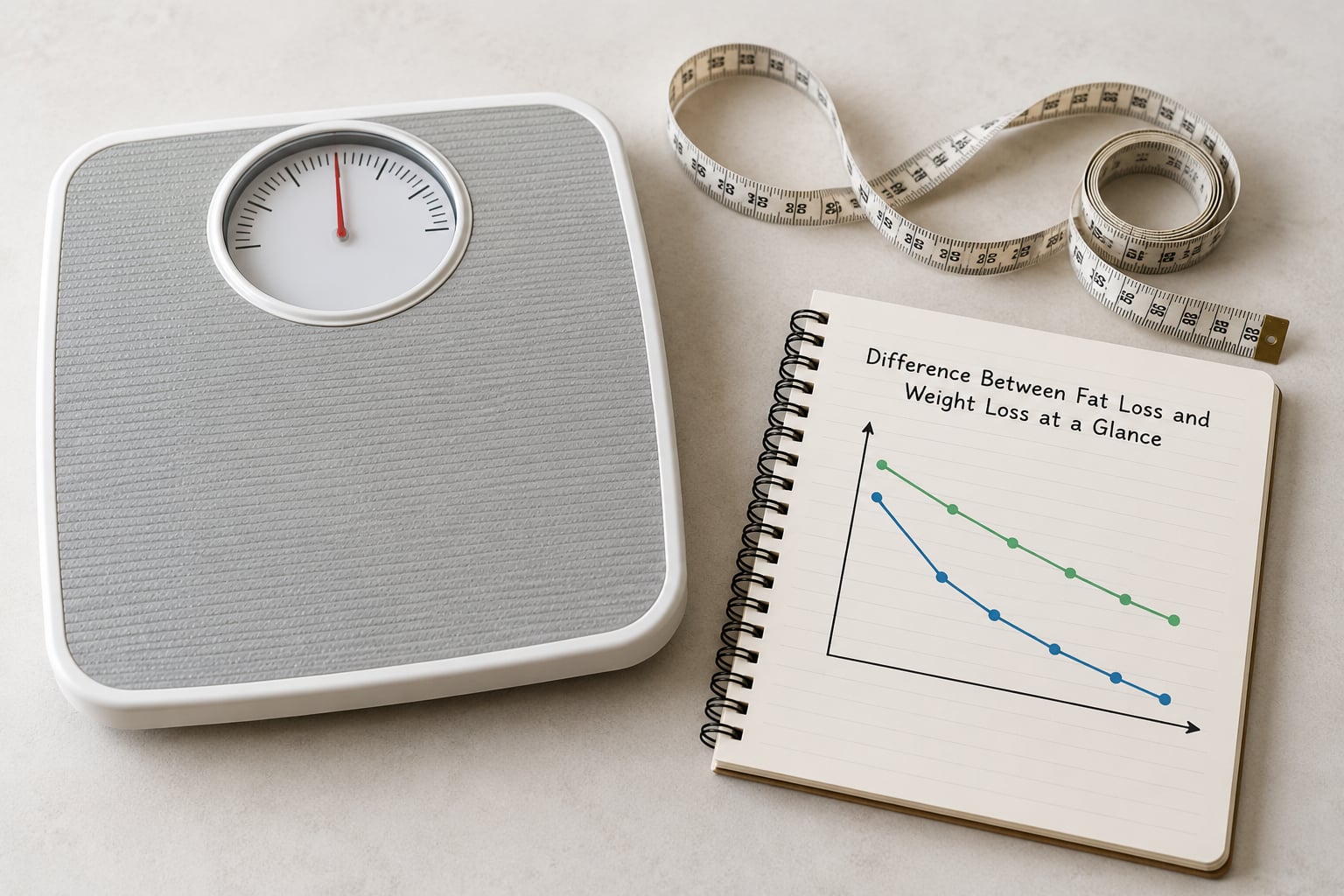
The table below is the whole argument in one view. Weight loss is the broad category. Fat loss is one specific, desirable version of it.
| Criterion | Weight loss | Fat loss |
|---|---|---|
| What it measures | Total body mass on a scale | Adipose tissue specifically, usually as a body fat percentage |
| What is lost | Any combination of fat, muscle, water, bone and gut contents | Fat, while muscle is preserved or occasionally built |
| Typical speed | Often fast in the first two weeks, especially on a very low calorie intake | Slower and steadier, around 0.5 to 1 percent of bodyweight per week |
| Effect on resting metabolic rate | Usually falls, because active tissue was lost | Mostly maintained, because muscle is intact |
| How it looks | Smaller in every direction, including muscle | Smaller around the waist and face, firmer everywhere |
| How it is measured | A bathroom scale, daily or weekly | Tape measure, strength log, photos, calipers, BIA scale or DEXA |
| How easily it comes back | Rebound is common after the diet stops | More sustainable, because the underlying habits and muscle are intact |
| Health impact | Can improve blood markers, but carries risk if muscle goes with it | Improves body composition, insulin sensitivity and strength alongside markers |
| Best for | Cases where scale weight itself carries clinical risk, under medical supervision | Shape, performance, metabolic health and keeping weight off long term |
What Is Fat Loss?
Fat loss means the amount of stored body fat, also called adipose tissue, goes down. Your body fat percentage falls, and the weight on the scale usually falls with it, but not always.
That last part trips people up. Fat loss is defined by the tissue, not by the number. If you lose three pounds of fat and gain a pound of muscle, you have lost fat and gained one pound of scale weight. Most tracking methods people own, including the scale, cannot see that trade at all.
Fat is also not one thing. Subcutaneous fat sits under the skin across your body and is largely cosmetic. Visceral fat sits around your organs inside the ribcage and is the type most tied to blood sugar, blood pressure and cholesterol. Reducing visceral fat often shows up in blood work long before it shows up in a mirror.
It helps to think of fat as a stored energy reserve. Your body holds roughly 3,500 calories in a pound of fat tissue, and it will release that reserve when intake runs below what you burn. The catch is that it will also reach for other reserves, which is where things get complicated.
What Is Weight Loss?
Weight loss is a decrease in total body mass. It is a number, not a substance, and the number does not tell you what came off.
The scale moves for reasons that have nothing to do with fat. A cup of coffee is roughly a pound of fluid that has not left your body yet. A high sodium meal pulls water into your bloodstream to help process it, and that water comes off over the next day or two. Cutting carbohydrates depletes glycogen stores, and every gram of glycogen carries about three grams of water with it, so a low carb week can drop three or four pounds that were never fat.
Muscle loss, bone loss, and the mass of food still sitting in your stomach all register as weight too. Two people can step on the same scale on the same morning, both be down ten pounds since summer, and one have lost eight pounds of fat while the other lost five pounds of fat and five pounds of muscle.
What Changes in the Body?
Body composition is the ratio of fat mass to fat-free mass, and it is the number that actually separates fat loss from weight loss. Muscle, bone, organs and connective tissue all count as fat-free mass. Fat-free mass is the metabolically active part of you.
When fat comes off and muscle stays, you get the set of changes most people are hoping for. Waist and hip measurements shrink, clothes fit differently, resting metabolic rate holds steady, and strength stays or climbs. Energy tends to be steadier too, because you are not running on a shrinking active mass.
When scale weight comes off as fat plus muscle, the changes read differently. Your resting metabolic rate falls, so the same food now sustains you more. That is adaptive thermogenesis doing its job, and it is a big reason people plateau or regain. Sarcopenia, the age-related loss of muscle that accelerates after 50, is a related and more serious version of the same problem.
This is where the community shorthand comes from. Someone who loses weight while their body fat percentage stays high or rises is often described as skinny fat, and the label is accurate: the weight went, the fat did not.
How Do Fat Loss and Weight Loss Happen?
Both start with the same mechanism, a sustained calorie deficit. You take in fewer calories than you burn, and the body covers the gap from somewhere. Where it pulls from decides what kind of loss you got.
Think of the order the body draws on its reserves. Glycogen and its bound water go first, which is why the first week of a diet is the fastest and least meaningful. Fat stores come next. Muscle protein only gets broken down for fuel when the deficit is large, protein intake is low, or you are not giving resistance training a reason to keep it.
What tends to cause fat loss
- A moderate calorie deficit. Most commonly 300 to 500 calories a day below maintenance. Big enough to work, small enough that you stay functional.
- Higher protein intake. Guidance from the American College of Sports Medicine puts protein around 0.7 to 1 gram per pound of bodyweight per day for people training during a cut.
- Resistance training two to three times a week. This is the signal that keeps muscle protein from being cannibalised.
- Sleep and enough steps. The CDC recommends 150 minutes of moderate activity a week plus two strength days, and daily movement adds up quietly through non-exercise activity thermogenesis.
What tends to cause weight loss that is not fat loss
- Very low calorie intakes. Aggressive dieting without resistance training can pull a large share of the loss from muscle, commonly cited in the range of 25 to 40 percent.
- Low protein, low resistance training. Combine the two and the body has no particular reason to spare muscle.
- Sudden carb restriction. Fast early scale drops that are mostly glycogen and its water.
- High sodium swings. A day or two of extra fluid, then it clears.
- Overreliance on cardio. Long steady sessions without any lifting signal can nudge you toward losing both tissue types.
There is a version of this argument worth taking seriously, because people on Reddit raise it honestly: fat loss and weight loss are pretty much the same thing. They are partly right. Every pound of fat you lose is a pound of weight you lose. Weight loss is the category and fat loss is one of its outcomes. The useful part of the distinction is that it tells you which outcome you actually got.
How Can You Tell Which One Is Happening?
Look at trends over weeks, not single mornings. A single weighing tells you almost nothing, because a normal day’s swing between two people can be several pounds.
Five ways to track fat loss and weight loss at home, cheapest first
Waist and hip measurements. A soft tape measure costs a few dollars and is more informative than any consumer scale. Measure at the navel, at the widest point of the hips, and keep the waist-to-hip ratio in mind. A ratio above 0.8 for women or above 0.95 for men is a commonly used marker of central fat, and waist circumference over 88 cm in women or 102 cm in men is a risk threshold cited in clinical guidance.
Clothing fit. Not a measurement, but the community treats it as the real scoreboard. If your jeans are loose and your belt needs a new hole, something is changing even when the scale is flat.
Progress photos. Same time of day, same lighting, front and side, every two weeks. Angle and posture hide as much as they reveal, so keep them consistent.
Strength logs. If your squat, deadlift or push-up numbers hold steady or go up while your weight drops, you are almost certainly losing fat and keeping muscle. If they fall away fast, muscle is leaving with it.
Skinfold calipers, BIA scales or DEXA. Calipers are cheap and repeatable if you measure the same sites the same way. Consumer bioelectrical impedance scales are the easiest and the least trustworthy, since hydration swings the reading by several pounds of water. DEXA is accurate and available through some clinics and gyms. No single method is fully accurate, which is why triangulation beats any one device.
Is that water weight or fat?
- Timing. Fat loss shows up over weeks and months. Water shows up in two days.
- Magnitude. Fat disappears at roughly 0.5 to 1 percent of bodyweight per week. Anything faster than that is mostly water, glycogen or gut contents.
- Waist measurement. If the number moved but your waist did not, it was not fat.
- Strength. Falling gym numbers alongside falling weight is the clearest sign muscle is going.
- Duration. Water clears. Fat does not come back on its own.
A seven-day example. Someone drops carbs and sodium for four days and loses six pounds. Their waist is unchanged, their lifts are the same, and their weight climbs back over the next five days as they reintroduce carbs and normal salt. That was water. Now imagine the same week with a moderate deficit, constant protein and two lifting sessions. The scale moves down one to two pounds, the waist drops slightly at week four, and it keeps trending down at week eight. That is fat.
Which Should You Choose?
For almost everyone reading this, fat loss is the better goal. Not because it produces a lower number, but because it keeps your muscle, your strength and your metabolic rate intact while it changes your shape. That is the version of progress that holds once the diet stops.
It fits beginners best, since a person new to training has less muscle to lose and tends to recomposition well. It also suits anyone returning after a break, anyone who has regained the same pounds more than once, and anyone over 40 or in perimenopause and menopause, where losing three to five percent of muscle mass per decade is already happening without any dieting involved.
Weight loss as the primary goal makes more sense when scale weight itself is a clinical risk. That category belongs to a doctor, not a blog, and it generally involves structured, monitored programmes with follow-up blood work. The same goes for GLP-1 and other prescription weight-loss medications: appetite drops dramatically, which makes protein and resistance training the deciding factors for how much of the loss is muscle. Raise that with the prescribing clinician rather than reading it here.
There is also a hybrid case. If your weight is normal but your body fat percentage is high, losing fat while staying at the same weight is the goal, and that is body recomposition. The scale stays flat while your waist shrinks and your lifts climb. It is slow, it is real, and it is common among people who train and have never trained heavily before.
One honest caution on realistic timelines. Roughly 0.5 to 1 percent of bodyweight per week is a range most coaches and mainstream guidance treat as sustainable. Past that, muscle loss becomes more likely, and more importantly, the plan is harder to stick to. A slower rate is not a failure of effort. It is the price of keeping the muscle you already have.
Frequently Asked Questions
Which one is better, fat loss or weight loss?
Fat loss is better for almost everyone. Weight loss includes fat, muscle and water, so it tells you a number changed without saying what changed. Fat loss keeps muscle intact, which protects resting metabolic rate, strength and bone support, and makes the result easier to maintain. Weight loss is the right primary goal only when scale weight carries a real clinical risk, and that decision belongs with your doctor.
How do you know if you are losing water weight or fat?
Water changes fast and fat does not. Fat loss trends over weeks at roughly 0.5 to 1 percent of bodyweight per week; anything faster is usually glycogen, its bound water, sodium-related fluid or gut contents. Check your waist measurement and your strength numbers alongside the scale. If weight dropped and your waist stayed flat, it was water. If it stays off for good, it was fat.
Can I lose fat without losing weight?
Yes, and the process has a name: body recomposition. Fat is lost while muscle is preserved or built, so total scale weight can stay flat or drift up while your waist shrinks and your lifts climb. It is most common in beginners, in people who train but have never trained heavily, and in older adults. Progress is slow and the scale is a poor tool for it, so track measurements and strength instead.
What is the 3-3-3 rule for fat loss?
The 3-3-3 rule is a social media framing with no scientific basis behind it. It suggests losing three pounds in three days or something similar, which is not a rate any guideline supports. The defensible rule is 0.5 to 1 percent of your bodyweight per week. That pace is slow enough that you keep your muscle, and it is the range most coaches and mainstream nutrition guidance treat as sustainable.
How long until I see fat loss results?
Weeks one to two are mostly glycogen and water, so the scale moves fastest when it means the least. Visible changes in clothing and mirror usually start around weeks three to four. Waist measurements tend to confirm it by week six to eight. Anything slower than that is normal, and anyone promising faster without asking about your muscle is selling a plan, not an outcome.
Why do I look slimmer but weigh the same?
Because fat loss is measured in body composition, not pounds. You may have shed fat and picked up a similar amount of muscle or water, leaving the total unchanged while your shape changed. Waist and hip measurements will show the reduction even though the scale does not. This is also what happens during body recomposition, and it is a good reason to track more than one measure.
Conclusion
The difference between fat loss and weight loss comes down to what you are counting. Weight is a single number that moves for reasons ranging from salt to muscle. Body composition is the ratio of fat to everything else, and it is the only measure that tells you whether the change you made was the change you wanted.
Start with a baseline rather than a plan. Weigh yourself once a week at the same time, measure your waist and hips, and write down what you lift today. Those three numbers take ten minutes and they are the ones that will tell you the truth when the scale goes quiet.
Then aim for the slow version. A moderate deficit of 300 to 500 calories, roughly 0.7 to 1 grams of protein per pound of bodyweight, and two or three resistance sessions a week is the combination most likely to move fat while leaving muscle alone. Track trends across a month, not a morning. And if your weight carries real health risk rather than a number goal, talk to your doctor or a registered dietitian about a plan built around that instead.