Yes, you can lose fat and gain muscle at the same time. The process is called body recomposition, and it works best for beginners, people returning to exercise after a break, and anyone starting at a higher body fat percentage. The formula is a modest calorie deficit of roughly 200 to 300 calories below your maintenance calories, 1.6 to 2.2 grams of protein per kilogram of bodyweight, and resistance training three to four times a week.
Here is the honest version of how to lose fat and gain muscle at the same time: the scale will frustrate you, progress looks like nothing for weeks, and the payoff arrives quietly in your strength log and your waist measurement. Expect measurable change between 8 and 12 weeks, and visible change somewhere around 3 to 6 months.
Five pillars carry the whole approach: a small calorie deficit, resistance training that you progress week to week, enough protein to protect and build muscle, real recovery, and tracking that keeps you honest. Miss one and the other four get harder for no reason.
Table of Contents
- What You Need
- Step-by-Step: How to Lose Fat and Gain Muscle at the Same Time
- Step 1: Set a Body Recomposition Baseline
- Step 2: Eat in a Small, Sustainable Deficit
- Step 3: Meet Protein and Nutrition Needs
- Step 4: Train Weights Two to Four Times Weekly
- Step 5: Add Cardio Without Interfering With Recovery
- Step 6: Recover, Sleep, and Adjust Slowly
- Common Mistakes
- Frequently Asked Questions
- Can you lose fat and gain muscle at the same time?
- How long does it take to lose fat and gain muscle?
- How much protein do I need to lose fat and gain muscle?
- Do I need to do cardio while recomposing?
- Why is the scale not moving while my strength keeps climbing?
- Conclusion
What You Need
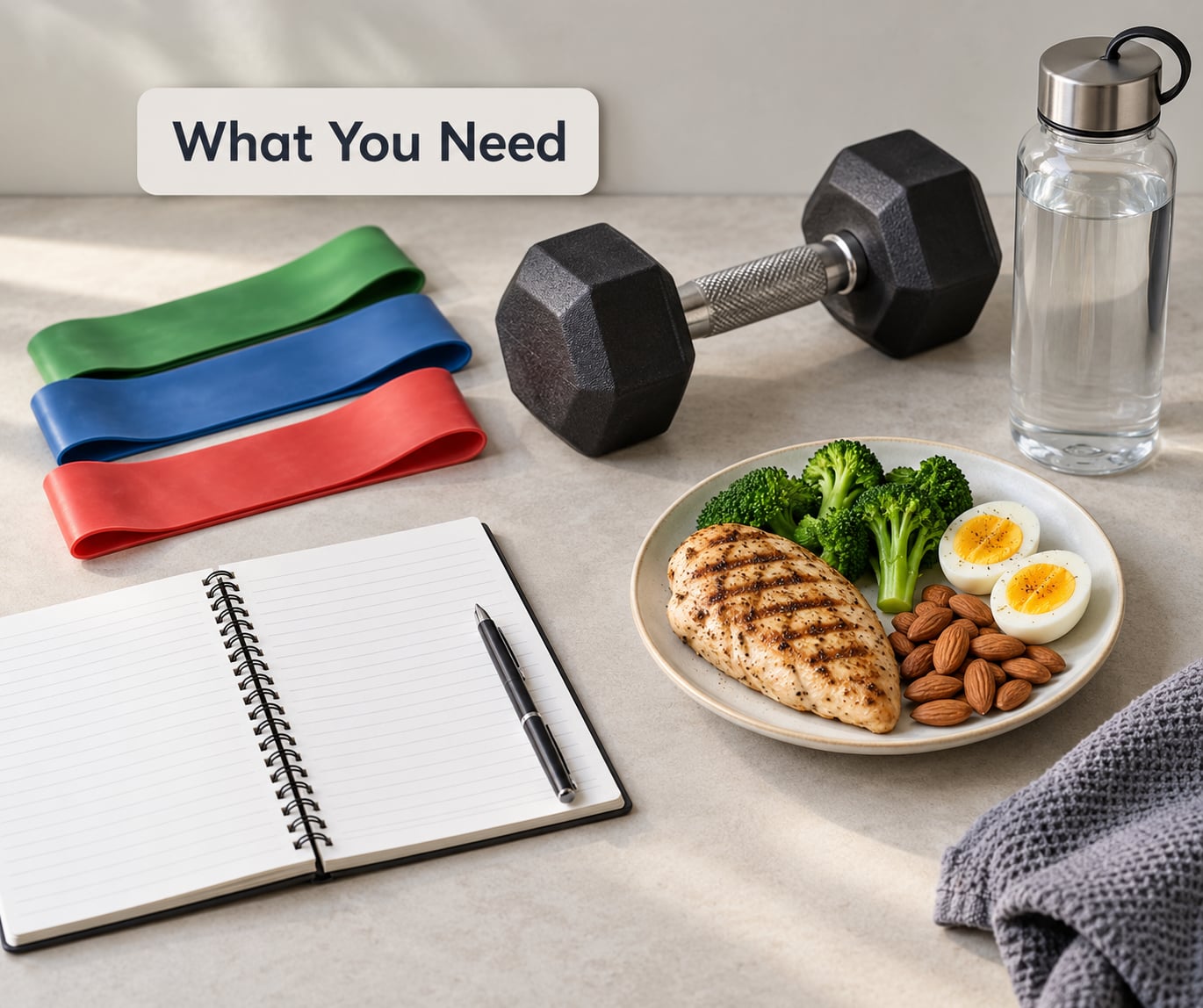
Recomposition needs less than people assume. You do not need a fancy meal delivery service, a six-day split, or a supplement stack. You need five things, and if you are missing one of them, the whole plan gets harder than it needs to be.
- A modest calorie deficit. Between 200 and 300 calories a day below maintenance, which is roughly 10 to 15 percent of your total intake. Anything harsher and you trade muscle for speed.
- A full-body resistance training plan you can actually run three or four days a week, using squats, hinges or deadlifts, presses, rows and carries.
- Enough protein. 0.7 to 1 g per pound of bodyweight, spread across three to four meals.
- Minimally processed food most of the time. Chicken, eggs, fish, tofu, Greek yogurt, legumes, vegetables, fruit and whole grains do the heavy lifting here.
- Sleep and a way to track. Seven to nine hours, plus a notebook or app for weight, waist measurements and every set you perform.
The last item matters more than beginners expect. Recomposition shows up in measurements and lifts long before it shows up on the scale, and tracking is how you keep the plan honest for eight weeks instead of two.
Step-by-Step: How to Lose Fat and Gain Muscle at the Same Time
Step 1: Set a Body Recomposition Baseline
Record four numbers before you change anything: your weight, your waist measurement at the navel, your current training age, and the loads you manage on five basic lifts. A two-minute check now saves you from guessing for twelve weeks.
For strength, write down what you can do with control today. Fifteen goblet squats at a 35 pound dumbbell, three sets of eight push-ups, or a 95 pound barbell for five reps is a perfectly good starting baseline. If you are returning after years away, bodyweight movements or bands count.
Compare measurements over several weeks, never day to day. Water weight moves two to four pounds on its own after a salty meal or a hard session, and a single morning reading tells you almost nothing.
Step 2: Eat in a Small, Sustainable Deficit
How to lose fat and gain muscle at the same time starts with a deficit most people underestimate: 200 to 300 calories a day, not 800. Find maintenance as a starting estimate by multiplying your bodyweight in pounds by roughly 14 to 16 for a lightly active person, then adjust from real data rather than the estimate.
Adjust from two weeks of real data. Eat the same amount for 14 days, weigh yourself every morning after using the bathroom, and average the week. If the average moves by more than about 1 percent of bodyweight in either direction, trim or add roughly 150 calories and repeat.
A practical day at 2,000 calories and about 150 grams of protein looks ordinary: eggs and toast at breakfast, chicken with rice and vegetables at lunch, Greek yogurt and fruit as a snack, salmon with potatoes and a salad at dinner. Volume comes from vegetables and protein, which keeps hunger manageable at a small deficit.
Aggressive deficits fight your training. Cut calories hard and your lifts drop within a couple of weeks, which tells your body to hold onto muscle. The result is a smaller version of what you started with, and that is the pattern most beginners call a failed recomp.
Step 3: Meet Protein and Nutrition Needs
Eat 1.6 to 2.2 g of protein per kilogram of bodyweight, which is 0.7 to 1 g per pound. Higher end of the range if you are in a deficit, training hard, or carrying more body fat; lower end still works for lighter people and lighter training loads.
Worked example: at 180 pounds, that is 130 to 180 grams of protein a day. Split it across four feeds of 35 to 45 grams each. Four feeds of 40 grams hits 160 grams without any single meal feeling excessive.
Everyday sources are unglamorous and work fine: chicken breast, eggs, fish, cottage cheese, Greek yogurt, tofu, tempeh, lean beef, and protein powder as a convenience. Carbohydrates and fats still matter, mostly for training quality and how the day feels, so keep meals built around a protein source, a vegetable or two, and a carbohydrate.
If you have kidney disease, a history of eating disorders, or any medical concern, talk to a doctor or registered dietitian before changing how much protein you eat. General guidance is not a plan for your specific situation.
Step 4: Train Weights Two to Four Times Weekly
Two to four full-body sessions a week, with 2 to 3 sets of 6 to 12 reps per exercise, is enough to add muscle while in a deficit. Cover the main patterns each session: squat or leg press, hinge such as a deadlift or Romanian deadlift, horizontal push, vertical push, and a row.
Leave a small amount in reserve. Pick a load where the last rep of each set feels like it could have been one or two more, and stop there. Going to failure on every set works, but it costs recovery you need elsewhere.
A three-day version: Monday, Wednesday and Friday, full body with squats, bench press or push-ups, rows, overhead press and hinges. A two-day version for a busy week: Tuesday and Saturday, each covering those same patterns, with one extra set and longer rest between them.
Add load when you can, or add reps with the same load. Double progression works well for beginners: pick a rep range such as 6 to 10, stay in it until you hit 10 clean reps on all three sets, then raise the weight and start back at 6. That single rule, progressive overload, is what actually builds the muscle.
Step 5: Add Cardio Without Interfering With Recovery
Walking, cycling, and low-to-moderate intensity cardio burn energy without the recovery cost of hard interval work. Walking 8,000 to 10,000 steps a day plus two or three short sessions of 20 to 30 minutes is plenty, and it covers the deficit without adding fatigue to your lifts.
Place cardio after lifting, or on its own day, and keep it easy enough to hold a conversation. If your sessions feel like they take something out of your training rather than giving something back, cut the minutes in half. Nobody has ever failed recomp by walking less than they should have.
Increase steps gradually, adding a thousand a week rather than five thousand overnight. Recovery is the constraint, not calories.
Step 6: Recover, Sleep, and Adjust Slowly
Sleep for seven to nine hours and keep one to two full rest days in the week. Muscle is assembled during recovery, so a plan that ends with you wrecked is a plan that stops paying out.
Review progress every two to four weeks, never weekly. Look at the averaged bodyweight, the waist measurement, and the strength log together. Any one of those alone tells a misleading story.
Change one variable at a time. If the waist is unchanged and lifts are climbing, keep going. If both measurements and lifts are flat for three to four weeks, trim about 150 calories or add one set per lift, not both. Adjusting everything at once means you learn nothing about what worked.
See a doctor for persistent pain, dizziness, unusual fatigue, or any symptom that worries you. Feeling tired for three days after a hard week is normal. Feeling unwell is a reason to stop and get checked.
Common Mistakes
Chasing fast scale loss. Dropping more than about 1 percent of bodyweight per week is a cutting pace, not a recomp pace, and it costs you muscle. Fix: hold the deficit at 200 to 300 calories and judge progress in four-week blocks.
Undereating while adding training volume. This is the single most common failure in beginner threads, and the reason most recomp attempts stall in month two. Fix: eat enough to perform, and treat the appetite and fatigue you feel as data.
Skipping protein. Under 0.7 g per pound and muscle preservation becomes a coin flip. Fix: hit the number daily with simple foods rather than saving protein for dinner.
Adding excessive cardio. Hours of hard cardio sit next to your lifts and eat recovery. Fix: keep cardio short, conversational, and preferably after training.
Changing calories and training volume at the same time. You lose the ability to tell what caused what. Fix: one change, then two to four weeks of observation.
Training through pain. Soreness is fine; sharp joint pain is not. Fix: swap the exercise, get the injury assessed, and never use pain as a measure of a good session.
Expecting spot reduction. You cannot choose where fat leaves your body, and abdominal training alone will not flatten a waist. Fix: judge the waist with a tape measure, not with an ab routine.
One tip that outlasts all of them: pick a plan boring enough that a bad week does not end it. Consistency across twelve unremarkable weeks is the entire method.
Frequently Asked Questions
Can you lose fat and gain muscle at the same time?
Yes. The process is called body recomposition, and it means losing fat while adding muscle at the same time, often with little change in bodyweight. It works best for beginners, people returning after a break, and those starting at a higher body fat percentage. Less experienced lifters can build muscle more easily, which is why recomposition is easier early in training.
How long does it take to lose fat and gain muscle?
Most beginners notice measurable change in 8 to 12 weeks, with visible changes between 3 and 6 months. Leaner people and experienced lifters move slower, because building muscle while already near your limits is genuinely slow. Think in months, not weeks, and compare waist measurements and strength every two to four weeks rather than weighing yourself daily.
How much protein do I need to lose fat and gain muscle?
Aim for 1.6 to 2.2 grams per kilogram of bodyweight, which is 0.7 to 1 gram per pound. A 180 pound person would target 130 to 180 grams a day. Split it across three to four meals of 35 to 45 grams each, using foods like chicken, eggs, fish, tofu, Greek yogurt or protein powder. If you have kidney disease, ask your doctor first.
Do I need to do cardio while recomposing?
Cardio is optional, not required. Most of your deficit can come from food, with walking and daily steps covering the rest. Two or three short sessions of 20 to 30 minutes at low to moderate intensity is more than enough, and it works best placed after lifting or on separate days. More cardio usually means more fatigue and slower progress in the gym.
Why is the scale not moving while my strength keeps climbing?
That pattern usually means recomposition is working. Muscle gained and fat lost can roughly offset each other in bodyweight, so the scale stays flat while your waist drops and your lifts rise. Track a weekly average, waist measurement, and strength log instead of daily weight. If strength stalls too for several weeks, adjust calories or training volume, and talk to a doctor or dietitian for individual guidance.
Conclusion
Start with three things this week. Write down your weight, waist measurement, and five baseline lifts so you have something to compare against. Set calories about 250 below maintenance and eat 0.7 to 1 gram of protein per pound, split across four meals. Book three full-body weight sessions into next week and put two short cardio sessions or a daily step target beside them.
That is the whole plan for how to lose fat and gain muscle at the same time. Judge it in four-week blocks using your waist and your strength log, adjust one thing at a time, and let the scale do whatever it wants. Anyone with a medical condition, an injury, or a history of disordered eating should get individual guidance from a doctor or registered dietitian rather than running a generic plan.