To calculate body fat percentage at home, the most reliable route is the U.S. Navy circumference method: you take two or three tape measurements at set anatomical landmarks, plug them into a published equation from Hodgdon and Beckett (1984), and read off an estimate. It takes about five minutes, needs nothing but a soft tape measure, and it repeats well enough to track over weeks.
The catch is worth saying up front. Every home method gives you an estimate with a real margin of error, usually three to four percentage points, and the number gets less trustworthy the further you sit from average height and weight. So treat the first result as a baseline and the tenth as a trend, not as a diagnosis.
Table of Contents
- What You Need
- Step-by-Step: How to Calculate Body Fat Percentage at Home
- Step 1: Weigh Yourself and Record Your Measurements
- Step 2: Measure Your Waist at the Navel
- Step 3: Measure Your Neck and Hip Circumferences
- Step 4: Calculate Your Estimated Body Fat Percentage
- Step 5: Check the Result and Track the Trend
- Step 6: Compare Your Estimate With Other Home Measures
- Common Mistakes
- Tips for a More Reliable Estimate
- Frequently Asked Questions
- How accurate is the US Navy body fat formula at home?
- How often should I calculate my body fat percentage?
- Can a bathroom scale reliably measure body fat percentage?
- Is a lower body fat percentage always better?
- When should I get body composition measured by a professional?
- Conclusion
What You Need
A short list, and almost all of it costs nothing:
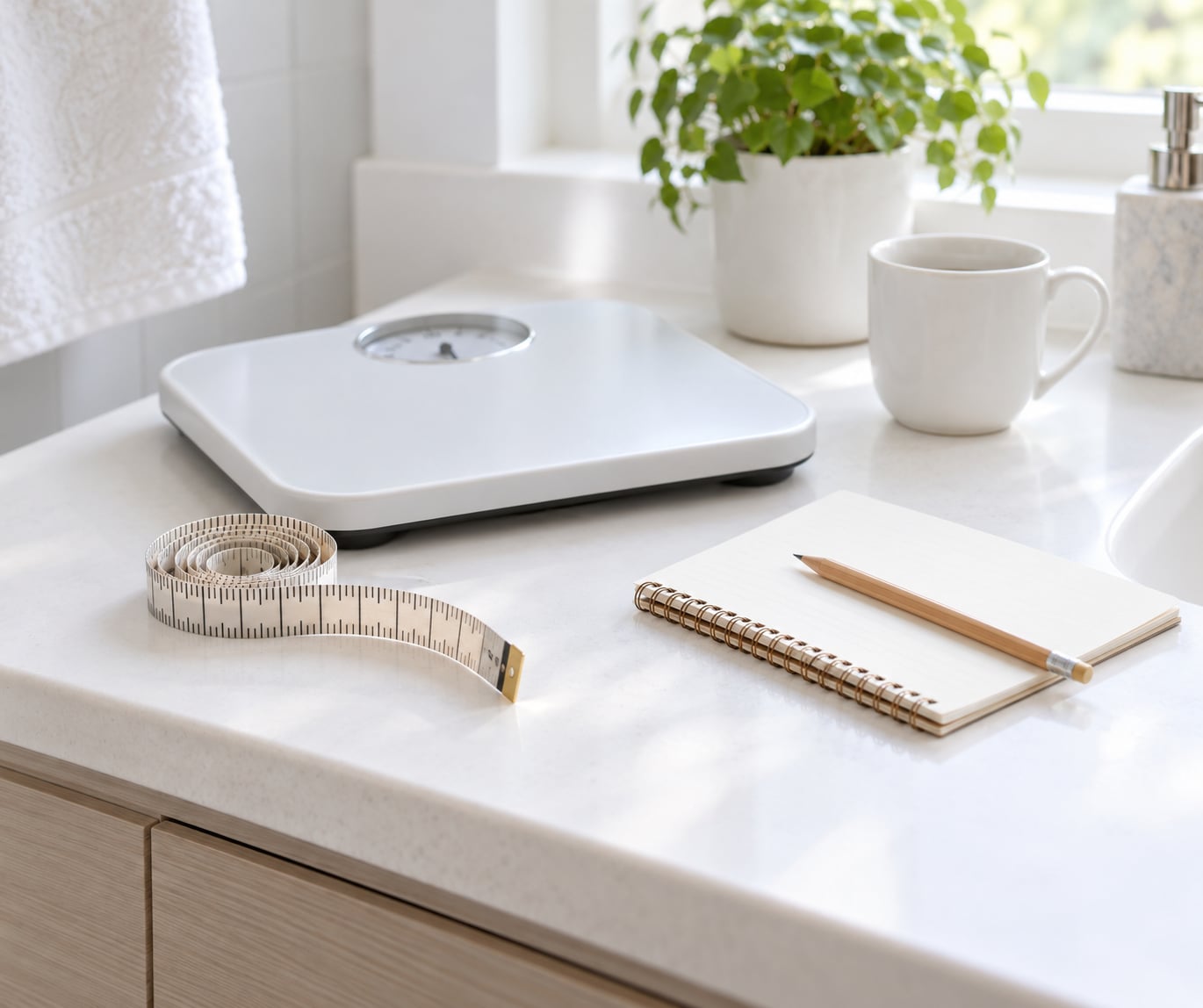
- A soft, flexible, non-stretch tape measure. Cheap cloth or retractable ones work. A stiff tape gives you a different number than an elastic one.
- A bathroom scale for weight in pounds. The Navy equation itself does not use weight, but you need it to turn a percentage into pounds of fat.
- A full-length mirror so you can keep the tape level and horizontal without twisting.
- A phone calculator. These equations need a base-10 logarithm, which no mental arithmetic is going to do for you.
- A notebook or notes app. You need last week’s numbers more than you need this week’s.
- Optional: skinfold calipers. More accurate in trained hands, more expensive, and much harder to do consistently by yourself.
One thing to keep straight: a scale measures weight. It does not measure body composition unless it is a bioelectrical impedance model, and that model’s accuracy depends on hydration, time of day and how much muscle you are carrying.
Step-by-Step: How to Calculate Body Fat Percentage at Home
The protocol takes about five minutes once you know the landmarks. Measure everything in the same unit system, take every reading twice, and average the two.
Step 1: Weigh Yourself and Record Your Measurements
Step onto the scale in the morning, after using the bathroom and before eating or drinking anything. That timing keeps water weight roughly constant from week to week, which matters more than the actual number on the scale.
Write down four things every time: date, weight in pounds, and the three circumference readings you are about to take. Repeat the whole set under similar conditions rather than measuring at whatever time you happen to remember.
Step 2: Measure Your Waist at the Navel
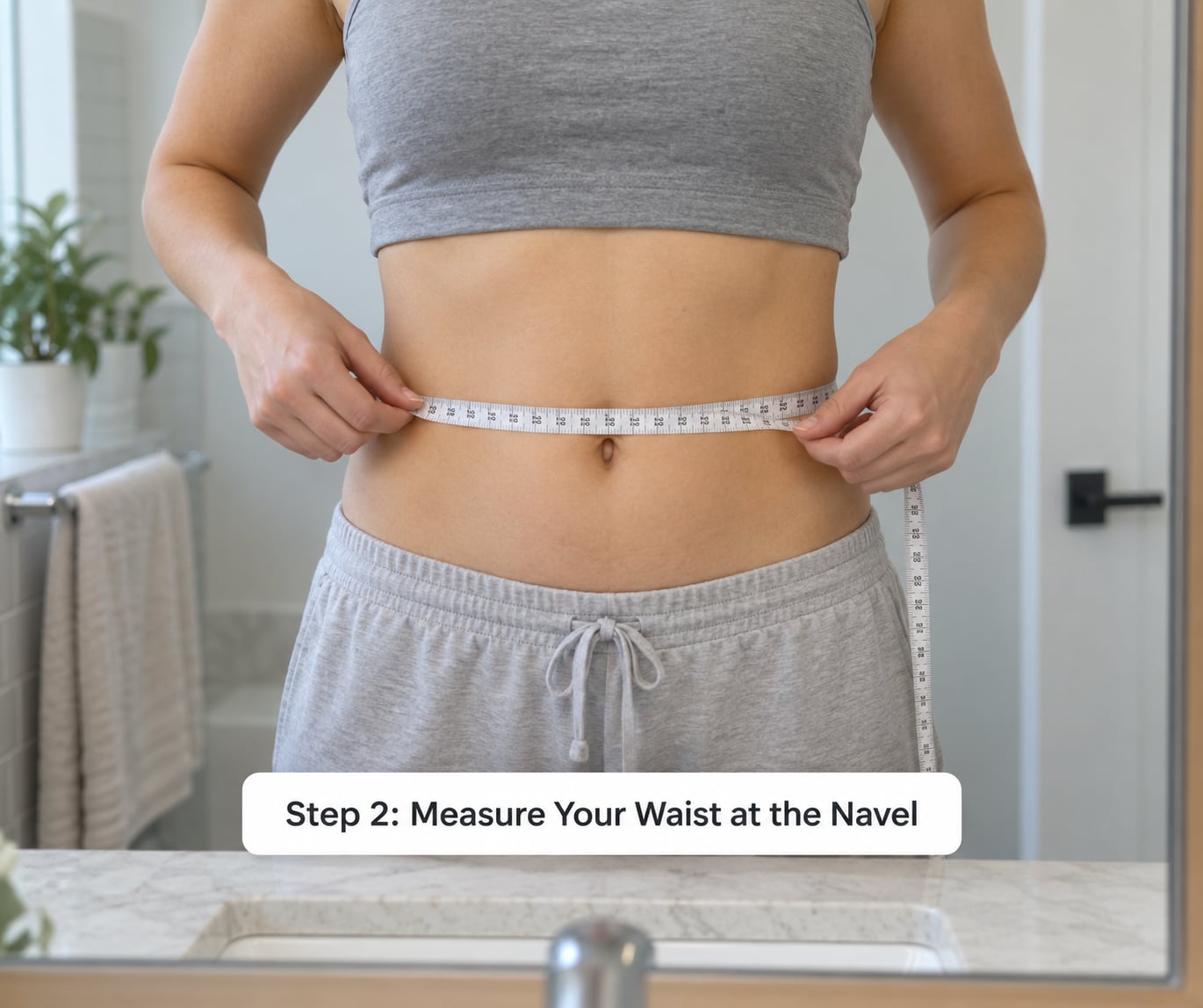
Stand relaxed with feet together, arms hanging at your sides, and breathe out normally. Do not pull the stomach in, because that changes the measurement you are trying to record.
For men, the measurement used in the Navy equation is the abdomen circumference at the navel. For women, it is the waist at the narrowest point between the rib cage and the hip bone, which sits above the navel. Either way, keep the tape horizontal, snug without digging into the skin, and take two readings.
The two most common errors here are measuring at the belly button on women and squeezing the tape tight enough to compress the fat underneath. Loose is bad too: a tape riding up your back gives a short reading.
Step 3: Measure Your Neck and Hip Circumferences
The neck measurement is taken just below the Adam’s apple, or the thyroid cartilage, so the tape sits above the shoulders and below the voice box. Keep it snug and keep the shoulders down.
Women also need a hip measurement, taken at the widest point of the buttocks, roughly level with the top of the pubic bone. If you measure at more than one spot and the numbers disagree, use the larger reading.
Note what the hip measurement is not: it is not the waist-to-hip ratio, which is a separate health marker comparing waist size against hip size. The Navy method needs the hip figure on its own. Take each reading twice and use the average.
Step 4: Calculate Your Estimated Body Fat Percentage
Both equations use log10, which is the base-10 logarithm. All measurements in a given calculation must be in the same units, and these equations were fitted to one unit system, so the result shifts noticeably if you mix inches and centimetres. Pick one, stay with it, and remember the number is an estimate rather than a medical measurement.
| Equation | Measurements needed | Variables |
|---|---|---|
| Men: BF% = 86.010 × log10(abdomen − neck) − 70.041 × log10(height) + 36.76 | Height, neck, abdomen | All lengths in the same unit |
| Women: BF% = 163.205 × log10(waist + hip − neck) − 97.684 × log10(height) − 78.387 | Height, neck, waist, hip | All lengths in the same unit |
A worked example for a man: height 71 inches, neck 15.5 inches, abdomen 35 inches. Abdomen minus neck is 19.5, log10 of that is 1.29003, and 86.010 multiplied by 1.29003 gives 110.96. Log10 of 71 is 1.85126, and 70.041 multiplied by that gives 129.66. The final line is 110.96 − 129.66 + 36.76, which comes to roughly 18% body fat.
For a woman: height 65 inches, neck 11.5 inches, waist 29 inches, hips 38 inches. Waist plus hip minus neck is 55.5, log10 is 1.74429, and 163.205 multiplied by that is 284.67. Log10 of 65 is 1.81291, and 97.684 multiplied by that is 177.08. The result is 284.67 − 177.08 − 78.39, or about 29% body fat.
Step 5: Check the Result and Track the Trend
Major published classifications split adult body fat into the following bands. They come from the American Council on Exercise framework and are useful orientation, not a scorecard.
| Classification | Men | Women |
|---|---|---|
| Essential fat | 2–5% | 10–13% |
| Athletes | 6–13% | 14–20% |
| Fitness | 14–17% | 21–24% |
| Average | 18–24% | 25–31% |
| Obesity | 25%+ | 32%+ |
So is 20% body fat still fat? For a woman it sits in the average band. For a man it is the top of fitness range. At 18%, a man is at the boundary between average and fit, and a woman is in the athlete band. The label matters less than the direction of travel.
Check your number every one to two weeks, under the same conditions, and only after you have at least three readings. Day-to-day swings are mostly water, food and digestion.
Step 6: Compare Your Estimate With Other Home Measures
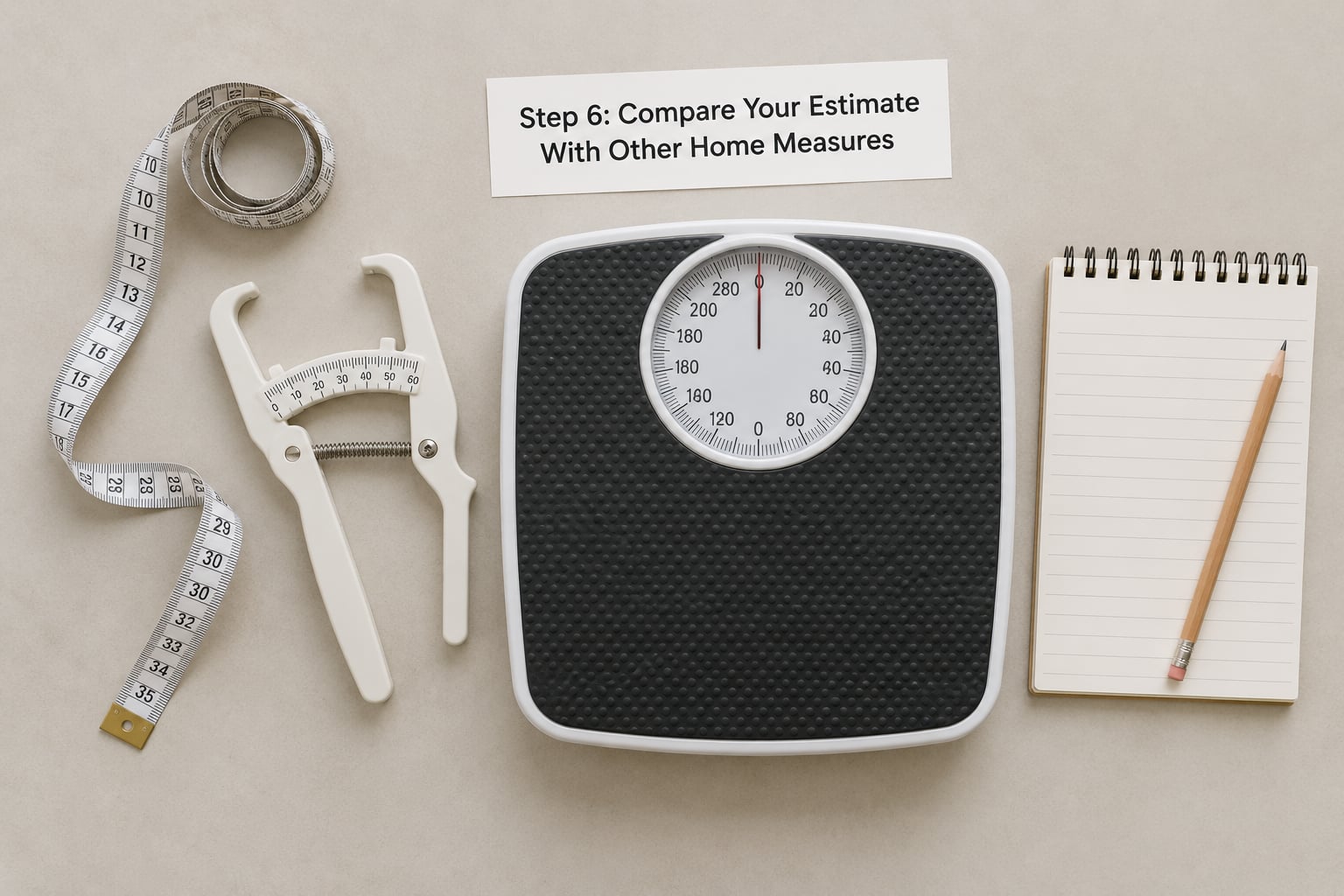
Here is how the home options stack up against a clinical DEXA scan, which is usually treated as the reference standard for body composition.
| Method | Typical accuracy | Skill needed | Cost category | Main limitation |
|---|---|---|---|---|
| Tape measure, Navy method | Within about 3–4 percentage points | Low after a few tries | Free or under a few dollars | Mismeasuring landmarks |
| Skinfold calipers | Within about 3–5 points at home | High | Low | Operator error dominates |
| Bioelectrical impedance scale | Roughly 3–8 points, highly variable | None | Low to moderate | Hydration and muscle mass skew results |
| DEXA or air displacement scan | Closest to clinical reference | None for the subject | Highest | Cost, availability, appointments |
No home method is exact. When you need precise clinical data, speak with a doctor or registered dietitian rather than trying to squeeze more precision out of a bathroom device.
Common Mistakes
- Compressing the skin. Pull snug, not tight. Digging in pushes fat aside and produces a smaller reading.
- Wrong waist location. Men measure at the navel, women at the narrowest point above it. Reversing the two shifts the result by several points.
- Wrong formula for your sex. The two branches are not interchangeable. Using the men’s formula on women’s measurements gives nonsense.
- Mixed units. Inches for height and centimetres for waist break every one of these equations.
- Measuring after food or dehydration. A long run, a high-salt dinner or a missed water bottle all move fluid and distort circumference readings.
- Reacting to single-day weight swings. A five-pound change on the scale says very little about fat. Your Navy estimate barely notices it, because the equation uses height and circumferences rather than weight, so the percentage moves only a fraction of a point for a five-pound loss.
Tips for a More Reliable Estimate
- Measure at the same time of day, ideally morning, fasted and after the bathroom.
- Use the same tape every time. A different tape changes the tension and the reading.
- Take each reading twice and average. If the two differ by more than a quarter inch, try again.
- Mark your landmark spots so you repeat them at exactly the same place. Body shape drifts as you lose fat.
- Judge multiweek trends. Two percent points over two months is signal; two percent points over two days is noise.
- Watch the waist-to-hip relationship alongside the percentage. Waist size carries its own health meaning.
If you want to see how a percentage turns into actual mass, multiply your weight in pounds by the decimal percentage. At 200 pounds and 25%, that is 50 pounds of fat and 150 pounds of lean mass. Drop to 190 pounds at 26% and you are at 49.4 pounds of fat, so the percentage ticked up while fat mass edged down. That happens, and it is why one number is never enough.
Frequently Asked Questions
How accurate is the US Navy body fat formula at home?
Expect an estimate within roughly three to four percentage points of a laboratory result for most adults, assuming careful measurements. Accuracy drops for people far from average height or weight, for muscular frames, and for very wide or very narrow bone structure. Treat the number as a trend tool rather than a lab value.
How often should I calculate my body fat percentage?
Every one to two weeks is enough, measured under similar conditions each time. Daily checks add stress and produce numbers dominated by water, food and digestion. Keep a simple log of date, weight and circumferences. Compare readings from four to six weeks apart, and only act when the direction is consistent.
Can a bathroom scale reliably measure body fat percentage?
A bioelectrical impedance scale estimates body fat by passing a weak current through the body, and hydration strongly affects the reading. Many people report swings of several points across a single day. It is fine for casual awareness, but it is the least trustworthy of the home methods, especially for muscular people.
Is a lower body fat percentage always better?
No. Each sex has an essential fat floor, roughly 2 to 5 percent for men and 10 to 13 percent for women, below which hormone production and organ function suffer. Pushing far below the fitness range usually costs muscle and energy rather than extra health. A sustainable range beats a record low.
When should I get body composition measured by a professional?
Book a professional assessment when you need precise clinical data, such as during a physician-directed programme, when weight loss stalls unexpectedly, or when you suspect visceral fat. A DEXA scan is the usual reference method. A doctor or registered dietitian can also interpret whether your percentage and waist size make sense for your health history.
Conclusion
Start tonight: weigh yourself, take neck, waist and hip readings twice each, run them through the equation for your sex, and write the result down with the date. Then do the same thing in two weeks under the same conditions.
Three or four weeks of consistent readings tell you far more than any single estimate ever will. Home body fat percentages are trend tools, not diagnoses, and they are most useful alongside how you feel, how your clothes fit and what your waist is doing.