To read a nutrition label for weight loss, work through it in a fixed order: serving size and servings per container first, then calories, then the % Daily Value column, then fiber, protein, added sugars, saturated fat and sodium, and finish with the ingredient list. Every number on that panel is tied to one serving, so the serving size is the number that makes all the others true or useless.
It takes about two minutes per package once you know the order. The hard part is not the reading, it is the serving sizes: on most packaged food, the printed serving is smaller than what a normal person eats. A chip bag listing 150 calories per 28 g serving with 2.5 servings per container turns into 375 calories if you finish the bag. That gap, repeated across a day, is where a calorie deficit quietly becomes a surplus.
Table of Contents
- What You Need
- Step-by-Step: How to Read a Nutrition Label for Weight Loss
- Check the Serving Size and Number of Servings First
- Compare the Calories for the Amount You Will Eat
- Use Total Fat, Saturated Fat, and Unsaturated Fat
- Evaluate Sodium, Carbohydrates, and Added Sugars
- Look for Protein and Fiber
- Check the Percent Daily Value Column
- Read the Ingredient List as a Final Check
- Compare Two Foods Using the Same Amount
- Common Mistakes When You Read a Nutrition Label for Weight Loss
- Frequently Asked Questions
- How many calories should I eat to lose weight?
- Are low-fat or low-calorie foods better for weight loss?
- Does 0 grams of trans fat mean a food is always healthy?
- Is Percent Daily Value the same as a daily calorie goal?
- Do organic or natural nutrition claims make a food healthier?
- When should I ask a doctor or registered dietitian for nutrition help?
- Conclusion
What You Need
You need the package itself and about two minutes. That is genuinely the whole equipment list.
Helpful extras, if you have them:
- A serving-size reference such as a measuring cup, a kitchen scale, or a standard measuring spoon set, so a listed serving matches a real amount on your plate.
- A food diary or calorie-tracking app if you are counting. A label is only useful if the number ends up somewhere you will look again tomorrow.
- A second package for the comparison step at the end of the process. Comparing is where the label reading actually pays off.
No lab equipment, no calculator app, no special software. If a food claims to be healthy and the label is the only evidence on the front, the panel is the evidence.
Step-by-Step: How to Read a Nutrition Label for Weight Loss
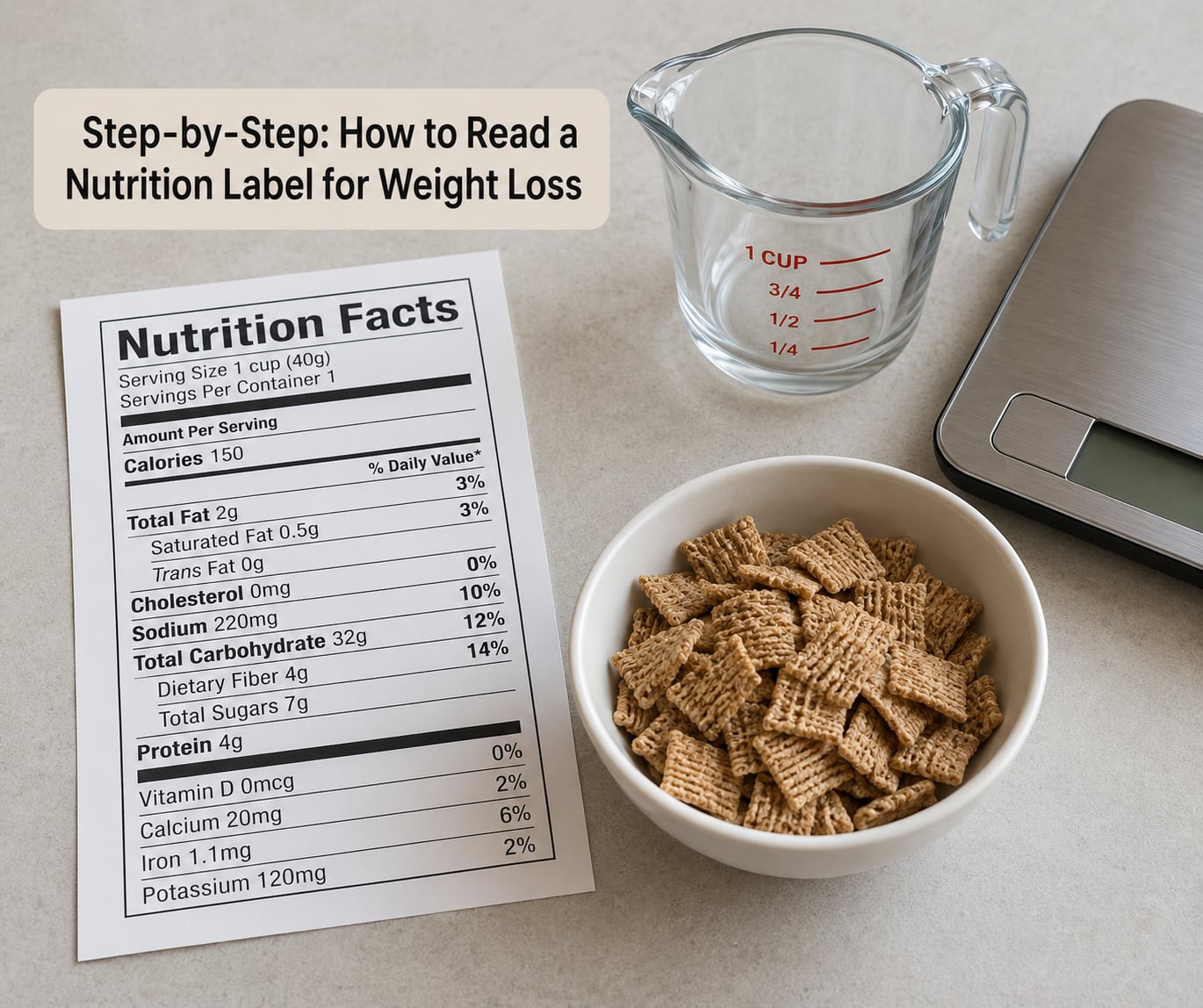
Read the panel from the top down, in the order below, and stop at each step long enough to make a decision rather than a reaction. Steps 1 and 2 do most of the work; the rest narrow the choice.
Check the Serving Size and Number of Servings First
Serving size is the amount of food all the numbers below it describe, and servings per container tells you how many of those amounts are in the package. Multiply the two and you get what the whole package holds.
Two things trip people up here. First, a listed serving is not automatically a portion anyone would choose to eat. Second, on a bag or a tub with a small serving size, the container count tells you how many times you would have to eat that serving to clear it. If a bag says 2.5 servings and you finish the bag in one sitting, you ate 2.5 servings, and every other line multiplies by 2.5 too.
Some packages carry two panels, one for a single serving and one for the whole package. Under FDA rules for packages that could reasonably be finished in one sitting, the per-package panel is right there so you do not have to multiply. When you see two panels, use the one that matches what you are about to eat.
Compare the Calories for the Amount You Will Eat
Multiply calories per serving by the number of servings you actually plan to eat, then compare that number with what you are trying to fit into your day.
Say a cereal lists 140 calories per 1 cup serving, and you eat two cups. That is 280 calories, not 140. A dressing listed at 90 calories per 2 tablespoons is 180 if you use a quarter cup. The arithmetic is not complicated; people just skip it because the panel already did the multiplication for them.
Calories matter because weight loss generally requires eating fewer calories than your body uses, but the number that matters is your personal total, not someone else’s. A daily target is individual, and calorie needs vary with body size, activity, age and health. What the label gives you is a reliable per-portion number you can plan around.
If your tracking app shows a number that disagrees with the package by a lot, the package is usually right. Apps rely on crowdsourced database entries, and the manufacturer measured the food in a lab.
Use Total Fat, Saturated Fat, and Unsaturated Fat
Total fat is the whole fat content of one serving, saturated fat is the portion that comes mainly from animal fats and tropical oils, and trans fat is the industrial kind that does not need to be listed in grams at all.
Saturated fat deserves the most attention. FDA sets its Daily Value at 20 g on a 2,000-calorie diet, so 20% DV or more is high. Trans fat counts as the worst offender because even small amounts matter, and a label that says 0 g trans fat can legally declare anything under 0.5 g per serving as zero. Ingredients ending in “partially hydrogenated oil” are the thing to scan for instead.
Total fat on its own is not a verdict. A food with 10 g of total fat can be mostly olive oil, nuts or seeds, or it can be a blend of tropical oil and sugar. Saturated fat and the ingredient list tell you which one you are looking at. A food that is higher in fat but low in sugar and refined starch will often sit better in a weight-loss pattern than a low-fat product loaded with added sugar, because fat slows digestion and the sugar does not.
Evaluate Sodium, Carbohydrates, and Added Sugars
Look at all three for the portion you will eat, with added sugars getting the closest attention because that line only appeared on US labels in 2016 and it separates added sweetener from the natural sugar in fruit and plain milk.
Added sugars carry a Daily Value of 50 g, roughly 12 teaspoons on a 2,000-calorie diet. Anything at 20% DV or more, meaning 10 g per serving or more, is a large share of that daily ceiling. Total sugars includes the added portion plus any sugar that came in with the fruit, vegetables or milk itself, which is why a plain cup of milk shows sugar with zero added sugars beside it.
Sodium has a Daily Value of 2,300 mg, and it hides in sauces, soups, breads, canned goods and condiments where nobody expects it. A 400 mg serving is a fifth of the daily figure before you add the rest of the day. It is worth knowing that high sodium can make you look heavier on the scale through water retention, and people often mistake that for a fat-loss stall.
Carbohydrate needs a similar portion check. Under 5% DV, a serving is low; at 20% DV or more, it is high. Total carbohydrate includes fiber, so subtracting fiber is how “net carbs” figures on the front of a package are usually derived. Check the net figure against the real one before you trust it.
Look for Protein and Fiber
Protein and fiber are the two numbers to actively seek out, because they do most of the work of keeping you full on relatively few calories.
Protein’s Daily Value is 50 g. As a per-serving target while reading labels, 10 g or more gives you something substantial, and protein supports fullness and helps protect lean mass while eating in a calorie deficit. Fiber’s Daily Value is 28 g, and 3 g to 5 g per serving is a reasonable bar for a snack or breakfast food. Higher is usually better if the food is one you actually enjoy eating.
There is a quick test that costs no mental effort: grams of fiber and protein against calories. A 200-calorie food with 8 g of protein and 6 g of fiber does far more for satiety than a 200-calorie food with 2 g of each. Nutrient density is the phrase for that ratio, and it is a better guide than the calorie number alone.
None of this means tracking macros to the gram or hitting rigid targets. The point is choosing between two similar products, not building a spreadsheet for breakfast.
Check the Percent Daily Value Column
Percent Daily Value is a shortcut built on a 2,000-calorie diet, and 5% DV or less is low while 20% DV or more is high. Those two thresholds are on the panel already, which saves you doing the division yourself.
Use this table while you shop. It is a weight-loss-specific version of the whole panel.
| Line on the label | Look for | Limit | Why it matters |
|---|---|---|---|
| Calories per serving | Enough to fit your day | 100 calories per serving for a snack | Sets the calorie budget for the whole meal or sitting |
| Dietary fiber | 3-5 g or more per serving, 20% DV or more | Under 3 g per serving | Fiber drives fullness and steadier energy |
| Protein | 10 g or more per serving | Under 5 g per serving | Supports satiety and lean mass in a deficit |
| Added sugars | Under 5 g per serving, under 10% DV | 10 g or more per serving, 20% DV or more | Added sugar arrives with calories and little else |
| Saturated fat | Under 10% DV | 20% DV or more | High saturated fat travels with more calorie-dense foods |
| Trans fat | 0 g, no partially hydrogenated oils | Any hydrogenated oil in the list | The one fat worth treating as a hard red flag |
| Sodium | Under 140 mg per serving, under 5% DV | 400 mg or more per serving | Easy to overeat across sauces and packaged meals |
| Total sugars | Compare against the added sugars line | A high total with low added means fruit or milk | Tells you whether the sugar came in with the food or was added to it |
Two limits on the %DV column are worth knowing. It is a minimum set to prevent nutrient deficiency, not a target to hit, and every figure is calculated against a 2,000-calorie diet whether you eat 1,500 or 2,400 calories. And %DV sits on the right-hand side, so you have to go looking for it; the left side of the panel is grams and milligrams only.
Because the numbers are rounded, a 0 g line may mean anything below 0.5 g, and calories under 5 are allowed to be shown as 0. Small amounts do not vanish from the label, they just disappear from the number. Across several servings a day, several small rounds add up.
On a label that lists every nutrient as 0% DV, the food is not automatically fine. It may simply be a small serving of something that contributes almost nothing, which is a different problem.
Read the Ingredient List as a Final Check
Reading a nutrition label for weight loss ends with the ingredient list, because it explains what the numbers above are made of. Ingredients are listed by weight, from most to least, so the first three are the bulk of the product.
What to scan for:
- Sugar in disguise. Look for added sugar under its many names: cane sugar, high fructose corn syrup, dextrose, fructose, corn syrup, maltose, honey, agave, molasses, fruit juice concentrate. If one of those is first or second, the food is largely sweetener.
- Refined grains. Enriched flour, white flour and refined starches deliver carbohydrate with far less fiber than the whole-grain version of the same food.
- Sodium sources. Salt, sodium phosphate, monosodium glutamate, soy sauce, cured items. If salt sits high on the list, expect a high sodium number.
- Hydrogenated or partially hydrogenated oils. These are the industrial trans fats that a 0 g line cannot show you.
- A short list in general. Fewer than five ingredients is a rough, imperfect signal of a less processed food. It is a clue, not a verdict.
Whole foods listed first is a good sign, but order alone does not decide whether a food belongs in your diet. Olive oil listed first on a cracker still means a cracker. Use the list to understand the panel, and the panel to check the front-of-package story.
If a label is missing something you are avoiding for allergy, intolerance or religious reasons, treat it as a warning. Not every product is labeled for every allergen, and the contains statement in the US covers the major tree nuts, peanuts, wheat, soy, milk, eggs, fish, shellfish and sesame.
Compare Two Foods Using the Same Amount
Put two similar products side by side and compare them for the amount you would actually eat, not for whatever serving each company chose. That is the whole skill in one exercise.
Start with the top. If one product lists 100 calories per half cup and the other lists 150 per cup, the numbers are not comparable yet. Normalize them to the same amount, the easiest being per 100 g. Take the 100-calorie cereal at 45 g per serving: 100 calories divided by 45 g gives roughly 2.2 calories per gram, so 100 g is about 222 calories. Do the same for the second cereal and the two are finally on equal footing.
Then work down the same list for both: calories, fiber, protein, added sugars, saturated fat, sodium, and finally the first three ingredients. Write the two side by side. Nine of ten times the answer is obvious, and it is almost never the one with the claim on the front.
If one is close to a tie, that is a real result, not a failure of method. Pick the one you would rather eat again, because a food you keep eating is worth more than a marginally better label you reject once.
Common Mistakes When You Read a Nutrition Label for Weight Loss
Trusting the listed serving size. The serving is a standardized reference amount set by the manufacturer, not a portion anyone decided to eat. Fix: before you touch the food, look at servings per container and multiply.
Judging a food on calories alone. Two foods at 200 calories can leave you completely differently satisfied, depending on protein, fiber and how much water they carry. Fix: look at calories last, after the numbers that drive fullness.
Treating %DV as a pass or fail score. A 0% DV panel is not a green light. Fix: use 5% and 20% as markers for individual nutrients, and read several lines together rather than hunting for a perfect panel.
Believing the front of the package. Organic, natural, gluten-free, low-fat, keto, high-protein and plant-based describe how a food was made or what it excludes, not how many calories are in the portion you will eat. Fix: ignore the claims until the panel has given you its version. Check whether the company has to meet a legal standard for that claim, because some do and most do not.
Confusing a dietary restriction with a weight-loss rule. Gluten-free and organic are about ingredients and production methods, not calories. Fix: judge a food on the numbers that affect energy intake and fullness, and let the label’s other lines speak for whatever else you care about.
Reading labels only in the aisle. A food chosen in ten seconds is a food you will not think about again. Fix: build a short list of staples that hit your fiber and protein targets, then check the panel only when you are trying something new.
Quick habits that take almost no time: read the serving size before anything else, glance at the added sugars line, and skip the front of the package entirely. Those three checks catch most of what matters.
Frequently Asked Questions
How many calories should I eat to lose weight?
There is no single number that works for everyone, and any label-reading guide that gives you one is oversimplifying. A calorie deficit means eating fewer calories than your body uses in a day, and how many that is depends on your body size, activity level, age and health. The label cannot tell you the figure. What it can do is give you accurate calories for a real portion, so you can build a day you control. If you want a number built for you, ask a doctor or a registered dietitian.
Are low-fat or low-calorie foods better for weight loss?
Not automatically. Low-fat products often replace fat with refined starch or added sugar, so they can deliver the same calories with less of what makes food filling. A low-calorie claim also tells you about one serving, and those serving sizes are often smaller than what people actually eat. Compare two products on the portion you will eat and look at fiber and protein alongside calories. That is a more reliable basis for the choice than the claim on the front.
Does 0 grams of trans fat mean a food is always healthy?
No. Under FDA rounding rules, anything under 0.5 g per serving can be declared as 0 g, so a zero line is not always a literal zero. It also says nothing about the rest of the panel. A product with 0 g trans fat can still be high in calories, added sugars or sodium. If you are checking for industrial trans fats, scan the ingredient list for partially hydrogenated oil, which is the more reliable signal.
Is Percent Daily Value the same as a daily calorie goal?
No. Percent Daily Value is a nutrient reference calculated on a 2,000-calorie diet, set at levels intended to prevent deficiency, not to describe an optimum intake. It is a percentage of a nutrient target, not a percentage of your calorie budget, and it stays the same whether you eat 1,500 calories or 2,400. Use 5% DV or less as low and 20% DV or more as high, and remember the column sits on the right side of the panel.
Do organic or natural nutrition claims make a food healthier?
Neither claim changes the calories, the serving size or the added sugars, so on their own they do not make a food better for weight loss. Organic is a production standard about how ingredients were grown and processed, and natural is a looser marketing term with no calorie content. Both are useful if you care about farming practices or specific ingredients, and for people with allergies or sensitivities. For a calorie goal, read the Nutrition Facts panel instead.
When should I ask a doctor or registered dietitian for nutrition help?
Ask whenever you have a medical condition, take regular medication, are pregnant or breastfeeding, have a history of disordered eating, or are managing diabetes, kidney disease, high blood pressure or high cholesterol. Those situations change what sodium, added sugars, carbohydrate and saturated fat mean for you, and a label rule of thumb may not fit. A registered dietitian can also help if you have tried reading labels and still feel lost. This guide is general education, not personal nutrition advice.
Conclusion
Here is the whole process in five moves. Check the serving size and how many servings are in the package. Multiply the calories for the portion you will actually eat. Scan the % Daily Value column for fiber, protein, saturated fat, sodium and added sugars, aiming for 5% as low and 20% as high. Then read the ingredient list and see whether the first three entries match what the numbers imply. Finally, ask whether this food fits the pattern you eat most days, because a label tells you about one package, not about your week.
Two minutes per package, in a consistent order, beats a perfect plan you do not follow. If you are working with a medical condition, take regular medication, or have a history of disordered eating, talk to a doctor or a registered dietitian before changing what you eat, and get urgent help for any warning sign.