Hidden sugar is added sugar that never uses the word “sugar” on the package. It sits in the ingredients list under names like corn syrup, dextrose, fructose, sucrose, cane juice, fruit juice concentrate, honey, agave nectar or maltodextrin, and it gets quantified on its own line of the Nutrition Facts panel. Since US labels have carried a separate Added Sugars line under the FDA’s 2016 rule, learning how to spot hidden sugar in packaged foods takes about thirty seconds a package.
The trick is doing the same three things in the same order every time, so you stop reading the front of the pack first. Turn it over, match the serving size to what you would actually eat, then read Added Sugars. Only after that do you touch the ingredients list.
A note before we start: this is general label-reading information for adults. If you are managing diabetes, blood sugar or cholesterol, your targets may be tighter than the ones below, so take your personal numbers to a registered dietitian rather than using a general guideline.
Table of Contents
- What You Need: Three Label Areas and One Small Calculation
- Step-by-Step: Six Checks on Any Package
- Step 1: Check the Serving Size and Servings per Container
- Step 2: Find Total Sugars and Added Sugars
- Step 3: Scan the Ingredients for Sugar Aliases
- Step 4: Identify Different Forms of Added Sugar
- Step 5: Treat Front-of-Pack Claims as a Starting Point
- Step 6: Compare Similar Products Before Buying
- Common Mistakes That Leave Sugar Unnoticed
- Frequently Asked Questions
- How can I identify hidden sugar in food labels?
- How can I tell if sugar is the main ingredient?
- What are the most common names for sugar on an ingredient list?
- Which foods hide the most added sugar?
- What does no added sugar or sugar free actually mean?
- What is the FDA’s guidance for added sugars on food labels?
- What to Do on Your Next Shop
What You Need: Three Label Areas and One Small Calculation
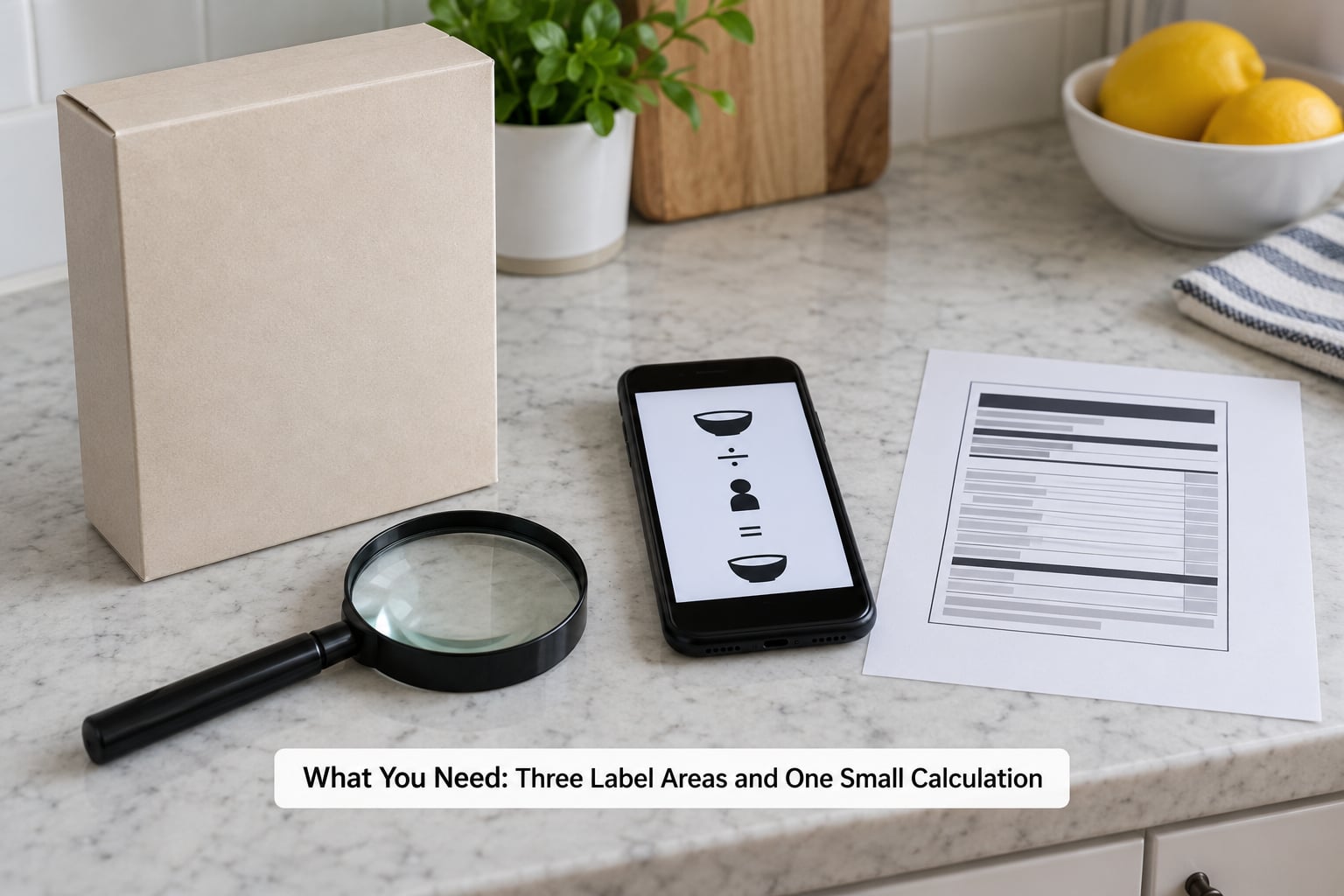
You need the back of the package, your own serving size in mind, and roughly thirty seconds. That is genuinely the whole toolkit.
Three areas of the package matter, and they answer different questions:
- Serving size and servings per container. These are the top two lines of the Nutrition Facts panel. They tell you what the numbers on the rest of the panel actually describe.
- The Added Sugars line. This sits under Total Carbohydrate, at the bottom of the carbohydrate block. It is the single most useful number on any US packaged food label.
- The ingredients list. That is where the aliases live. The ingredients list tells you whether sugar is the main ingredient, and under what names it hides.
A phone calculator is genuinely useful for one thing: normalizing a label to per 100 grams so two products with different serving sizes can be compared fairly. Any bag of sugar you own is a shortcut to the other conversion, which is that 4 grams of added sugar is about one teaspoon. That number is worth committing to memory.
One distinction to hold onto before you start. Total Sugars includes both added sugar and sugar that arrives naturally with fruit, milk and vegetables. Added Sugars is only the sugar put in during processing, and it is the line that matters when you are trying to cut back. Whole fruit and plain milk are not the problem here.
Step-by-Step: Six Checks on Any Package
Step 1: Check the Serving Size and Servings per Container
Compare the printed serving size against the amount you would realistically eat. A cereal box listing 30 g per serving is honest; whether it matters depends on whether you pour 30 g or the 60 g you actually pour on a busy morning.
Then multiply. If the panel says 11 g added sugars per serving and the container holds 2.5 servings, the whole box carries about 27 g. If you were planning to eat the box, that is the number that counts.
The same math catches a trick that catches nearly everyone: a small serving size. Many cereals, crackers and snack mixes list a serving small enough to make the added sugar figure look modest. It is not lying, but it is not what you are eating either.
Step 2: Find Total Sugars and Added Sugars
The Added Sugars line is the second-to-last line of the carbohydrate section, right above Protein. It was added to US labels under the FDA’s 2016 nutrition labeling rule, and it tells you the grams of sugar that were added during manufacturing.
Do not confuse it with the older Total Sugars line, which lumps in natural sugar. For a bowl of fruit or a glass of milk, that natural sugar is part of the food, and the Added Sugars line will read zero.
The percentage next to it is the % Daily Value, and it is a benchmark rather than a cap. The FDA set the Daily Value for added sugars at 50 g, about 12 teaspoons. Treat it as a reference point for how much one serving contributes, not as a personal allowance.
Step 3: Scan the Ingredients for Sugar Aliases
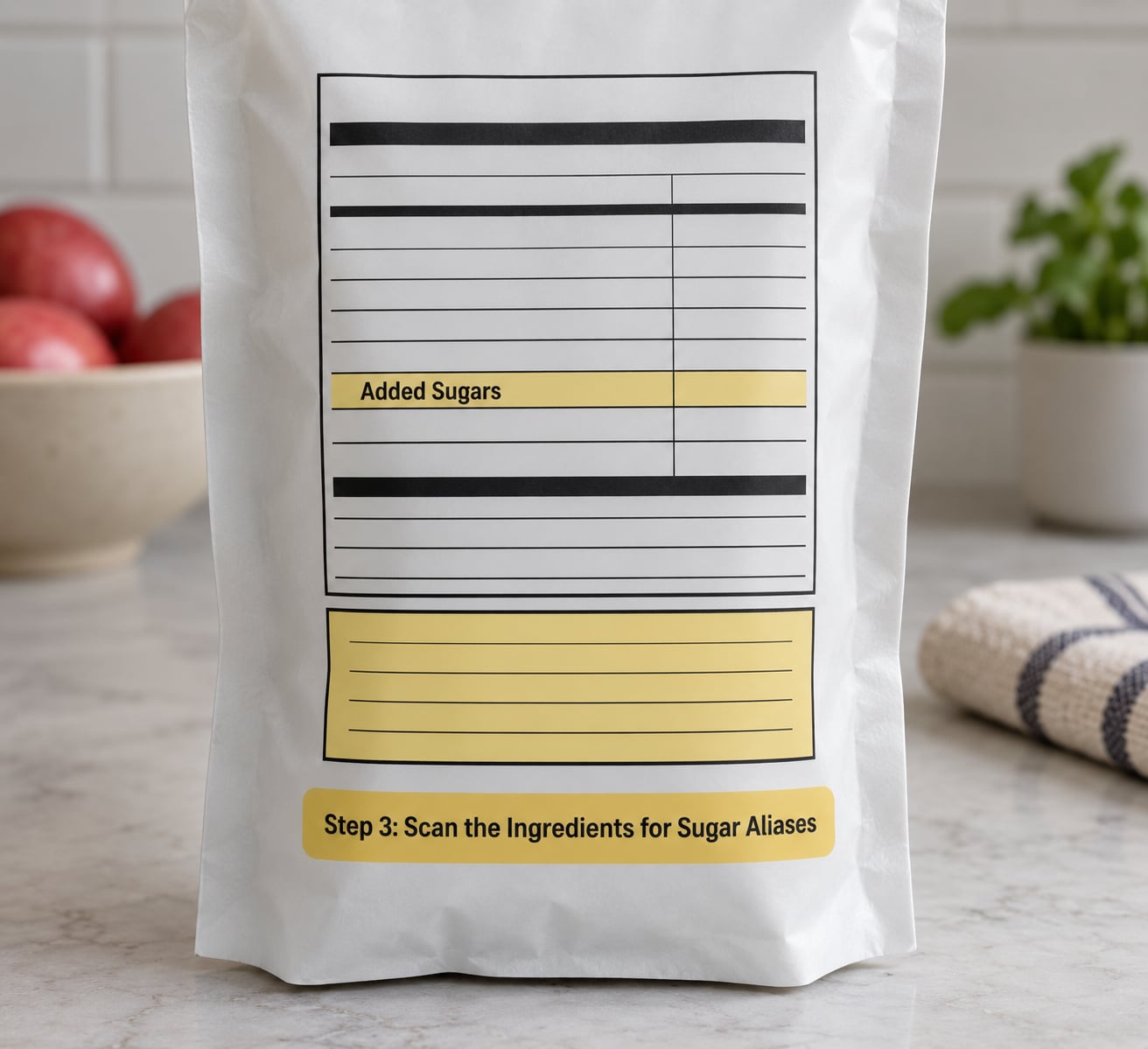
Ingredients are listed in descending order by weight, and that order is the most useful tell nobody uses. If any sugar name appears in the first two or three ingredients, sugar is one of the largest things in the package by weight.
If it appears in the seventh slot, behind whole oats, cocoa and salt, the amount is small and you can move on.
Here is the cheat sheet. Grouped by pattern, it is far quicker to scan than a flat list of sixty names:
| Naming pattern | Names you will see | What it is |
|---|---|---|
| Ends in -ose | dextrose, fructose, glucose, sucrose, maltose, galactose, mannose | Refined sugar under a chemical-sounding name |
| Contains syrup | corn syrup, high-fructose corn syrup, corn syrup solids, brown rice syrup, rice syrup, sorghum syrup, malt syrup, barley malt syrup, cane syrup, refiner’s syrup | Liquid or powdered starch sugar |
| Contains sugar | cane sugar, raw sugar, brown sugar, turbinado sugar, muscovado, panocha, grape sugar | Unrefined or partly refined cane sugar |
| Nectar, honey, molasses | honey, agave nectar, molasses, treacle, maple syrup, date syrup, cane juice, dehydrated cane juice | Sweeteners that sound wholesome and count the same |
| Juice concentrate | fruit juice concentrate, apple juice concentrate, pear juice concentrate, fruit nectar, grape juice concentrate | Concentrated fruit sugar used as a sweetener |
| Starch and blends | maltodextrin, dextrin, glucose-fructose syrup, crystalline fructose, maltitol, sorbitol, erythritol | Starch sweeteners and sugar alcohols |
Agave nectar, raw sugar, coconut sugar and date sugar appear in the natural-sounding row because that is exactly how they are marketed. On a US label they still count as added sugar, because they were added during processing.
Step 4: Identify Different Forms of Added Sugar
Not all sugar lists as sugar. Some packages contain it under a name that neither contains “sugar” or “syrup” nor ends in -ose, which is why scanning for those three patterns alone still misses things.
Watch for three specific forms. Dried fruit ingredients such as raisins, dates and concentrated apple juice in a granola bar are naturally occurring sugar that arrives concentrated. Protein and fiber blends like inulin and polydextrose are bulking agents rather than sweeteners, so they sit in a different category. Sugar alcohols, listed by the ending -itol or named erythritol, are the ones behind most zero-sugar claims.
The FDA counts sugar alcohols in Total Sugars but not in Added Sugars. That is why a product can say zero added sugar and still list sorbitol or erythritol among its ingredients.
Step 5: Treat Front-of-Pack Claims as a Starting Point
Front-of-pack claims tell you what a manufacturer wants you to notice, which is rarely what you need to know. Decode them before you trust any of them.
| Claim on the pack | What it actually means | What to do |
|---|---|---|
| No added sugars | No sugar was added during processing. Natural sugar from fruit or milk concentrate can still be 20 g or more. | Check Added Sugars and the ingredients list anyway |
| No sugar added | Almost identical to no added sugars. It says nothing about total sugar. | Treat it as a starting point, not an answer |
| Sugar free | Less than 0.5 g of sugar per serving, so it can still be sweet via sugar alcohols or non-nutritive sweeteners. | Read the ingredients for what is doing the sweetening |
| Made with real fruit | Refers to the fruit included, not the sugar added. Fruit concentrates count as added sugar. | Look for added sugar in grams |
| No high fructose corn syrup | The sugar is there under a different syrup name. | Search the list for syrup and -ose endings |
| Lightly sweetened | No regulatory limit. It can still be a meaningful number of grams. | Use the Added Sugars line, not the adjective |
| Natural, organic, whole grain, fat-free | None of these carry a sugar limit. Fat-free versions often add sugar to replace texture. | Read the label as if the claim were not there |
None of this means these products are bad. It means the adjective on the front is marketing, and the panel on the back is measurement.
Step 6: Compare Similar Products Before Buying
Set the two packages side by side and compare the same line. Added sugars per serving is the fair comparison; comparing grams while ignoring serving size is not.
Then normalize when the serving sizes differ. Divide the added sugar by the serving weight in grams, then multiply by 100. A cereal with 8 g added sugar in a 30 g serving works out to about 27 g per 100 g. A granola bar with 12 g in a 55 g bar works out to about 22 g per 100 g.
Once normalized, the per-100 g number is where thresholds become useful. Under 5 g per 100 g is a low-sugar choice in ordinary eating. Between 5 and 15 g per 100 g is fine occasionally and worth watching if you eat a lot of it. Above 15 g per 100 g is a sugar-forward product dressed as something else, and a label alone will not tell you which one it is.
Readers in the UK and EU will not have an Added Sugars line. Those labels use a separate per-100 g added sugar figure and a traffic-light pictogram on the front, which is easier to read than anything on a US package.
Common Mistakes That Leave Sugar Unnoticed
Judging by taste. Sugar in a savory product tastes like balance, not sweetness. Bread, pasta sauce, ketchup, barbecue sauce, salad dressing, salsa, glaze and marinades routinely carry added sugar for browning and preservation, and you will not taste it.
Reading Total Sugars instead of Added Sugars. This one is usually harmless in the other direction. It makes whole fruit and plain yogurt look worse than they are, which leads people to avoid foods that do not need avoiding.
Ignoring the container count. A 6 g per serving number on a package with three servings is an 18 g package, and crackers and snack mixes rarely get eaten in servings.
Assuming no added sugar means no sugar. The single most misunderstood claim on packaged food. A product with no added sugar can still carry 20 g or more of naturally occurring sugar from concentrated fruit, and concentrated fruit is added sugar under the FDA definition anyway.
Skipping the back of the pack. The most common pattern I see is a decision made on the front and confirmed on the back. Reverse the order and the whole check becomes reliable.
For reference, the American Heart Association suggests 25 g of added sugar a day for women and 36 g for men, which is roughly 6 and 9 teaspoons. UCSF’s SugarScience project reports added sugar in about 74% of US packaged foods, so the limit is easy to pass before you touch dessert.
Long-term intake above the recommended range is associated with weight gain, type 2 diabetes, heart disease, fatty liver and tooth decay. If you are worried about where you stand, a doctor or registered dietitian can look at your actual intake with you.
Frequently Asked Questions
How can I identify hidden sugar in food labels?
Look at three places on the back of the package. First, check the serving size and multiply by the servings per container. Second, read the Added Sugars line under Total Carbohydrate for grams per serving. Third, scan the ingredients list for names ending in -ose, containing syrup or sugar, or naming a nectar, juice concentrate or honey. Ingredients are listed in descending order by weight, so a sugar name in the first three positions means sugar is one of the largest ingredients.
How can I tell if sugar is the main ingredient?
Read the ingredients list in order. Ingredients appear from most to least by weight, so if sugar appears under any name in the first two or three slots, it is one of the largest ingredients in the product by weight. That is true even when the label never uses the word sugar, which is why the alias patterns matter. A sugar name sitting in the seventh slot or later, behind whole grains and salt, means the amount is small.
What are the most common names for sugar on an ingredient list?
The most common patterns are endings in -ose such as dextrose, fructose, sucrose and maltose, and anything containing syrup such as corn syrup, brown rice syrup or sorghum syrup. Also look for cane sugar, raw sugar, brown sugar, turbinado sugar, honey, agave nectar, molasses, treacle, maple syrup, cane juice, fruit juice concentrate and maltodextrin. Across US packaged food there are more than sixty names in regular use, which is why pattern recognition beats scanning word by word.
Which foods hide the most added sugar?
Sugar-sweetened drinks sit at the top, and liquid forms of sugar are consumed faster and feel less sweet than the same amount in solid food. Then come breakfast cereal, granola, flavored yogurt, protein and snack bars, granola bars marketed as real fruit and whole grains, salad dressing, barbecue sauce, ketchup, bread and pasta sauce, and instant oatmeal. Savory items rarely taste sweet, so most people never suspect them.
What does no added sugar or sugar free actually mean?
No added sugar and no added sugars mean no sugar was added during processing, but naturally occurring sugar from fruit or dairy concentrates can still be high, and those concentrates often count as added sugar anyway. Sugar free means less than 0.5 g of sugar per serving, so the product can still be sweet through sugar alcohols such as erythritol, sorbitol or maltitol. None of these three claims tells you the total sugar figure. Read the panel.
What is the FDA’s guidance for added sugars on food labels?
Under the FDA’s 2016 nutrition labeling rule, packaged foods must declare added sugars separately from total sugars on the Nutrition Facts panel, and added sugars carry their own percent Daily Value. The rollout extended to smaller manufacturers over several years after that. The Daily Value printed next to added sugars is a benchmark, not a personal limit, and the FDA set it at 50 grams for adults, roughly 12 teaspoons.
What to Do on Your Next Shop
Turn the package over first, match the serving size to what you would eat, and read the Added Sugars line before you read anything printed on the front. If sugar appears in the first three ingredients, put it back or find the plain version of the same product; that single habit removes more added sugar than anything else you can do in a week.
This guide reflects US Nutrition Facts labeling. If you are managing a health condition, talk with your doctor or a registered dietitian about your own targets.