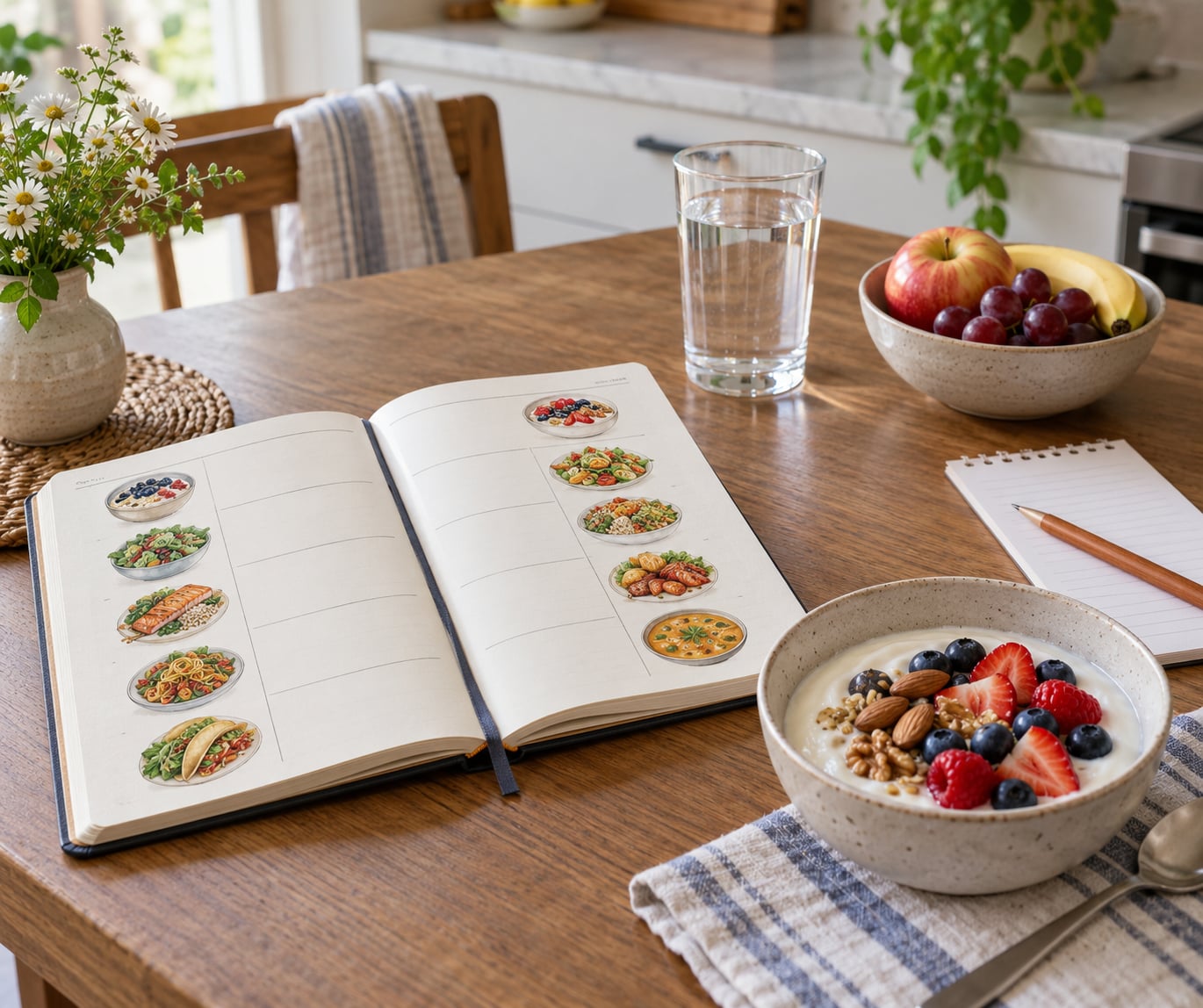
To stop binge eating on weekends, you build the fix on a Wednesday rather than waiting for Saturday night: plan the weekend meals and snacks, know which triggers set the episode off, keep a rough structure across the two days, and build in a ten-minute pause before you eat on autopilot. Most weekend binges are not a hunger problem. They are the rebound from a week of strict rules, and the plan below takes about twenty minutes to set up and works even if you are not tracking calories.
That matters more than it sounds, because the pattern most people describe is remarkably consistent. You track cleanly Monday to Friday, you feel good about it, and then Friday evening arrives with no plan and no hunger, and by Sunday night you feel bloated, guilty and oddly determined that Monday will be different again. That cycle is what this guide is built to break.
Table of Contents
- What You Need
- How to Stop Binge Eating on Weekends Step by Step
- Step 1: Build a Reliable Weekend Eating Plan
- Step 2: Identify the Triggers Behind the Binge
- Step 3: Create a Structured Weekend Routine
- Step 4: Use a Pause Before Reaching for Food
- Step 5: Recover Without Turning One Episode Into Another
- Common Binge-Eating Triggers and What to Do
- Common Mistakes
- Treating the weekend as a cheat day
- Restricting hard all week to compensate
- Starting the fix on Monday
- Making the plan perfect
- Responding to a slip with punishment
- Frequently Asked Questions
- Why do I eat so much on weekends?
- What is the 3-3-3 rule for eating?
- How do I maintain a diet on weekends?
- Will a weekend of overeating ruin my progress?
- Is weekend overeating a sign of binge eating disorder?
- How do I stop craving sweets on weekend evenings?
- Conclusion
What You Need
You need four things ready before the pattern starts, not after. None of them costs money or requires an app, and you can set all four up in one sitting on a Wednesday evening.
- A short trigger list. The specific situations, times and feelings that have preceded past binges. Most people find three or four repeat offenders, and they are rarely actual hunger.
- Planned meals and snacks for Saturday and Sunday. Not a diet, just decided in advance so you are not choosing from an open cupboard at nine at night. Include one deliberately satisfying item, because a plan that only contains foods you dislike will not survive contact with a real weekend.
- A rough weekend routine. Meals at roughly set times, one planned activity, one thing you look forward to. Structure is what keeps most people out of the couch-and-snacking loop.
- One non-food move for when it starts. A ten-minute walk, a shower, a phone call to someone, a glass of water, a short breathing exercise. Decided now, while you are calm, because improvising coping in the moment is the hard part.
If you take only one thing from that list, take the trigger list. Almost everything downstream gets easier once you know your actual trigger, because the response changes completely. A boredom trigger needs an activity. A stress trigger needs a different coping skill. Alcohol needs a limit. Treating all of them as hunger is why so many attempts quietly fail by Sunday.
How to Stop Binge Eating on Weekends Step by Step
Step 1: Build a Reliable Weekend Eating Plan
Write down what you will eat on Saturday and Sunday before the weekend starts, including snacks. The goal is a plan loose enough to survive a birthday party but specific enough that you are not improvising at nine at night.
Three things make a plan work. Anchor meals, which are the main meals you eat at roughly the same time every day, including weekends. Protein and fiber in the first meal, which slow digestion and take the edge off hunger for a few hours. And a planned snack, so hunger never arrives unannounced.
A typical anchor breakfast is something like Greek yogurt with berries and nuts, eggs with toast and fruit, or oatmeal with peanut butter. It does not have to be small, and skipping breakfast to save room for later is one of the more reliable ways to end up eating everything in the cupboard at once.
Here is the signal that Step 1 is working: you reach Saturday lunchtime without the feeling that you have already missed something. A good weekend plan leaves you satisfied, not merely well-behaved.
Step 2: Identify the Triggers Behind the Binge
Weekend binges start for a reason, and the reason is almost never a calorie shortfall. It is one of six things: real hunger, boredom, stress, a social situation, poor sleep, or alcohol. Each one needs a different response, so identify which one it is before you try to fix it.
Run a simple check after every episode for the next two or three weekends. Note the time, what you ate, what you were doing, who was around, how you felt, and how much you had slept the night before. That is all you need. People who log food in any form, including quick photos on their phone, tend to notice the pattern sooner than people trying to remember it later.
Look at the log for repetition rather than for a single explanation. If every episode starts at around eight at night on a Saturday with the television on, you have a boredom or mindless-eating trigger. If they cluster after drinks, alcohol is doing more work than you want to admit. If they follow arguments or a hard week at work, emotional eating is the thing to address.
The sign this step is working is that you can name your top trigger in a single sentence. If you cannot, keep logging. The two people who named their trigger fastest in the discussions I read were the ones who were also the least convinced they had a problem at all.
Step 3: Create a Structured Weekend Routine
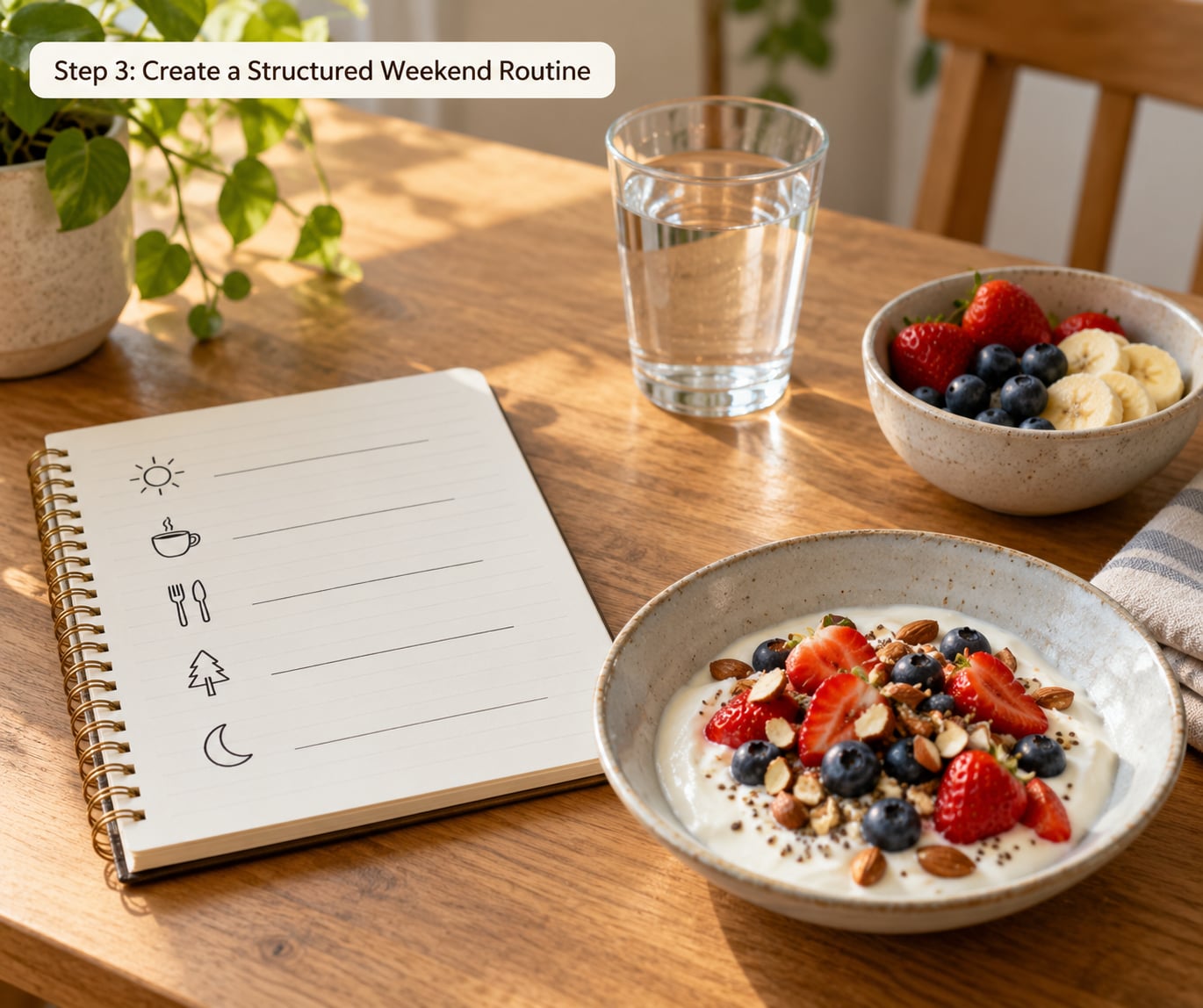
Weekdays run on alarms, meetings and commutes. Weekends run on nothing, and unstructured time is where most mindless eating happens. A light routine fixes that without turning your weekend into a second workweek.
Keep meal times roughly where they are on weekdays, shift them by an hour at most, and put one thing on the calendar for each day. A morning walk, grocery shopping, a class, a visit with a friend, or an hour in the garden. Then pick a realistic stopping point for the evening, because late nights are where the pattern usually runs.
Most people do not need a full schedule. They need one anchor meal, one planned snack, one activity and one end-of-evening marker. Saturday looks like breakfast at nine, lunch at one, a walk at three, dinner at seven, and television from nine rather than six. Specific enough to follow, loose enough that a birthday party does not break it.
You will know Step 3 is working when the weekend stops feeling like a blank stretch of hours. If you miss the walk, that is fine. If you miss the walk and then eat in front of the television for four hours because the day fell apart, the routine was carrying more weight than it should. Keep it light enough to survive an average weekend.
Step 4: Use a Pause Before Reaching for Food
The ten-minute pause is the single most useful tool in this guide, because it works whether the urge came from hunger, boredom or a hard day. When you feel the pull to eat something unplanned, set a timer and move through a fixed sequence.
- Drink a large glass of water. Thirst is frequently mistaken for hunger, and it takes a couple of minutes to find out.
- Step outside or stand up and move. A ten-minute walk around the block, or even a lap of the house, is enough. You are not burning anything off, you are giving the urge time to pass.
- Breathe slowly. Four seconds in, six seconds out, for about a minute. A raised heart rate makes a craving feel like an emergency, and slowing it down shrinks it.
- Decide out loud what the actual plan is. Either the planned snack from Step 1, or nothing. Deciding beats drifting.
If hunger is still real after ten minutes, eat. That is not failure; that is the pause doing its job of sorting a physical need from a habit. The goal is not to override hunger forever, it is to stop the automatic hand-to-mouth moments that follow it.
Watch for the shift. A successful pause usually ends in one of three ways: you eat what you planned, you genuinely were not hungry and you do something else, or you go back to eating but with a clear portion rather than out of the container. The pause is working even when you do eat.
Step 5: Recover Without Turning One Episode Into Another
This is where most well-intentioned plans fall apart. You eat a lot on Saturday night, feel guilty on Sunday, restrict hard or plan to fast, arrive at Sunday evening hungrier than you have been all week, and eat it all again. The second episode is usually caused by the first response to the first one.
There is a name for the punishing-restrict-and-binge pattern: the what-the-heck effect. One slip feels like proof that the whole week is lost, and the reasoning runs backwards from there. It is also why people in weight-loss forums most often repeat the same advice to each other: go back to your plan, without punishment.
What to do on the morning after, in order:
- Do not fast and do not attempt to compensate. Skip workouts designed to burn off last night, and skip the skip-your-breakfast plan. Both extend the cycle.
- Hydrate. Water, and regular meals through the day. Bloating and water retention after a big meal make people feel heavier than they are, and that feeling is what drives the next restriction.
- Eat your next planned meal. Include protein and fiber. Meals made of refined flour and sugar leave you hungry again within an hour, which is how a recovery day turns into a second binge.
- Move lightly if you want to. A walk, some stretching, ten minutes outside. Ordinary movement for how you feel, not punishment.
- Go to bed at a reasonable hour. A short night makes Monday cravings noticeably worse.
- Write one line about what happened. Trigger, time, what you were doing. Then close the notebook until next weekend.
The sign that Step 5 is working is emotional, not physical. You feel annoyed, not ashamed. Guilt is useful as a signal once; shame is useful for roughly nothing, and it is what turns one episode into a pattern.
On the calorie question that comes up constantly: a weekend of significantly more food than usual can undo a week of careful eating, and that is real math, not a moral judgment. It is also why the answer is not to eat less during the week. Restricting harder simply sets up the next rebound, so the more useful response is a regular pattern on Saturday and Sunday, not a stricter one on Monday.
Common Binge-Eating Triggers and What to Do
Here is the matching exercise: find the trigger that fits your situation and take the action next to it. Most people need two of these, not all seven.
- Skipped breakfast, or breakfast too small. You arrive at dinner with low blood sugar and eat far past fullness. Fix: a protein- and fiber-heavy breakfast at your usual weekday time, plus a planned afternoon snack.
- Boredom and low-structure afternoons. Nothing to do, snacks within reach, screens on. Fix: put one activity in the afternoon, and move the cupboard snack to somewhere slightly inconvenient.
- Alcohol. Friday and Saturday drinks lower inhibition and make portion sizes feel abstract. This is the amplifier most people underweight. Fix: decide the limit before the first drink, alternate with water, and eat a real meal before drinking rather than grazing through an evening of it.
- Social pressure. Seconds offers, someone commenting on your plate, a table that keeps refilling. Fix: order or choose first, sit down away from the serving dish, serve yourself a plate rather than eating from the tray, and let someone else handle seconds.
- Late meals and late nights. Eating starts at nine or ten, when self-control is lowest. Fix: keep dinner at its usual time, and set a real end to the evening rather than an intention to stop.
- Stress and low mood. A hard week, an argument, Sunday night dread about Monday. Fix: build in a non-food coping move for these specific situations, because food is holding the job right now and something else needs to take it.
- All-or-nothing thinking. One indulgence apparently cancels the week. Fix: a next-meal rule. Nothing is cancelled by one episode, and the next planned meal is always available.
Common Mistakes
Most failed attempts make the same handful of errors, and each one has a straightforward correction.
Treating the weekend as a cheat day
A cheat day is a scheduled loss of control, and scheduled loss of control teaches your brain that weekends are the one stretch where eating is unrestricted. Readers in weight-loss communities are increasingly blunt about this: giving up cheat days is one of the few changes they report sticking with.
The correction is treating the treat as a treat. Ice cream on Saturday afternoon is fine. A planned day of eating whatever is in the cupboard is not the same thing, and it usually ends with the rebound you were trying to avoid.
Restricting hard all week to compensate
This is the most common mistake and the one that causes the most damage, because it is usually offered as the responsible option. A tightly controlled week builds genuine physical hunger, and by Friday evening your body is asking for exactly what it has been denied.
The correction is a looser week. Most people who stop binge eating on weekends report that they ate slightly more during the week and less on the weekend, and that the weekend was the easier part to fix.
Starting the fix on Monday
Monday is a bad time to build a plan. You are tired, the weekend is still in your head, and any slip feels like a verdict on the whole week. Wednesday is the better day, because it is early enough to be deliberate and late enough to matter.
The correction is a fifteen-minute Wednesday routine: decide Saturday and Sunday meals, write down the top three triggers, book one activity, and pick the non-food move.
Making the plan perfect
Perfect plans fail on contact with real life, and the first thing that changes is usually food. A workable plan absorbs a cancelled workout, a late dinner or a birthday without falling apart.
The correction is aiming for good enough. Reasonable and repeatable beats ambitious and abandoned, and it is the version of this you will still be running in three months.
Responding to a slip with punishment
Fasting, punishing workouts, skipping meals and self-criticism all feel like accountability. What they actually do is guarantee a hungrier, lower-control evening later, which is how one episode becomes a weekend.
The correction is the clean-slate approach: the next meal is the next meal, and nothing about last night is carried forward.
A few short maintenance habits keep the gains once the pattern settles. Eat at roughly the same times daily, keep a protein- and fiber-heavy first meal, keep one planned activity in the weekend, and keep alcohol somewhere you have decided in advance rather than somewhere you drift. If you already track food, keep a short weekend note; people who log anything at all, photos included, tend to spot the pattern earlier.
One more thing worth doing: tell one person what you are working on. Not for pressure, just because the version of this that only lives in your own head is the version that quietly stops. A partner, a friend or a coach is enough.
This is general information, not personal advice. If episodes are happening weekly, you feel you cannot stop once you start, or eating is causing real distress, that is worth a conversation with your doctor, a psychologist or a registered dietitian, who can tell you whether what you are describing is a habit or something clinical.
Frequently Asked Questions
Why do I eat so much on weekends?
Mostly because your weekdays are more controlled than your weekends. Restricting during the week builds real physical hunger by Friday, and then structure drops: meals happen later, you are around food more often, alcohol may lower your inhibitions, and boredom fills the gaps. The result is disinhibited eating that feels automatic. The fix targets the weekday cause rather than trying to white-knuckle Saturday night.
What is the 3-3-3 rule for eating?
The 3-3-3 rule is a social media idea rather than a clinical or NHS guideline, so treat it as a loose prompt, not science. In practice it means roughly three meals and three snacks spread across your day, about every three to four hours. That spacing supports steadier blood sugar and gives hunger signals somewhere to land, which is why regular intervals help more than any specific food rule.
How do I maintain a diet on weekends?
Keep the anchors and loosen the rules. Eat a protein- and fiber-heavy first meal at your usual weekday time, keep one planned snack, and keep meal times within about an hour of your weekday pattern. Plan Saturday and Sunday meals on Wednesday so you are not choosing at nine at night, book one activity, and set an end-of-evening marker. Aim for good enough, not perfect, and never bank a day of unrestricted eating for later in the week.
Will a weekend of overeating ruin my progress?
A weekend of eating significantly more than usual can offset a week of careful eating, and the arithmetic is real. But the common response of eating less all week tends to produce a hungrier Friday and another big weekend. A more useful reframe is that one weekend is a small share of a year and consistency matters more than any single weekend. Judge progress over several weeks, not over Saturday night.
Is weekend overeating a sign of binge eating disorder?
Not on its own. Most weekend overeating is a habit and an environment problem: a controlled week followed by a loose one. Binge eating disorder is different, and involves repeated episodes of eating large amounts in a limited time, a feeling of loss of control during them, and significant distress, occurring weekly for at least three months. If that sounds familiar, speak to your doctor or a registered dietitian rather than trying to fix it with a plan.
How do I stop craving sweets on weekend evenings?
Late evening sweet cravings usually mean the day was under-eaten or under-structured, not that you have a willpower problem. Add a planned protein- and fiber-containing snack in the afternoon, keep dinner at its usual time, and set a real end to the evening. Alcohol makes this noticeably worse, so set your limit before the first drink. The ten-minute pause from the guide interrupts most of these cravings once they start.
Conclusion
Do four things this week, in order. Plan the next two days of meals and snacks, including one protein-heavy first meal. Write down the three triggers that show up most often in your episodes. Put one activity on Saturday and one on the calendar. And decide now what the ten-minute pause looks like when it is nine at night and the urge shows up.
Then, when an episode happens anyway, go straight to the next planned meal. No fasting, no punishing workout, no verdict on the week. Learning how to stop binge eating on weekends is mostly a matter of consistency rather than perfection, and consistency includes the weekends you do not get right.