
The common weight loss mistakes beginners make are rarely about willpower. They are about cutting too hard, eating the wrong things, and expecting results on a timeline that has nothing to do with how bodies actually respond. Almost all of them share one root cause: a plan too aggressive to keep.
Below I break down 12 of those mistakes, why each one backfires, and what to do instead. This is general information, not personal medical advice. If you have a health condition, take medication, or have a history of disordered eating, talk to a doctor or registered dietitian before changing how you eat.
Table of Contents
- Common Weight Loss Mistakes Beginners Make at a Glance
- 1. Cutting Too Many Calories Too Quickly
- 2. Skipping Meals and Then Overeating
- 3. Eliminating Entire Food Groups
- 4. Counting Calories Obsessively
- 5. Choosing Diet Foods Instead of Satisfying Foods
- 6. Drinking Too Many Sugary Drinks
- 7. Relying on a Very Strict Exercise Plan
- 8. Expecting Quick, Linear Results
- 9. Changing Everything at Once
- 10. Not Sleeping Enough
- 11. Using Weight Loss Supplements or Extreme Cleanse Plans
- 12. Giving Up After a Slow Week
- Frequently Asked Questions
- How quickly should beginners expect to see weight loss results?
- Do I need to exercise to lose weight?
- Is it normal for weight to fluctuate from day to day?
- Are weight loss supplements or detox products effective?
- How many habits should I change at once?
- Where to Start: Fixing the Weight Loss Mistakes Beginners Repeat
Common Weight Loss Mistakes Beginners Make at a Glance
Here is the whole list in one place, with the reason each habit backfires and the first small fix to try.
| Mistake | Why it stalls progress | First fix |
|---|---|---|
| 1. Cutting calories too fast | Larger deficits cost muscle and raise hunger | Cut 500 to 750 calories a day, not more |
| 2. Skipping meals, then overeating | Hunger builds and rebounds harder at night | Three steady meals with protein and fiber |
| 3. Cutting out whole food groups | Hard to sustain and easy to overeat around | Balance the plate, don’t ban foods |
| 4. Obsessive calorie counting | Stress, and food quality gets ignored | Track for 2 weeks, then loosen up |
| 5. Eating diet foods instead of filling ones | Low satisfaction leads to rebound eating | Choose foods you actually enjoy |
| 6. Drinking too many sugary drinks | Liquid calories do not register as full | Water, sparkling water, unsweetened tea |
| 7. An exercise plan too strict to keep | Missed sessions turn into quit weeks | Walk daily, train 2 to 3 times a week |
| 8. Expecting fast, linear results | Weeks with no change feel like failure | Judge progress over 4 weeks, not 4 days |
| 9. Changing everything at once | All-or-nothing thinking sets you up to fail | Pick two habits and hold them |
| 10. Sleeping too little | Hunger control and training both suffer | A fixed wind-down, 7 to 9 hours |
| 11. Supplements and cleanse plans | Little evidence, real side effects, lost money | Spend the effort on food and sleep instead |
| 12. Quitting after a slow week | One flat week gets read as permanent failure | Adjust one variable and keep going |
1. Cutting Too Many Calories Too Quickly
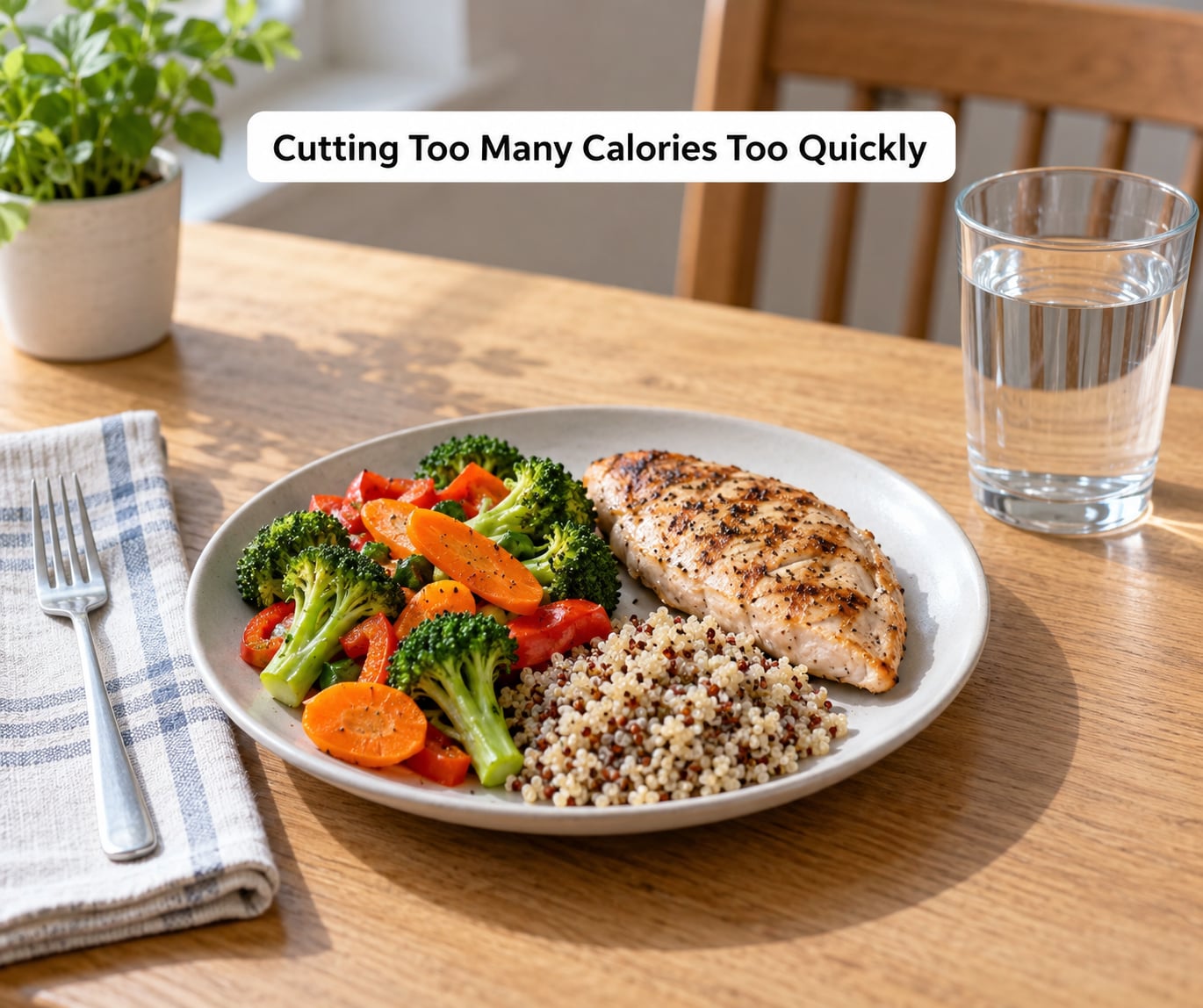
Cutting too many calories too quickly is the most common weight loss mistake beginners make, and it works against you. Most people start by skipping meals and cutting carbs hard, and the result is fatigue, constant hunger, and a bigger appetite a few weeks later.
The CDC puts a realistic pace at 1 to 2 pounds per week, which usually works out to a daily deficit of 500 to 1,000 calories. Cut far below that and you lose more muscle than fat, because your body protects lean tissue first when energy is scarce.
You also adapt. Your resting metabolic rate and daily movement both drop as you weigh less, an effect researchers call metabolic adaptation. Members of r/loseit describe it as real but modest, often quoted around a hundred calories a day rather than the dramatic drops people fear. Either way, a deficit that felt easy at the start gets harder every week, and most people give up before month two.
The fix: aim for the smallest deficit that still moves the scale, usually 500 to 750 calories. Eat food you actually like, keep protein high, and give it three to four weeks before you judge it.
2. Skipping Meals and Then Overeating
Skipping meals and then overeating wastes the day twice. When you skip breakfast and lunch, hunger compounds quietly, and by 8pm the kitchen counter is doing the work your meals should have done.
That evening session rarely stops at a sensible portion. It usually ends in something salty and sweet, and the next morning feels worse, so the cycle repeats. Regular beginner threads on r/WeightLossAdvice keep circling the same point: structure beats intensity, and steady meals beat a good Monday.
Build three meals that each carry protein, fiber, and a satisfying carbohydrate. Greek yogurt with berries, beans and rice, eggs with whole-grain toast. Each one takes a few minutes and stops you arriving at dinner with nothing in reserve.
3. Eliminating Entire Food Groups
Eliminating entire food groups is a fast route to a diet you will abandon. Carbs, fats, and dairy each do something useful, and cutting a whole group usually means losing the foods that made meals satisfying in the first place.
Drop bread and pasta and you remove fiber and the bulk that keeps you full. Drop dairy and you lose calcium and a reliable protein source. Most people do not replace those foods thoughtfully, they just eat more of whatever is left, often the packaged stuff marketed as a substitute.
There is a difference between a genuine food allergy, a diagnosed intolerance, or a medical recommendation from a doctor, and a lifestyle ban you picked from a list. Keep a small amount of the foods you are restricting, and pair them with protein and vegetables so the plate still works.
4. Counting Calories Obsessively
Counting calories obsessively can work, but for most beginners it adds stress rather than control. Every meal becomes arithmetic, eating out becomes a puzzle, and the number starts to matter more than the food.
That stress is the problem. When eating becomes a performance, a dinner with friends feels like a test, and the first relaxed meal tends to be the one that gets out of hand. Overall beginners also report the overwhelm of logging everything for the first time, which is how a useful habit turns into a nightly argument.
Use tracking as a two-week diagnostic rather than a permanent lifestyle. Log honestly, look for the invisible calories, then switch to portion awareness: plate method, eating to about 80 percent full, protein and fiber at every meal. If you do keep tracking, sanity-check that food quality is not being sacrificed to hit a number.
5. Choosing Diet Foods Instead of Satisfying Foods
Choosing diet foods instead of satisfying foods is where low-fat and low-calorie packaging gets expensive. Many of those products are built to be eaten in larger portions, which is the opposite of what you need.
A 200-calorie serving of cookies and a 200-calorie serving of broccoli are not the same decision. One leaves you hunting for something else twenty minutes later, the other does not. Without nutrient density and enough protein and fiber, you will feel hungry again soon and start treating the diet food as a failure.
Nutrient-dense means more protein, fiber and volume per calorie, not a label. Eggs, lentils, Greek yogurt, tofu, vegetables and whole grains will keep you full longer than anything branded a light meal. Keep the foods you enjoy in the plan, because a diet built out of foods you resent does not survive month three.
6. Drinking Too Many Sugary Drinks
Drinking too many sugary drinks is the easiest calorie mistake to fix and the easiest to miss. Soda, sweetened coffee, juice, alcohol and even large coffees with cream can add several hundred calories a day without ever producing a feeling of fullness.
Beginners on r/loseit and r/WeightLossAdvice often report gaining weight on what they called a healthy diet, then finding that the real culprit was a weekday coffee habit and weekend drinks. The food looked fine because the drinks were invisible to them.
Swap rather than ban. Water, sparkling water, unsweetened tea, or water with fruit and a splash of juice. Keep the one drink you actually enjoy, make it the small version, and leave the rest of the day for water.
7. Relying on a Very Strict Exercise Plan
Relying on a very strict exercise plan is another weight loss mistake that backfires on beginners. Signing up for six classes a week, a punishing interval routine, or daily training produces soreness, missed sessions, and a cancelled plan by week three.
Consistency beats intensity at the start, because a beginner loses fat through a calorie deficit and exercise helps you keep muscle and stay honest. Walking counts, and it is the easiest activity to repeat. Aim for something you could still do on a bad week.
A workable shape for most beginners is daily movement plus two or three strength sessions a week. Squats, push-ups, rows or resistance bands, two or three sets of 8 to 12 reps, with a little more load each time you can. Add cardio you enjoy rather than punishing cardio you dread.
8. Expecting Quick, Linear Results
Expecting quick, linear results sets you up to quit in your first quiet week. Weight loss is not a straight line. Water weight, salt, bowel habits, a heavy leg day, poor sleep, all of it moves the number without any change in body fat.
Most people lose the first few pounds quickly, partly because glycogen stores hold water. Then the rate settles into something far less dramatic. Comparing week four to week five and reading the difference as failure is one of the most repeated complaints in weight loss forums, and it is usually a measurement problem rather than a metabolism problem.
Here is roughly what a healthy first two months looks like: weeks 1 and 2, a noticeable drop in the first week then a slower pace. Weeks 3 and 4, the scale holds close to steady while your habits and clothes change. Weeks 5 to 8, a steady average loss becomes visible in monthly comparisons. Weigh the same time, same day of week, and compare averages, not single days.
9. Changing Everything at Once
Changing everything at once is the mistake that turns a restart into another abandoned attempt. The perfect diet, daily workouts, no sugar, no snacks, early nights. Six changes, all demanding, all watched.
One bad week and it collapses, because you no longer see a routine with a bad day in it, you see a failed plan. The all-or-nothing mindset is the single most common theme in r/WeightLossAdvice threads about the biggest beginner mistake, and the fix people keep landing on is doing less and holding it for longer.
Choose one or two measurable habits and let them run for a month. Protein at breakfast and a 20-minute walk after dinner is a complete first month. Add a third habit only when the first two feel automatic, and accept that progress will look uneven on the calendar.
10. Not Sleeping Enough
Not sleeping enough quietly works against fat loss. Short sleep raises ghrelin, the hunger hormone, and lowers leptin, the fullness signal, so hunger increases and portion control gets harder the day after a bad night.
It also cuts insulin sensitivity and leaves you with less energy to train, which is where the walking and strength sessions go. On a five-hour night you will choose the easier option more often, and that compounds over a month.
Aim for 7 to 9 hours and build a fixed wind-down rather than chasing the number. Same bedtime, screens out of the bedroom, caffeine stopped earlier in the day. If you are sleeping fine and still stuck, stress and cortisol are worth looking at next, especially if you are eating more when stressed rather than when hungry.
11. Using Weight Loss Supplements or Extreme Cleanse Plans
Using weight loss supplements or extreme cleanse plans spends money and hope for very little. Fat burners, laxative-based cleanses, appetite suppressants and detox teas have weak or no evidence behind them for lasting weight loss.
Some carry real risks. Very low calorie and laxative-heavy plans cause dehydration, electrolyte problems, and for some people disordered eating patterns, which is the concern forum moderators raise most often. Prescription weight loss medication is a different category entirely, with clinical evidence and medical supervision, and it is not something to source without a doctor.
For GLP-1 and similar medications, habits still decide the outcome. People often under-eat during the appetite suppression phase, then return to their old eating pattern when it stops, and some stop the prescribed routine entirely without medical advice. Talk to your prescriber about side effects, and eat enough protein and fiber that you are not losing muscle while your appetite is low.
The honest alternative is free and unglamorous: more protein, more vegetables, some strength training, better sleep, less liquid sugar. That is where the results are.
12. Giving Up After a Slow Week
Giving up after a slow week is how most beginners decide the method does not work on them, when the method is usually fine and the expectations were not. A flat week is data, not a verdict, and treating it as a verdict is what turns a loss into a regain.
When progress stalls for two weeks, work through these in order before you change anything:
- Check your portions. Restaurant and packaged food portions are the most common hidden surplus.
- Check your drinks, including alcohol on weekends.
- Check your logging accuracy. Compare a logged day against a normal day.
- Check your sleep and step count before adding more training.
- Then, and only then, cut roughly 100 to 150 calories or add one short session a day.
A cheat day is rarely the answer to a plateau. It can trigger rebound eating and it does not address the cause. Weigh-ins are useful data, and treating the scale as a grade instead of an information source is a fast way to dread the thing that helps you most.
Frequently Asked Questions
How quickly should beginners expect to see weight loss results?
Most beginners see their fastest change in the first one to two weeks, largely from water weight, then settle into a slower pace. The CDC’s realistic range is 1 to 2 pounds per week. Judge progress on a four-week average rather than a single weigh-in, because daily changes usually reflect water, salt and digestion.
Do I need to exercise to lose weight?
A calorie deficit does most of the work, so exercise is not strictly required to lose weight. It helps you keep muscle, improve conditioning and make the deficit easier to maintain. For beginners, daily walking plus two or three strength sessions a week is more sustainable than a strict cardio plan.
Is it normal for weight to fluctuate from day to day?
Yes. Salt, carbohydrates, bowel habits, a heavy workout and poor sleep can all shift the scale by a few pounds in a day without any change in body fat. Weigh yourself at the same time on the same day each week and compare averages over a month. Daily numbers are noise; the trend is the useful part.
Are weight loss supplements or detox products effective?
Most over-the-counter fat burners, laxative cleanses and detox teas have little evidence for lasting weight loss, and some cause real side effects such as dehydration and electrolyte problems. Prescription weight loss medication is different and does have clinical evidence, but it needs a doctor’s supervision. Talk to a doctor or registered dietitian before starting either.
How many habits should I change at once?
One or two, held for at least a month. Beginners who try to change diet, exercise, sleep and snacking simultaneously tend to collapse within weeks and fall into all-or-nothing thinking. A habit you can hold for a year beats a perfect plan you abandon in a month, so add the next one only once the first feels automatic.
Where to Start: Fixing the Weight Loss Mistakes Beginners Repeat
Pick the two mistakes above that cost you the most this month and address only those. For most beginners that means a moderate deficit, protein and fiber at every meal, water instead of sugary drinks, a daily walk, and a 7 to 9 hour sleep target.
Give it four weeks before you evaluate anything, compare weekly averages rather than daily numbers, and change one variable at a time. If you have a medical condition, take medication, or find yourself eating in an all-or-nothing pattern, that is worth raising with a doctor or registered dietitian before the next attempt, not after.