To meal prep for the week on a budget, you cook three flexible base foods in one session, portion them into containers, and eat them for roughly a third of what takeout costs. Most of the saving comes from buying fewer ingredients and using each one twice or three times, not from cooking something complicated.
For a single person, a realistic plan is one cooked protein, one pot of grain or beans, and a tray of roasted vegetables. Those three components turn into different bowls, wraps, and plates across five days without repeating the same meal twice in a row.
The core money-saving strategies, in order of impact:
- Plan two or three base components instead of seven separate recipes
- Buy one protein and cook it in bulk, rather than several small packages
- Use frozen vegetables when fresh ones are marked down or out of season
- Cook grains and beans in large batches, since they are cheap per serving and freeze well
- Check the unit price on the shelf label, not the sticker price on the front
- Shop on a list after eating, so you are not hungry and not improvising
The whole session takes about two hours on a Sunday, and most of that is waiting for things to roast or simmer while you do the next batch.
Table of Contents
- How to Meal Prep for the Week on a Budget: What You Need
- Pantry staples that carry several meals
- Protein sources ranked by cost
- Vegetables and fruit
- Containers and tools
- Planning materials
- Step-by-Step
- How to Meal Prep for the Week on a Budget Checklist
- Shop by Sales and Seasonal Produce
- Cook a Batch of Flexible Base Recipes
- Portion Meals for the Week
- Label, Cool, and Refrigerate Everything
- Reheat Meals Without Losing Texture
- Use a Leftover-Plan Container System
- Make the Last Two Meals Flexible
- Common Mistakes
- Frequently Asked Questions
- How much should I budget for a week of meal prep?
- How long does it take to meal prep for a whole week?
- Which budget-friendly foods keep well after meal prep?
- Can I meal prep salads for several days?
- How should I reheat meal-prepped food safely?
- What should I do if I do not finish all of my prepped meals?
- Conclusion
How to Meal Prep for the Week on a Budget: What You Need
Budget meal prep needs very little equipment and a short list of ingredients you can use in several meals. Most beginners over-buy variety and under-buy staples, which is why the budget disappears by Wednesday.
Pantry staples that carry several meals
Brown rice, dried lentils, canned beans, rolled oats, pasta, and a simple tomato sauce are the cheapest base foods per serving in most US grocery stores. Buy the largest reasonable size, but check the unit price on the label first, because the biggest bag is not always the best value.
Stock the shelf with olive oil, garlic powder, cumin, paprika, black pepper, and a dried herb or two. Spices are the difference between eating the same chicken breast five days in a row and eating it without noticing.
Protein sources ranked by cost
Dried beans and lentils sit at the bottom of the cost ladder, eggs sit just above them, chicken thighs sit in the middle, and beef and fish sit at the top. Rotate through the lower tiers most weeks and use the pricier ones occasionally, and the same grocery budget buys noticeably more food.
Cooked chicken thighs freeze better than breasts because the dark meat stays moist, which matters for a week of reheated lunches. If you buy canned tuna, look for the no-salt-added version and use the liquid from the can in a quick pasta sauce.
Vegetables and fruit
Frozen broccoli, green beans, peas, and mixed peppers cost less per serving than fresh and lose nothing in a cooked dish, since roasting and simmering soften them. Fresh still wins for things you eat raw, like salad greens, apples, bananas, and carrots.
Buy produce that is in season. It is cheaper, it tastes better, and it does not need much thinking, which is the point on a prep day.
Containers and tools
A set of glass containers that works in the oven, microwave, and freezer means one piece of equipment instead of three. If you cook for one, four or five containers of the same size are enough for a week, and matching sizes stack neatly in the fridge.
You also need a cutting board, one large pot, one sheet pan, a colander, a few mixing bowls, and a roll of tape or a permanent marker for labels. That is the whole kit. A food scale helps if you are tracking calories, but it is not required for budgeting.
Planning materials
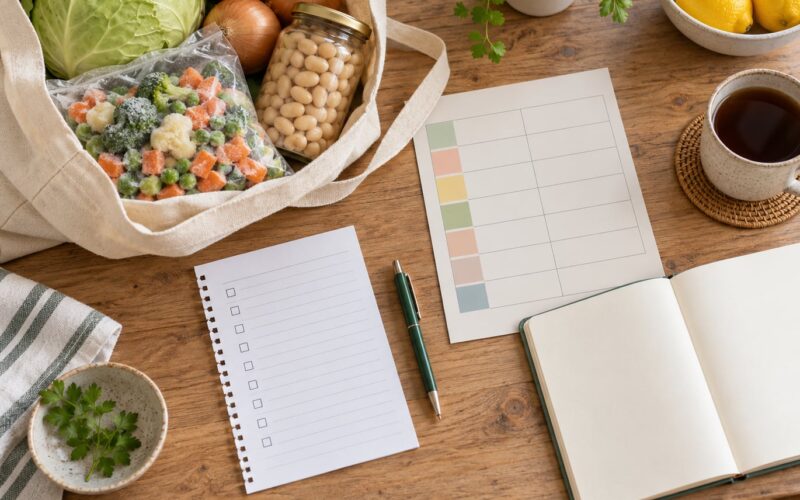
A notebook or a note on your phone with three things in it: your weekly number, your list of components, and the day each dish gets eaten. The calendar is what stops a Thursday lunch from turning into a drive-through.
Step-by-Step
The system below runs in six moves: plan, shop, cook, portion, store, and eat. Most people who quit meal prepping fail at the first or the fourth step, so those get the most attention here.
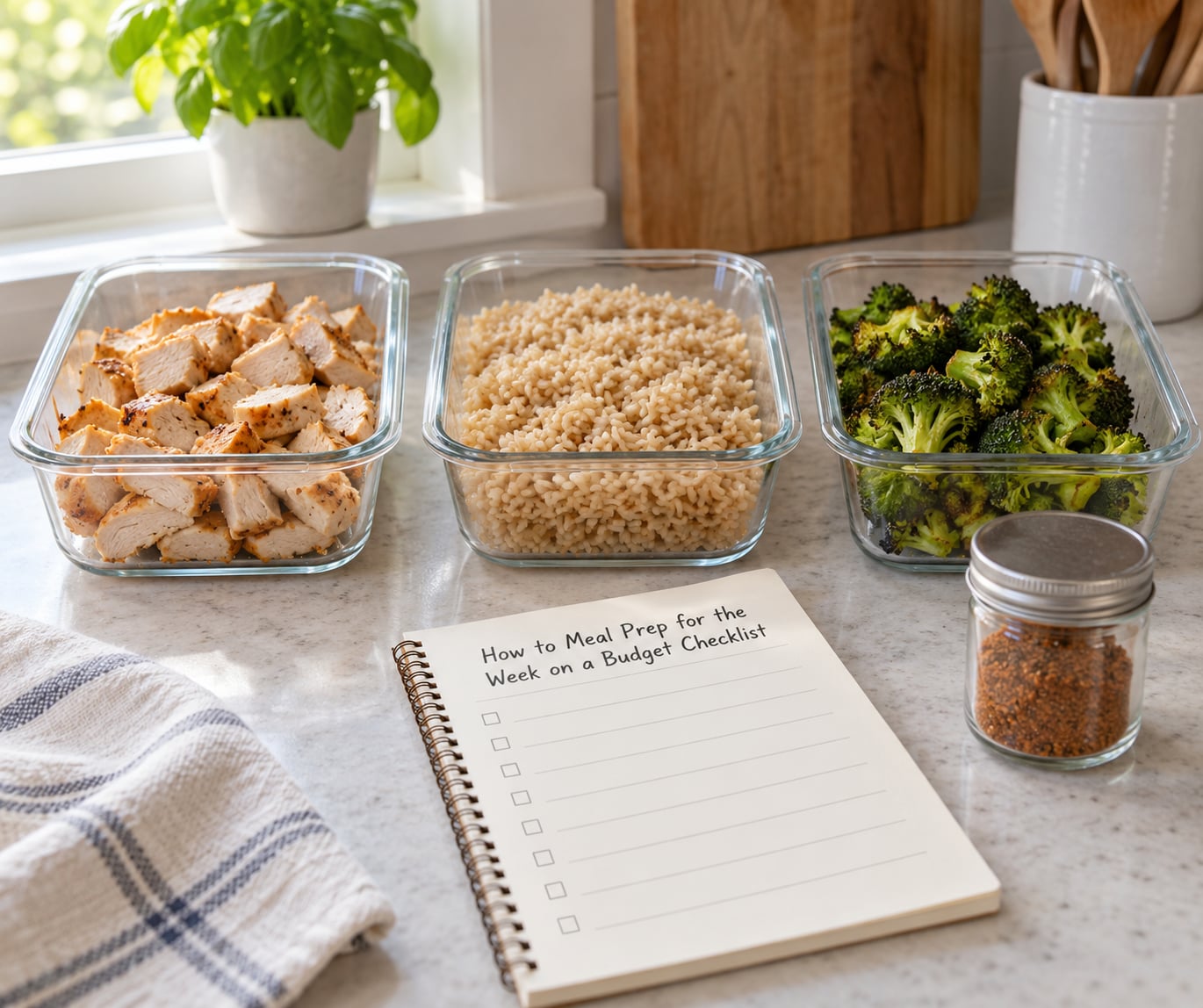
How to Meal Prep for the Week on a Budget Checklist
A working weekly meal prep plan needs five decisions made before you walk into a store: how many meals, which components, which protein, what you already own, and your hard spending limit.
- Count meals, not days. One person prepping five weekdays needs about 11 meals, not 15. Two dinners out of the week saves prep time and money at once.
- Pick three components. One protein, one starch, one vegetable, plus a sauce or seasoning you can reuse.
- Use each ingredient twice. If a bag of spinach appears in only one dish, swap it for something you will use again.
- Check the pantry first. Half the items on a typical list are already on the shelf, and the list gets shorter every time you do this.
- Set the limit and write it down. A fixed number is easier to keep than a vague intention to eat cheaper.
Write the plan where you will see it, and give every ingredient a home in at least two meals before you buy it. That single rule is the difference between a grocery list that saves money and one that produces a pile of leftovers nobody eats.
Shop by Sales and Seasonal Produce
Shop once, with a list, after you have eaten something, and compare unit prices rather than sticker prices. The unit price on the small print label is the only number that tells you whether the big bag is a deal or just a bigger bill.
Store-brand basics are the easiest saving in the store, and they are worth it on rice, beans, pasta, canned tomatoes, and canned tuna, where the difference in taste is small. It is not always worth it on spices or anything you use a pinch of.
Choose frozen vegetables over fresh when you are cooking them, and choose fresh over frozen for anything you eat raw. Buy meat on sale and freeze it in single-meal portions the day you get home, because a sale you cannot freeze is a sale you wasted.
Keep a substitution list. If the store is out of one vegetable, use the next one in the same category, and if chicken is expensive that week, swap in beans and lentils and shorten the cooking time by 30 minutes. Rigid plans break; flexible ones hold.
Cook a Batch of Flexible Base Recipes
Cook three flexible base recipes at once and you can assemble ten or more different meals from them. Each one should be seasoned well on its own and safe to eat hot or cold.
- Start with the oven. Put a sheet pan of chopped vegetables and seasoned chicken thighs in at the same time, at 425F, for 20 to 25 minutes. This is the longest cook, so it goes first.
- Then a pot of grain. Brown rice or quinoa needs about 20 minutes, and it mostly watches the pan. Start it while the oven runs.
- Then the beans. A pot of dried beans simmered with onion, cumin, and a bay leaf, or a pot of lentils that need no soaking, cooks in 25 to 40 minutes with almost no attention.
- Then a quick sauce. A pot of canned tomatoes with garlic and olive oil, or a simple tahini-lemon dressing, takes five minutes and turns plain rice into a meal.
Cook to safe temperatures, not to appearance. Poultry and ground meat reach 165F in the thickest part, whole cuts of beef, pork, and lamb reach 145F with a three-minute rest, and fish reaches 145F. Use a thermometer; it is the cheapest tool in the kitchen and the one that prevents the most trouble.
Portion Meals for the Week
Portion into the containers you will actually eat from, while the food is still warm, and decide portions by how hungry you are rather than by rule.
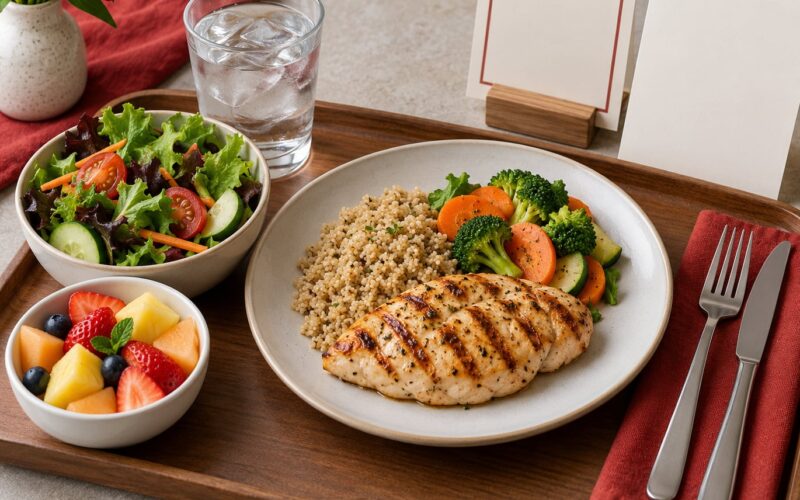
A useful starting point is a palm-sized portion of protein, a fist-sized portion of grain or beans, and two handfuls of vegetables. That is a rough visual guide, not a prescription, and it scales up for a family and down for someone who wants lighter meals. People tracking calories can weigh portions once to learn what a serving looks like to them.
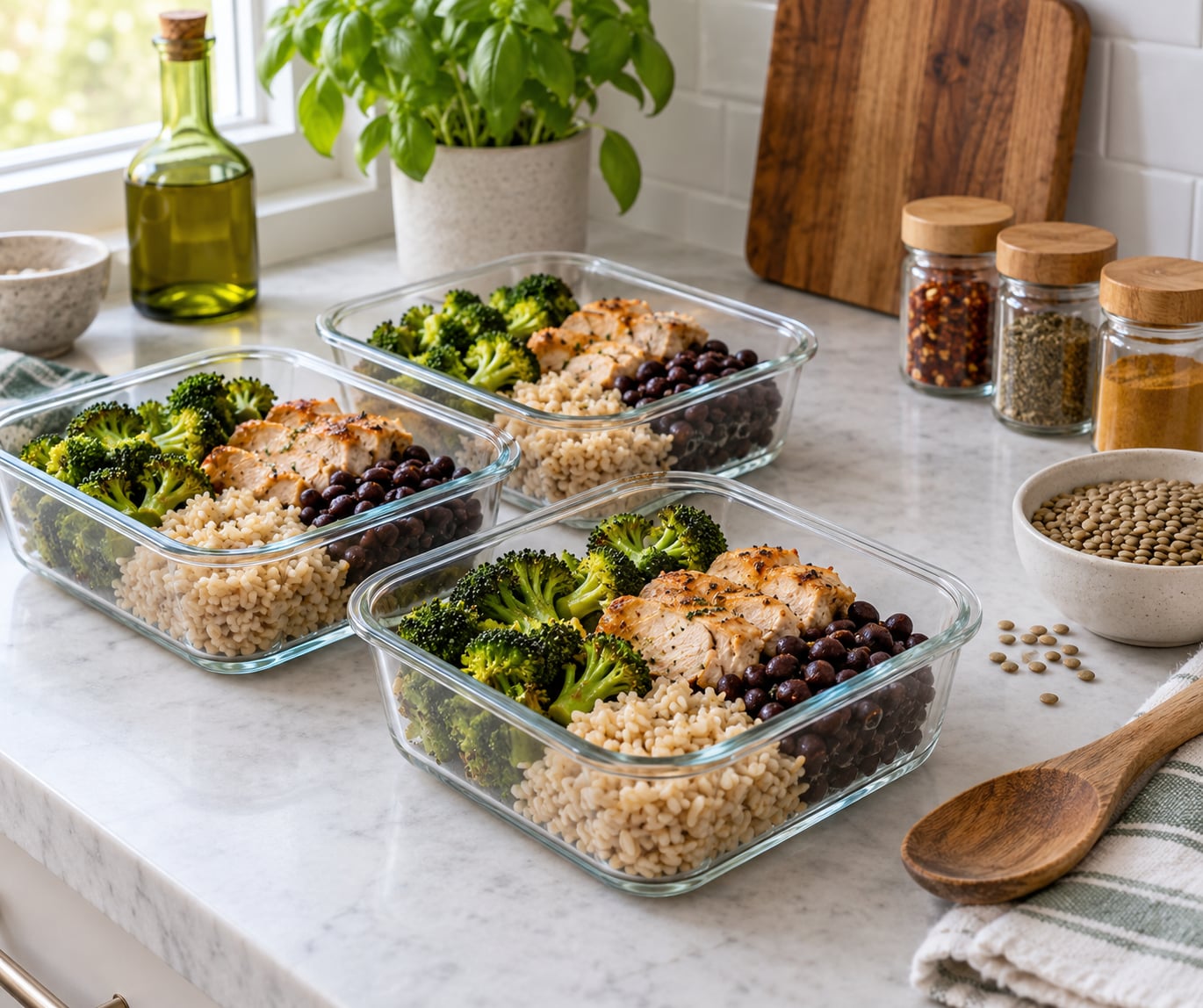
Compartment containers help when you want vegetables kept separate from grain, so the grain does not turn to mush by Wednesday. They cost more, though, and if you are on a tight budget, five of the same single-compartment size is the smarter buy.
Fill the containers you will eat first at the front of the fridge. Whatever is at the back is what you freeze, and labeling it now saves you guessing later.
Label, Cool, and Refrigerate Everything
Refrigerate cooked food within two hours of cooking, and get the food from room temperature into the fridge quickly rather than leaving a big hot pot to cool on the counter.
Divide large warm batches into shallow containers so heat escapes quickly. A deep stockpot cooling on a counter can sit in the food-safe range for hours, and that is the single most common way prepared food goes bad.
Label every container with two things: the contents and the date. A strip of tape and a marker take five seconds now and save you from a container you have to smell on Thursday.
Cooked leftovers, including cooked meat, poultry, seafood, eggs, rice, and pasta, keep three to four days in the refrigerator at 40F or below. That means a Sunday prep covers Monday through Wednesday comfortably. For Thursday and Friday, freeze the second portion of each dish as it cools and move it straight to the freezer.
Freezer timing works best on rice, cooked beans, soups, sauces, marinated meat, and cooked vegetables. Raw lettuce, salad dressings with dairy, pasta that is already mushy, and eggs in their shells do not freeze well. Thaw overnight in the fridge, never on the counter.
Reheat Meals Without Losing Texture
Reheat until the center reaches 165F, and add a splash of water or broth to anything that came out dry. Reheating is the step where most prepped food disappoints, and it takes two adjustments to fix.
For grains, put a teaspoon of water in the container, cover loosely, and microwave in 60-second bursts. The steam softens the dried-out edges and the covering keeps it from going soggy. For chicken, the same trick works, and a splash of sauce on top adds the moisture back.
For vegetables, skip the microwave when you can. A hot skillet for two minutes, or a few minutes under a hot broiler, keeps them from turning to mush. A dry skillet is the one piece of equipment worth adding if you cook a lot of roasted broccoli.
Microwave containers with venting, metal utensils, and sealed lids cause uneven heating and steam burns. Loosen the lid, use a microwave-safe dish, and stir halfway through.
Use a Leftover-Plan Container System
Think of the containers as four labeled boxes, not seven finished meals, and the week stops feeling repetitive. Each box holds one component, and you combine two or three per meal.
Container one: cooked chicken thighs, cooled and portioned. Container two: brown rice with a little of the cooking liquid so it does not dry out. Container three: beans with onion and cumin, cooled uncovered so the steam escapes. Container four: roasted vegetables from the sheet pan, cooled with the tray tilted over the sink.
Monday lunch is two and three with the lemon dressing. Tuesday dinner is one, two, and four with hot sauce. Wednesday lunch is three over two with cheese. Thursday is the same components as quesadillas. The groceries are identical every day; only the assembly changes.
Write the combination on the lid as you pack each night. It takes ten seconds and it is the difference between eating what you packed and ordering something else because the container looked like a chore.
Make the Last Two Meals Flexible
By Thursday, a single base meal starts to feel like a punishment, so plan the last two days as a build-your-own night rather than a fixed dish.
Set out the components plus two or three extras: a can of tuna, a hard-boiled egg, leftover sauce, cheese, or whatever is in the fridge. People call this a flex night, and it takes less effort than cooking, while removing the last thing that makes people quit a prep plan.
Breakfast follows the same logic. Oats cooked in bulk with milk and a spoon of peanut butter reheat into something that tastes deliberate rather than leftover, and eggs boiled in a pot alongside the beans add a protein option with no extra cooking.
If the week goes off-plan, the recovery move is small. Cook one single meal, use it for two portions, and stop trying to rebuild the whole week. One cooked dinner beats five skipped ones.
Common Mistakes
Most budget meal prep fails on shopping decisions rather than cooking technique. These are the six that quietly add money to the week, and each one has a straightforward fix.
Buying too much variety. Eight proteins means seven of them spoil in the back of the fridge. Fix: two proteins, and one of them is beans or lentils.
Skipping freezer-friendly dishes. Sunday prep covers Monday to Wednesday, not Monday to Friday. Fix: freeze the second portion of each dish the moment it cools.
Not labeling containers. Nobody wants to open nine lids to identify Tuesday’s lunch. Fix: tape and marker, contents and date, every time.
Portioning too much. Prepped food that stalls in the fridge gets thrown out, and waste is the most expensive part of any grocery budget. Fix: portion five days at most, and treat anything beyond that as a bonus.
Storing food incorrectly. A warm pot left to cool on the counter is the main way prepped food goes bad early. Fix: shallow containers, into the fridge within two hours.
Choosing complicated recipes. Six-burner meals fail on a weeknight and waste ingredients. Fix: three components, one sheet pan, one pot, and a sauce.
A few habits that compound over a month. Freeze bread, cook a second grain some weeks, use the freezer as a second pantry by batch cooking on a free weekend, and buy the same staple store brand every single time so you stop re-deciding.
The honest answer on whether this beats takeout is yes, for the meals it actually replaces. Prepared meal delivery services often run higher per serving than cooking from scratch, mostly because of packaging and delivery fees. The savings come from eating at home more often, not from buying a cheaper version of the same food.
One more thing worth saying plainly: budget tips do not solve food insecurity. If the weekly number is genuinely not there, community food programs, SNAP, and local pantry hours are the real answer, and a good list of staples is only a small part of the picture.
Frequently Asked Questions
How much should I budget for a week of meal prep?
Set a firm weekly number before you shop, then work backwards from servings. For one person cooking roughly eleven meals from three components, most of the spend goes on protein, grains, and vegetables. Measure your first month honestly, then aim to cut it by a small amount each month rather than guessing from the start.
How long does it take to meal prep for a whole week?
About two hours for a single person, most of it unattended while the oven and the pot run. The active work is chopping, seasoning, and portioning, which is closer to 45 minutes. If a recipe asks you to babysit a pan the whole time, it is the wrong recipe for a prep session. Choose dishes where you can start the next batch while the last one cooks.
Which budget-friendly foods keep well after meal prep?
Cooked beans, lentils, brown rice, tomato sauce, soups, marinated chicken, and roasted vegetables all hold up in the fridge for three to four days and most of them freeze well. Cooked pasta and rice go soft fastest, so use them in the first three days or freeze them. Raw salad greens, fresh tomatoes, and anything with a creamy dressing belong in the fridge, not the freezer, and are better eaten early in the week.
Can I meal prep salads for several days?
Prep the components separately and assemble the salad at eating time. Store greens dry with a paper towel, keep the protein and toppings in a second container, and put the dressing on its own, since a dressed salad turns limp within hours. Most greens last three to four days in the fridge, so plan leafy salads for the first half of the week and switch to cooked meals after that.
How should I reheat meal-prepped food safely?
Reheat until the center reaches 165F, stirring halfway through, and use a microwave-safe container with the lid loosened so steam can escape. Never microwave in a sealed container or with metal utensils. Add a splash of water or broth to grains and meat, cover loosely, and heat in 60-second bursts instead of one long cycle so nothing dries out or heats unevenly.
What should I do if I do not finish all of my prepped meals?
Eat what is left first, oldest container before newest, and do not add a big cooking session on top of it. Anything you will realistically eat within a day or two, cook fresh in a smaller batch instead. For the rest, freeze it before it turns, or move it to the back of the fridge, and adjust next week’s plan so you portion five days rather than seven.
Conclusion
Start small: pick three versatile meals, check what is already in your pantry, and cook one protein, one grain, and one vegetable this Sunday. Portion five days, label everything with a date, and freeze the extras the same afternoon.
That is the whole system for learning how to meal prep for the week on a budget. Adjust portions, protein choices, and meal timing to fit your household, your schedule, and any nutrition targets you are working toward, and check with a registered dietitian if you have specific requirements.