Fiber is the part of plant food your body cannot fully digest, and that is exactly why it fills you up. It holds water, expands in the stomach, and slows the movement of food through your gut, so hunger returns later. The best high fiber foods that keep you full do that while adding very few calories, which is why they sit at the center of so many weight loss plans. Updated for October 2026.
I cook for a household that is trying to eat better without spending more or spending all evening at the stove, and fiber is the single change that made the biggest difference. Beans, oats, and a handful of berries or seeds do more for a hungry afternoon than anything I have tried in a supplement bottle.
Below I break down 14 high fiber foods with typical grams of fiber per serving, the reason each one holds hunger off, and the easiest way to actually eat it. Figures come from USDA FoodData Central and similar standard references, and your Nutrition Facts label will give you the exact number for the product in your kitchen.
Table of Contents
- High Fiber Foods That Keep You Full at a Glance
- 1. Lentils
- 2. Black Beans
- 3. Chickpeas
- 4. Edamame
- 5. Oats
- 6. Barley
- 7. Quinoa
- 8. Raspberries
- 9. Apples with the Skin
- 10. Pears
- 11. Avocado
- 12. Chia Seeds
- 13. Flaxseed
- 14. Broccoli
- How to Increase Fiber Without Disrupting Your Digestion
- How much fiber do you actually need?
- A week-by-week ramp
- Drink with it and spread it out
- Signs to watch for
- How to Build a Filling High-Fiber Meal
- Frequently Asked Questions
- Which high fiber foods keep you full the longest?
- How much fiber should an adult eat each day?
- Do high fiber foods help you lose weight?
- What are the best high fiber foods for breakfast?
- How do I eat more fiber without getting bloated?
- Conclusion
High Fiber Foods That Keep You Full at a Glance
Here is the short answer: high fiber foods that keep you full are legumes, whole grains, fruit, vegetables, and seeds that deliver at least 5 grams of fiber a serving. They work because fiber absorbs water, adds bulk, and slows digestion without adding many calories, and the table below shows the serving size, fiber, calories, and best use for each of the 14 foods in this guide.
| Food | Typical serving | Fiber | Calories | Why it fills you up | Easiest use |
|---|---|---|---|---|---|
| Lentils | 1 cup cooked | 15.6 g | 230 | Very high fiber to calorie ratio plus plant protein | Soup, chili, curry |
| Black beans | 1 cup cooked | 15 g | 227 | Bulk and protein in a small bowl of calories | Tacos, bowls, soups |
| Chickpeas | 1 cup cooked | 12.5 g | 269 | Steady fiber with protein and a firm chew | Hummus, salads, curries |
| Edamame | 1 cup shelled | 8 g | 188 | Protein and fiber together, eaten like a snack | Bowls, noodle dishes |
| Oats | 1 cup cooked | about 4 g | 166 | Beta-glucan forms a gel that slows stomach emptying | Breakfast base |
| Barley | 1 cup cooked | 6 g | 193 | Bulks out a dish while adding soluble fiber | Soups, pilafs, salads |
| Quinoa | 1 cup cooked | 5 g | 222 | Light whole grain with a high protein bonus | Grain bowls, side dishes |
| Raspberries | 1 cup | 8 g | 64 | Highest fiber per calorie in the fruit aisle | Oatmeal, yogurt, snacks |
| Apple with skin | 1 medium | 4.4 g | 95 | Skin and flesh together, plus chew resistance | Snack, breakfast pairing |
| Pear | 1 medium | 5.5 g | 101 | Bulky, watery, and easy to portion | Snack, oatmeal, yogurt |
| Avocado | 1 whole (about 1 cup) | 10 to 11 g | 240 | Monounsaturated fat and fiber slow digestion | Toast, salads, guacamole |
| Chia seeds | 2 tablespoons | 10 g | 120 | Absorbs 12 times its weight in water and swells | Oats, yogurt, puddings |
| Flaxseed | 2 tablespoons, ground | about 4 g | 110 | Ground seeds add fiber and omega-3 fats | Oatmeal, smoothies, yogurt |
| Broccoli | 1 cup chopped, cooked | about 4 g | 55 | Adds a large volume of food for very few calories | Roasted, steamed, stir-fried |
A few things stand out in that table. Lentils, black beans, and chickpeas deliver three times more fiber than most people eat in a snack, and raspberries and broccoli are the calorie-light standouts. The FDA Nutrition Facts label calls 5 grams or more per serving an excellent source and 2.5 to 4.9 grams a good source, which is a handy rule when you are checking a packaged food in the aisle.
1. Lentils
One cup of cooked lentils gives you about 15.6 grams of fiber for roughly 230 calories. That is one of the best fiber to calorie ratios in any food, and it comes with about 18 grams of plant protein in the same bowl.
The protein and fiber work together. Fiber alone can feel like roughage, but paired with protein the meal actually satisfies you, which is why lentil soup has become my default answer to the “nothing sounds good” dinner.
Use them in soup, chili, curry, or a grain bowl. I cook a big pot of red lentils on Sunday because they cook in about 20 minutes, thicken whatever soup they go into, and freeze well in single portions.
2. Black Beans
A cup of cooked black beans brings about 15 grams of fiber and 227 calories. Rinsed canned beans are nearly as good as home-cooked for fiber content, which makes this one of the fastest fixes for a low fiber week.
They slot into a meal in every direction: tacos, bowls, salads, soups, and beside rice or roasted vegetables. Half a cup over salad greens with corn, tomato, and salsa makes a lunch that holds until dinner.
Watch the salt if you buy canned. Rinsing under water drops some of it, and it costs you none of the fiber.
3. Chickpeas
One cup of cooked chickpeas delivers about 12.5 grams of fiber and 269 calories, plus roughly 14 grams of protein. Their firm texture gives a meal chew resistance, which adds to the fullness effect beyond the fiber itself.
The most familiar use is hummus, but roasted chickpeas work as a crunchy snack, chickpeas go into curries and salads, and stirred into cooked rice they turn a plain side into dinner. Blended chickpeas also thicken soups the way red lentils do.
4. Edamame
A cup of shelled edamame supplies about 8 grams of fiber and 18 grams of protein for 188 calories. It is one of the few plant foods where the protein number is high enough to matter on its own.
That protein and fiber combination is why edamame works as a straight snack and not only as a bowl ingredient. Toss it with vegetables and a dressing for lunch, fold it into soba or udon, or eat a cup alongside broccoli and brown rice.
Frozen edamame is usually the better buy than fresh, and it reheats in a couple of minutes.
5. Oats
A cup of cooked rolled oats has about 4 grams of fiber and 166 calories, though old-fashioned oats give you slightly more than instant. Oats are also the cleanest example of soluble fiber: the beta-glucan in oats dissolves in water and forms a gel that slows how fast your stomach empties.
Insoluble fiber, by contrast, does not dissolve. It adds bulk and supports regularity, and you find it in whole wheat, bran, vegetables, and fruit skins. Most foods carry a mix of both, and meals that contain both tend to feel more complete than meals built on one type alone.
For breakfast, cook oats with milk, top with berries, a spoonful of ground flaxseed, and a handful of walnuts. That combination, roughly 10 grams of fiber, is what gets me to lunch without the mid-morning snack.
6. Barley
One cup of cooked barley has about 6 grams of fiber and 193 calories. It is a chewy whole grain that bulks out whatever it is mixed into without overpowering the flavor.
Barley soup is the classic use, and it is a genuinely complete bowl on its own when you add beans and vegetables. It also works cold in salads with cucumber, tomato, and herbs, and it holds up well in a pilaf or a grain bowl next to roasted vegetables.
Use pearl barley for a softer texture and a longer cook time, or the quicker-cooking pearled variety on a weeknight.
7. Quinoa
A cup of cooked quinoa gives about 5 grams of fiber, 8 grams of protein, and 222 calories. It is lighter than barley and rice in texture, which is why it disappeared from regular meals for me until I started treating it as a base rather than a side.
Build a plate around it: quinoa with roasted vegetables and chickpeas, quinoa with black beans and corn and avocado, or quinoa mixed with diced apple, walnuts, and a little cinnamon for a breakfast that holds until noon.
Rinse it after cooking. That removes a bitterness most people blame on the quinoa itself.
8. Raspberries
One cup of raspberries delivers about 8 grams of fiber for only 64 calories. That is the best fiber to calorie ratio in the fruit aisle by a wide margin, and it is why raspberries show up on lists of filling foods more than any other berry.
They are also physically large in volume for the fiber they provide, so a cup fills the space a small snack would not. Stir them into oatmeal, fold them through Greek yogurt with a little chia, blend them into a smoothie, or just eat a cup on their own when the afternoon crash starts.
Frozen raspberries work for smoothies and baking and cost less than fresh, and they thaw in a few minutes.
9. Apples with the Skin
A medium apple with the skin gives about 4.4 grams of fiber and 95 calories. The skin is a meaningful share of that fiber, so peeling an apple throws away part of the reason you picked it.
Apples are one of the easier filling snacks because they take minutes to eat, travel well, and pair naturally with a source of protein or fat. An apple with peanut butter, an apple with walnuts, or an apple sliced into overnight oats with cinnamon all turn a snack into a small meal.
If you find raw apples hard on your stomach, bake or microwave one and eat it with something else.
10. Pears
A medium pear provides about 5.5 grams of fiber and 101 calories, which puts it at the top of the standard fruit list. Its bulky, watery texture does a lot of the filling work on its own.
Most people eat a pear whole, which is also the easiest portion to eyeball. Sliced with plain Greek yogurt, added to oatmeal in the morning, or paired with a small handful of almonds, it makes a balanced snack with protein and fiber in one bowl.
Pears are usually in season in the fall, but they are fine year round. Choose them when they give slightly near the stem, not rock hard.
11. Avocado
One whole avocado, roughly a cup of flesh, contains about 10 to 11 grams of fiber and 240 calories. Half an avocado lands closer to 6 grams. Portion size matters more here than with almost any other food on this list, because a whole avocado is a real meal rather than a topping.
What makes avocado satisfying is the combination of fiber with unsaturated fat, which slows digestion compared with fruit eaten alone. Put half on toast, cube it into a salad with beans, mash it into guacamole with beans and tomatoes, or slice it over a bowl of brown rice and lentils.
12. Chia Seeds
Two tablespoons of chia seeds contain about 10 grams of fiber and 120 calories. The seeds absorb roughly 12 times their weight in liquid and swell into a gel, so a small spoonful becomes a much larger volume in your stomach.
That is also why chia is the easiest high fiber addition for most people. Stir it into overnight oats, blend it into yogurt, add a tablespoon to a smoothie, or make a pudding by mixing it with milk and leaving it in the fridge overnight. No chewing required, and you can dial the amount up or down freely.
Drink extra water with chia, since the seeds draw liquid from the rest of your system.
13. Flaxseed
Two tablespoons of ground flaxseed give you about 4 grams of fiber and 110 calories, plus a dose of omega-3 plant fat. Ground flax beats whole seed for both texture and absorption, since you cannot break the seed coat by chewing.
Stir a tablespoon into oatmeal, yogurt, or a smoothie in the morning and it disappears entirely. Some people grind a week’s worth in a small coffee grinder and keep it in a jar, which is the easiest way to stay consistent.
Start with one tablespoon and work up, because more than that at once is a common way to end up bloated.
14. Broccoli
A cup of chopped cooked broccoli provides about 4 grams of fiber for only 55 calories. It is a volume food: you eat a lot of it, chew a lot of it, and it adds very little to your calorie total.
Roast it on a sheet pan until the edges brown, steam it for four minutes, or stir-fry it with garlic and a little soy. It pairs with beans and whole grains for a complete plate, or it works as a side next to grilled fish or chicken with a small portion of rice.
Frozen broccoli is picked and frozen at peak freshness and is a genuinely good shortcut. It needs less time than fresh broccoli, not more.
How to Increase Fiber Without Disrupting Your Digestion
Most people who give up on fiber do it by jumping from about 15 grams a day to 40 overnight. A sudden increase produces gas, cramping, and bloating, and then people decide the food is the problem. Ramping up slowly is the difference between sticking with it and quitting in two weeks.
How much fiber do you actually need?
Most adult women need about 25 grams of dietary fiber a day and most adult men need about 38 grams, according to the National Academies of Sciences, Engineering, and Medicine. Those figures also translate to a practical rule of 14 grams of fiber for every 1,000 calories you eat, which scales up or down with your own intake.
For a reference point, a slice of whole wheat bread has 2 to 3 grams, a medium apple has about 4, and a cup of lentil soup can have 15 or more. One good breakfast and one bean-based meal a day can put you in range on its own.
A week-by-week ramp
Most Americans eat about half of the recommended amount, so the jump is real. Add roughly 5 grams at a time, and give your gut a few days at each level before moving up.
- Week 1: Add one serving of fruit with the skin on, or switch half your breakfast cereal to oatmeal. Target: about 5 extra grams a day.
- Week 2: Add half a cup of beans or lentils to one meal, and add one tablespoon of chia or ground flaxseed to breakfast. Target: another 5 grams.
- Week 3: Make one meal fully fiber-forward: a bean or lentil main, a whole grain, and two vegetables. Target: another 5 grams.
- Week 4 and after: Keep whichever additions stuck, and pick a second lunch or snack to repeat during the week.
Drink with it and spread it out
Fiber holds water, so it needs fluid to move through you. Aim for water spread across the day rather than a large amount at once, and count coffee, tea, and sparkling water toward that total. A sudden flood of water with a sudden jump in fiber is its own problem.
Spread your fiber across meals too. Eating 20 grams at dinner is a lot harder to digest than 7 grams at breakfast, 7 at lunch, and 6 at dinner, and the spread version does more for steady energy the next morning.
Signs to watch for
Bloating and gas that settles within a few days of a change are normal. Persistent pain, vomiting, a change in bowel habits that lasts, or any blood in your stool are not. Talk to a doctor or a registered dietitian before making large changes if you have IBS, inflammatory bowel disease, gastroparesis, or a history of bowel narrowing, or if you are pregnant. Anyone with a condition like that deserves personalized guidance rather than a list from the internet.
How to Build a Filling High-Fiber Meal
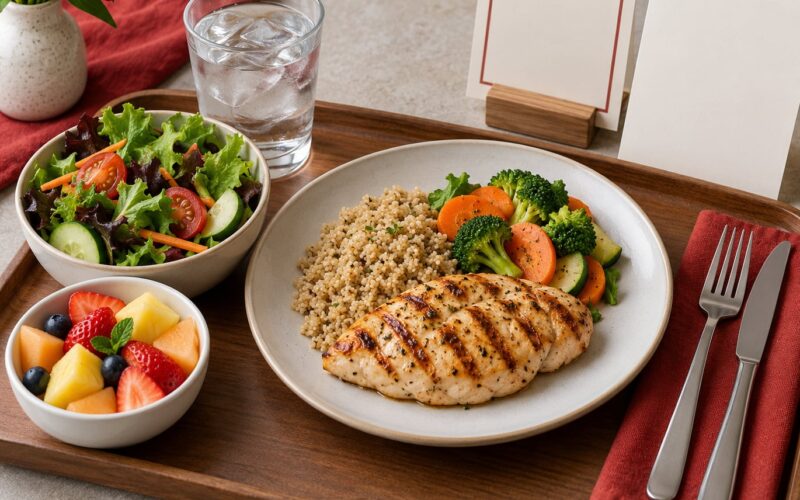
The simplest way to build a filling high fiber meal is to work from four components rather than counting grams. Take a fiber-rich whole grain, a bean or other protein, vegetables or fruit, and a small amount of healthy fat, and most meals assemble themselves in about ten minutes.
Portion guidance is looser than people expect. A half cup of cooked grain, a half to three-quarter cup of beans, two fists of vegetables, and a tablespoon or two of fat covers most adults, and the plate looks fuller than the numbers suggest.
Protein is the piece most high fiber advice leaves out, and it matters. Fiber with no protein can leave you hungry again in an hour, so pairing them is what makes the approach hold. Three combinations that work:
- Breakfast: Half a cup of dry oats cooked in milk, half a cup of raspberries, one tablespoon of ground flaxseed, and a small handful of walnuts. Roughly 9 to 10 grams of fiber with about 12 grams of protein.
- Lunch: A base of two-thirds cup quinoa, half a cup of chickpeas, a cup of raw or roasted vegetables, and a lemon olive oil dressing. Around 13 grams of fiber.
- Dinner: A cup of lentil or vegetable soup, one slice of whole wheat bread, a green salad, and an apple afterward. Around 15 grams of fiber across the day.
None of these take longer than the time the microwave takes for leftovers, which is the real reason they survive a busy week. What you cook on Sunday is what you eat on Wednesday.
Frequently Asked Questions
Which high fiber foods keep you full the longest?
Whole grains and legumes usually outlast fruit. A cup of lentil soup, a bowl of barley, or a large serving of oatmeal combines fiber with protein and holds hunger for several hours, while apple or pear on their own fade sooner. Foods that absorb water and swell, like oats, barley, chia, and beans, add bulk that stretches the stomach. Meals that mix fiber, protein, and a little fat last longest of all.
How much fiber should an adult eat each day?
About 25 grams a day for adult women and 38 grams for adult men, according to the National Academies of Sciences, Engineering, and Medicine. A useful alternative benchmark is 14 grams of fiber for every 1,000 calories eaten, which adjusts the target to your own intake. Most Americans eat about half of that. Check the Nutrition Facts label, where 5 grams or more per serving counts as an excellent source.
Do high fiber foods help you lose weight?
They help, but not on their own. Fiber increases fullness while adding few calories, which can reduce total intake without deliberate dieting, and it supports steadier blood sugar between meals. Research on fiber and weight loss is mixed because calorie balance still decides the outcome. Think of high fiber foods as a tool that makes a calorie-controlled plan easier to follow, not as a weight loss method by itself.
What are the best high fiber foods for breakfast?
Oats lead the list, at about 4 grams of fiber per cooked cup, and they are better still with berries, nuts, or yogurt added. Ground flaxseed and chia seeds are the fastest upgrades, each adding roughly 4 to 5 grams per tablespoon. A pear or an apple with the skin adds 4 to 5 grams, and an egg or Greek yogurt supplies the protein that keeps you full past mid-morning.
How do I eat more fiber without getting bloated?
Increase fiber gradually, about 5 grams every few days, rather than jumping to a high fiber diet overnight. Drink enough water throughout the day so fiber has the fluid it needs to move through your system. Spread your intake across meals instead of loading it all onto dinner, and start with foods your gut already tolerates, such as oats, bananas, and rice before working up to beans and lentils.
Conclusion
The high fiber foods that keep you full share three things: a lot of fiber per serving, a small calorie count, and enough volume or chew to slow you down. Beans, lentils, oats, barley, raspberries, pears, apples with the skin, avocado, chia, ground flaxseed, and broccoli all hit that mark, and every one of them is ordinary food you can buy on a normal grocery run.
The part that actually decides whether it works is what surrounds the fiber. Protein and fluid turn a plate of high fiber foods into a meal that holds, and a slow ramp-up is what keeps your stomach on your side while you get there.
So start with one thing this week. Pick a meal you already cook, and add a bean, a vegetable, a piece of fruit with the skin on, or a swap to a whole grain. Most people find the second and third changes follow on their own once the first one sticks.