High protein breakfast ideas for weight loss work because protein changes how long you stay full, not because breakfast itself burns fat. Aim for roughly 20-30 grams of protein in the morning meal, add some fiber alongside it, and keep the rest of the plate measured. That single combination is what cuts the 10:30 snack and the late-afternoon overeat that quietly wrecks a calorie deficit.
Below are ten breakfasts I keep coming back to, each with approximate protein grams, calorie range, and how long it takes. Some are ready in two minutes, some are batch-cooked on Sunday. Gram counts are estimates from standard food composition data, so treat them as a guide rather than a lab result. For your own numbers, especially if you have a medical condition or take medication, a registered dietitian can set a target that fits you.
Table of Contents
- High Protein Breakfast Ideas for Weight Loss at a Glance
- 1. Greek Yogurt with Berries and Chia Seeds
- 2. Cottage Cheese with Peach and Pistachios
- 3. Scrambled Eggs with Spinach and Feta
- 4. Egg and White Cheese Breakfast Wrap
- 5. Protein Oatmeal with Peanut Butter
- 6. Tofu and Vegetable Scramble
- 7. Smoked Salmon Bagel with Cottage Cheese
- 8. Turkey and Egg Breakfast Muffin Cups
- 9. Protein Smoothie with Milk, Fruit, and Seeds
- 10. Low-Carb Breakfast Pizza with Chicken and Vegetables
- Frequently Asked Questions
- What is a good protein breakfast for losing weight?
- How much protein do I need at breakfast to lose weight?
- Is 2 eggs a high protein breakfast?
- Will a high protein breakfast help me lose belly fat?
- Do I need protein powder for a high protein breakfast?
- Can I eat a high protein breakfast if I’m vegetarian?
- Conclusion
High Protein Breakfast Ideas for Weight Loss at a Glance
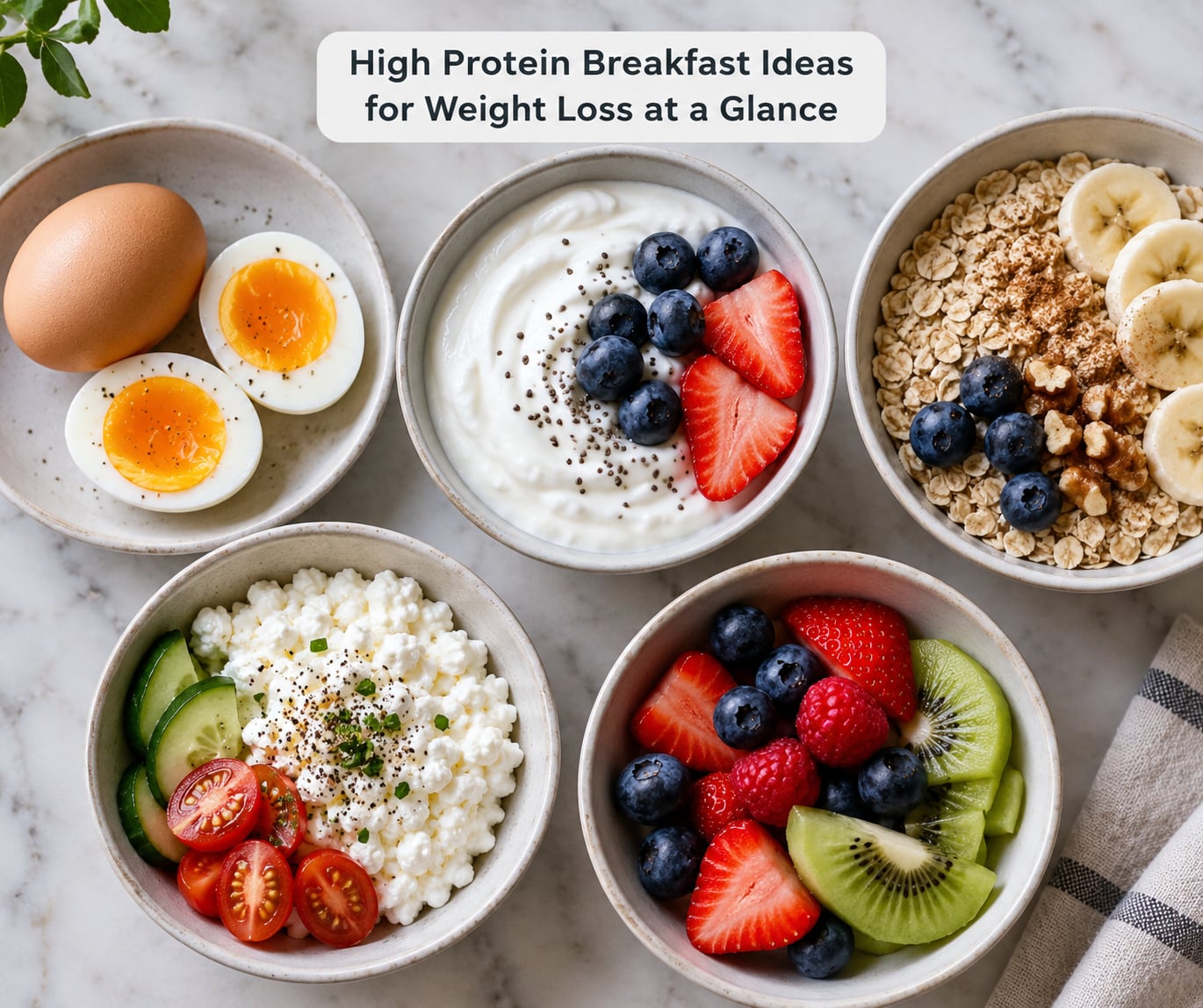
Here is the whole list on one page, so you can pick by protein source, time, and portability rather than scrolling.
| Breakfast | Main protein source | Protein (approx.) | Calories (approx.) | Prep time | Best for |
|---|---|---|---|---|---|
| Greek yogurt with berries and chia | Greek yogurt | 22-28 g | 280-400 | 3 min | No cook, portable |
| Cottage cheese with peach and pistachios | Cottage cheese | 24-28 g | 300-380 | 4 min | Sweet-savory, filling |
| Scrambled eggs with spinach and feta | Eggs plus egg whites | 25-30 g | 300-400 | 10 min | Savory, low carb |
| Egg and white cheese breakfast wrap | Eggs plus turkey | 28-35 g | 350-450 | 12 min | Commutes, shift work |
| Protein oatmeal with peanut butter | Oats plus milk or powder | 25-32 g | 380-480 | 8 min | Sweet, pre-workout |
| Tofu and vegetable scramble | Firm tofu | 24-30 g | 300-400 | 12 min | Plant-based, egg-free |
| Smoked salmon bagel with cottage cheese | Smoked salmon | 25-30 g | 350-450 | 5 min | No cook, low carb |
| Turkey and egg breakfast muffins | Eggs plus turkey | 18-22 g per cup | 150-200 per cup | 35 min batch | Meal prep, grab and go |
| Protein smoothie with fruit and seeds | Milk or yogurt plus powder | 25-35 g | 250-400 | 3 min | No time, no appetite |
| Low-carb breakfast pizza with chicken | Chicken plus eggs or cheese | 28-35 g | 350-450 | 15 min | Low carb, picky eaters |
1. Greek Yogurt with Berries and Chia Seeds
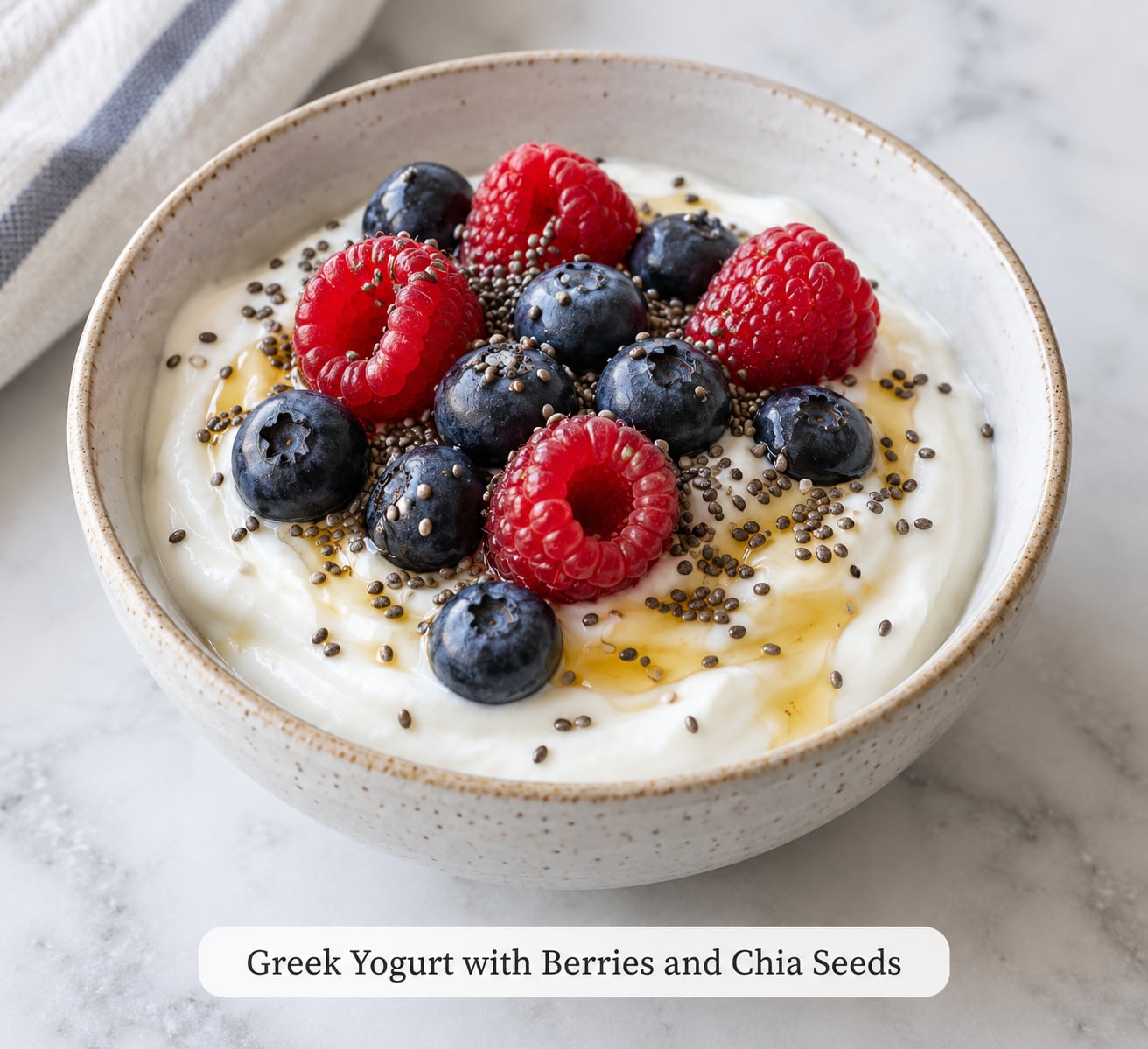
Greek yogurt is the easiest 20-gram protein anchor you can buy, and plain versions are the ones to pick. Flavored varieties carry 15 to 20 grams of added sugar, which is exactly the thing that blows a breakfast calorie target.
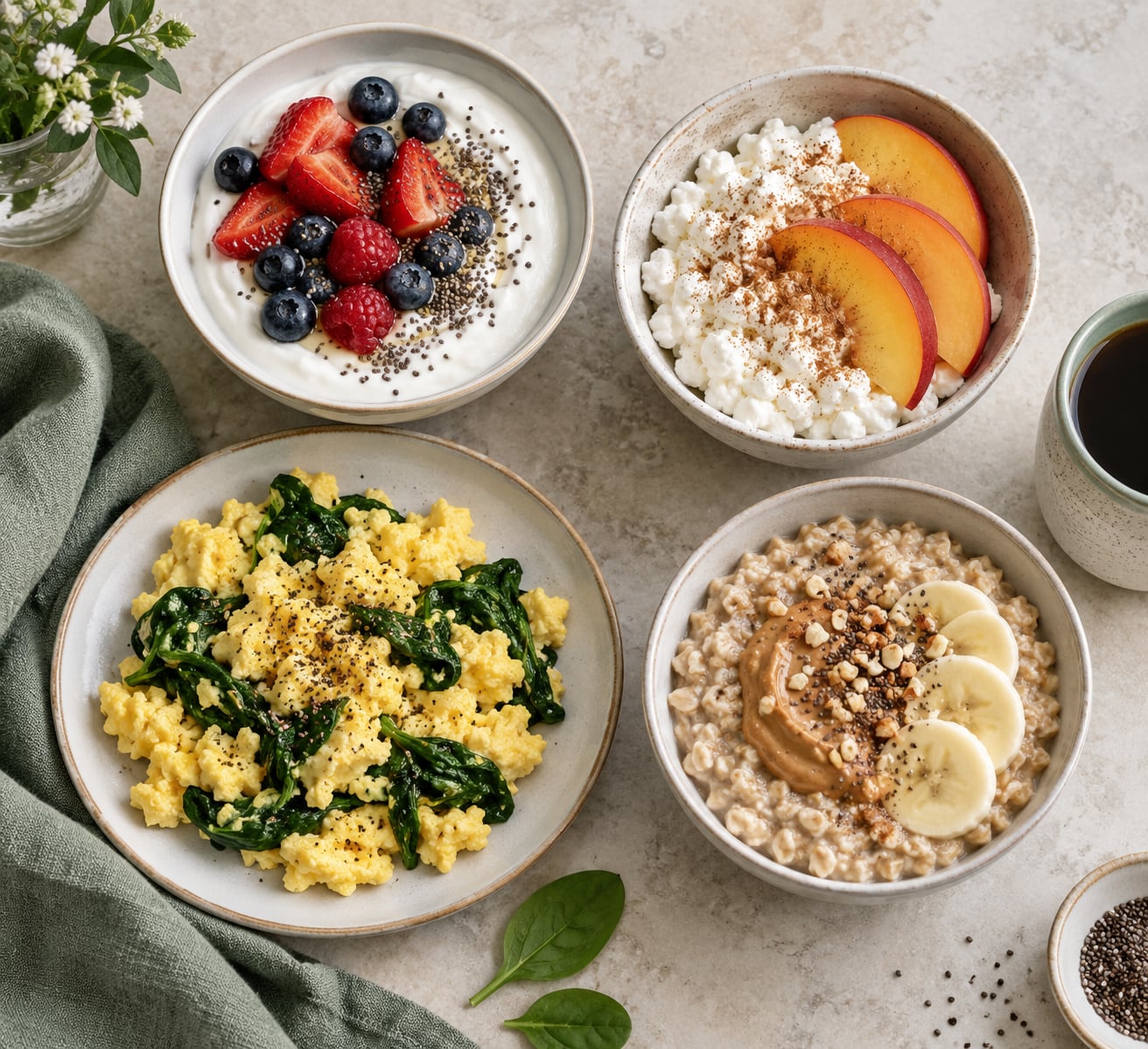
Build it like this: 3/4 cup plain nonfat Greek yogurt, a handful of berries, a tablespoon of chia seeds mixed in rather than sprinkled on top, and a teaspoon of honey if you need it. That lands somewhere around 22 to 28 grams of protein and 280 to 400 calories, depending on the yogurt fat content and how much honey you use.
Chia seeds add about 5 grams of protein and roughly 10 grams of fiber per tablespoon, and they thicken the bowl enough that it eats like something more substantial than yogurt. Mix them in and wait five minutes if you like the texture, or stir them straight through.
Practical note: if your mornings are rushed, mix this in a jar the night before. The oats-style jar breakfast is the single most repeated favorite in meal prep communities, and a yogurt version keeps the same rhythm without the chewing.
2. Cottage Cheese with Peach and Pistachios
Cottage cheese gets dismissed as diet food, mostly because people eat it plain out of the container. It works better as a base, because you can push it sweet or savory depending on the morning.
For the sweet version, use 3/4 cup low-fat cottage cheese, half a sliced peach, and a tablespoon of chopped pistachios. That gives you roughly 24 to 28 grams of protein and 300 to 380 calories. The pistachios are there for fat and staying power, not for crunch, so a tablespoon is plenty.
For the savory version, swap the fruit for cherry tomatoes, the pistachios for a teaspoon of olive oil and black pepper, and add a strip of bacon or a handful of leftover shredded chicken. The protein lands in a similar range.
Practical note: full-fat cottage cheese is higher in calories but also higher in protein density. Either works; pick the one that keeps you full to lunch instead of grazing by 10:30.
3. Scrambled Eggs with Spinach and Feta
Eggs alone rarely clear the target. Two large eggs deliver about 12 grams of protein, which is the single most misunderstood point in this whole topic, and the fix is simple: add whites.
Cook two whole eggs plus three or four egg whites, and you land near 25 to 30 grams. Wilt a big handful of spinach and a tablespoon of crumbled feta into the pan at the end. The whole thing comes in around 300 to 400 calories depending on how much oil goes in.
Technique matters more than people expect. Set the heat to medium, add a teaspoon of oil, and move the eggs constantly with a spatula in small curds. High heat gives you rubbery egg and dries out the whites, which is where most people give up on egg breakfasts.
Practical note: cook double the eggs and keep half for tomorrow’s wrap. Scrambled eggs reheat better than a full omelet, and it saves you seven minutes the next morning.
4. Egg and White Cheese Breakfast Wrap
This is the most portable option on the list, which makes it the one that survives a commute, a shift change, or a 6 a.m. departure.
Scramble two eggs and three whites, add a strip of cooked turkey or two slices of turkey bacon, and pile it onto a whole-grain tortilla with a slice of pepper jack or a thin layer of Greek yogurt. Fold it in and cook it seam-side down for a minute or two so it holds together. You get roughly 28 to 35 grams of protein in 350 to 450 calories.
Sodium is the thing to watch here, since turkey bacon, cheese, and tortillas stack up fast. Choose a single source of it rather than all three, and add spinach, peppers, or onions for volume instead of piling on cheese.
Practical note: a whole-grain tortilla brings more fiber than a white flour one and slows the digestion of the eggs. That fiber is doing real work on the fullness side.
5. Protein Oatmeal with Peanut Butter
Plain oatmeal is a slow carb with almost no protein, which is why a bowl of it leaves people hungry by 10. You fix that in the bowl rather than beside it.
Cook 1/2 cup of dry oats in 1 cup of milk instead of water, then stir in a scoop of protein powder or 1/2 cup of Greek yogurt after it comes off the heat. Top with half a banana and one tablespoon of peanut butter. That runs 25 to 32 grams of protein and 380 to 480 calories.
The balance point matters: the peanut butter is a fat, and fat plus fiber plus protein is what keeps a breakfast from being a snack. Two tablespoons is where a bowl stops being breakfast and starts being a dessert.
Practical note: savory oats work too. Skip the honey and berry, and add a poached egg, a spoon of nutritional yeast, and a handful of spinach instead. Same macros, different mood.
6. Tofu and Vegetable Scramble
If eggs are not your thing, this is the one to make. Firm tofu carries about 20 to 25 grams of protein per half block, and the texture comes from how you treat it, not from a special variety.
Drain half a block of firm tofu, press it for ten minutes under something heavy, then crumble it into a hot pan with a teaspoon of oil. Leave it alone for two minutes before touching it so it browns, then add diced onion, bell pepper, and spinach. Finish with nutritional yeast, salt, and pepper.
That gives you roughly 24 to 30 grams of protein and 300 to 400 calories. Skip the pressing step and you get watery eggs; press it and you get something with actual texture. That is the whole trick.
Practical note: tofu scramble reheats well and keeps three days in the fridge, so it fits a batch cook as easily as the egg version.
7. Smoked Salmon Bagel with Cottage Cheese
This is a five-minute assembly job, and it is the lowest-carb option that still feels like breakfast rather than a workaround.
Toast a small whole-grain bagel half, spread 1/3 cup cottage cheese on it, and drape over 2 ounces of smoked salmon with cucumber slices, red onion, dill, and cracked pepper. Roughly 25 to 30 grams of protein and 350 to 450 calories.
Smoked salmon is where the sodium comes from, and people who watch their salt should eat a lighter serving and lean on the cottage cheese for the protein. A cream cheese and cucumber version with lox only on one side works well.
Practical note: use a small bagel half rather than a full one. It cuts the carbohydrate without cutting the protein, which is the whole point of ordering breakfast this way.
8. Turkey and Egg Breakfast Muffin Cups
Egg muffins are the batch-cook workhorse: one 35-minute tray produces a week of mornings that take zero effort. They are also the option that suits shift workers best, since each cup travels in a container without a fork.
Whisk 8 eggs, add 8 ounces of chopped cooked turkey breast, a handful of diced bell pepper and spinach, and a quarter cup of shredded cheese. Divide into a greased 12-cup muffin tin, about three eggs per cup, and bake at 350 F for 20 to 25 minutes.
Each cup lands around 18 to 22 grams of protein and 150 to 200 calories. Two cups clear 36 grams, which handles a higher target or a post-workout morning. Cool them fully before lidding the container so they do not steam themselves soggy.
Practical note: they freeze well for up to two months. Reheat two at a time in the microwave for about 45 seconds, or eat one cold on the way out the door.
9. Protein Smoothie with Milk, Fruit, and Seeds
The smoothie is here for mornings when eating simply is not happening. No appetite, rushing, or a leftover smoothie from yesterday that has not met a blender yet.
Blend 1 cup of milk or unsweetened plant milk, 1/2 cup of Greek yogurt, a handful of frozen berries, one scoop of protein powder, and a tablespoon of chia or ground flax. Between 25 and 35 grams of protein and 250 to 400 calories.
Two things decide whether it works. First, the yogurt, which adds protein and thickness and stops it tasting like flavored water. Second, blending it thick rather than thin, because a thin drink is a beverage you will not feel full from.
Practical note: drink it with food, not in place of it, if your history includes evening binges. Blended calories register differently than solid ones, and that gap is a common trap in the first weeks.
10. Low-Carb Breakfast Pizza with Chicken and Vegetables
This is the one that gets picked up by kids and by adults who have been eating oatmeal for a month and quietly resent it.
Heat a small oven-safe skillet in the oven at 450 F, or use a low-carb crust. Whisk two eggs plus two whites, pour it in, and add 3 ounces of shredded chicken, a handful of spinach, and diced bell pepper. Bake 10 to 12 minutes until the edges set. That is 28 to 35 grams of protein and 350 to 450 calories.
For crust, either use a low-carb wrap pressed into a skillet as a base, or go crustless and let the eggs form the base. The egg version is lower in carbs and holds together better than a wrap does.
Practical note: add a side of berries or a piece of fruit if this is your main breakfast. Very low-carb mornings without any fiber tend to backfire by 11 a.m. for most people.
Frequently Asked Questions
What is a good protein breakfast for losing weight?
A good protein breakfast for losing weight delivers 20-30 grams of protein plus fiber and measured calories. Think plain Greek yogurt with berries and chia, cottage cheese with fruit, or eggs with spinach and feta. The protein extends fullness, the fiber slows digestion, and keeping calories in a 300-450 range leaves room for the rest of the day.
How much protein do I need at breakfast to lose weight?
Most people do well with 20-30 grams at breakfast, and 25-35 grams if you are lifting weights or already eating a high-protein diet. Spread that over three meals instead of one large serving. Breakfast matters because it sets the pattern, not because protein is magic there. What matters more is hitting your total daily target.
Is 2 eggs a high protein breakfast?
Two large eggs give you about 12 grams of protein, which is under the 20-gram floor for a high-protein breakfast. It is a fine food, just a small serving. Add three or four egg whites, or serve the eggs alongside cottage cheese, Greek yogurt, or turkey, and you are in range without a big change in calories.
Will a high protein breakfast help me lose belly fat?
No single breakfast targets belly fat, and no breakfast creates a deficit on its own. What it does is reduce hunger for the next three to five hours, which makes it easier to eat fewer calories across the whole day. Belly fat loss still comes down to your overall calorie balance and how much you move.
Do I need protein powder for a high protein breakfast?
No. Powder is the fastest way to add 20 to 25 grams, and it is useful when you are short on time, but it is not required. Greek yogurt, cottage cheese, eggs, tofu, canned fish, turkey, and even a scoop of dry cottage cheese will get most people into range without a tub in the cupboard.
Can I eat a high protein breakfast if I’m vegetarian?
Yes, and dairy plus eggs plus tofu plus protein powder gives you plenty of room. A tofu scramble with spinach and nutritional yeast sits near 25 to 30 grams, and cottage cheese with fruit sits in a similar range. If you eat no dairy or eggs, lean on tofu, tempeh, seitan, and plant protein powders.
Conclusion
Pick the one breakfast on this list you would eat on a bad Tuesday, not the one that photographs best, and make it repeatable. Start with a 20-gram target, add fiber and a small measured fat, and adjust portions alongside your overall eating and activity. If you want a number built for your own body, a registered dietitian can set it in a single visit.