
Calculating your calorie deficit takes about fifteen minutes with a calculator and an honest look at a normal week. You estimate your basal metabolic rate, multiply it by an activity factor to get maintenance calories, then subtract a moderate amount. If the number that comes out feels too low to actually eat, the inputs are wrong rather than you.
This guide walks through how to calculate your calorie deficit for fat loss step by step, including a full worked example with real numbers. Most people get stuck on one specific jump: turning a formula into a daily number they can live on. I will also flag the small measurement mistakes that quietly throw the whole calculation off.
Table of Contents
- What You Need
- Step-by-Step: How to Calculate Your Calorie Deficit for Fat Loss
- Step 1: Estimate Your Basal Metabolic Rate
- Step 2: Account for Your Daily Activity
- Step 3: Estimate Your Maintenance Calories
- Step 4: Choose a Realistic Calorie Deficit
- Step 5: Calculate and Track Your Daily Calorie Deficit Target
- Common Mistakes
- Frequently Asked Questions
- Are online calorie-deficit calculators accurate?
- Should I subtract exercise calories from my calorie deficit?
- How soon should I know whether my calorie target is working?
- What if my calorie target feels too low or I feel hungry?
- Can I lose fat without counting calories?
- When should I consult a doctor or registered dietitian for weight loss?
- Conclusion
What You Need
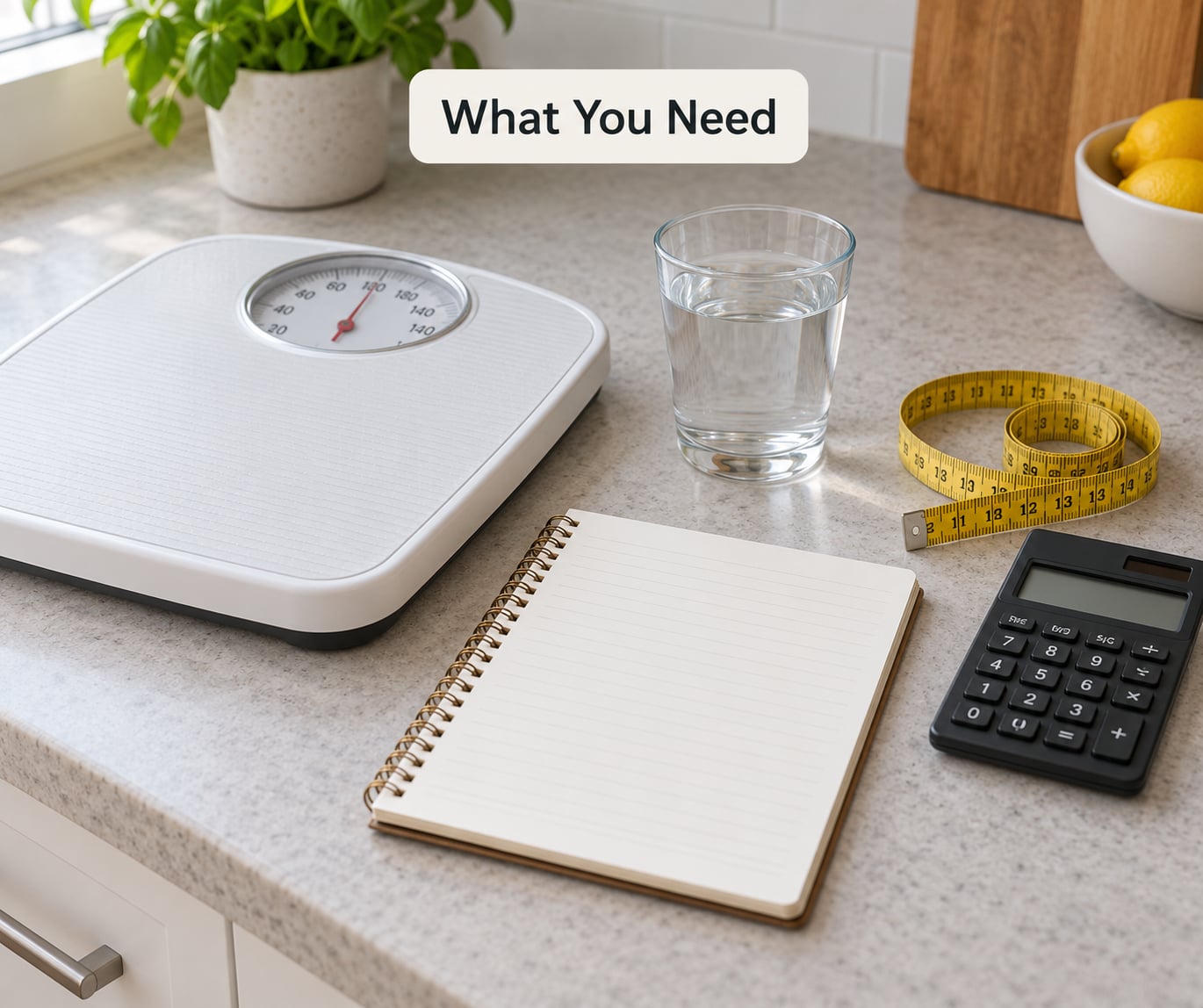
You need six things before the math starts, and five of them take under a minute to write down.
- Current weight, in pounds or kilograms, measured first thing in the morning on a hard floor.
- Height, measured against a wall rather than estimated from memory.
- Age in years.
- Sex, because the two standard formulas differ.
- Activity level for a typical week, including your job, not just your workouts.
- A tracking method you will still be using in four weeks, whether that is a food scale with a notebook or a logging app.
One honest note before you go further. Every number in this guide is an estimate produced by an equation, not a measurement taken in a lab. Two well-run calculators can disagree by several hundred calories for the same person, and the person is usually closer to the truth than either of them.
Anyone with a medical condition, anyone who is pregnant or breastfeeding, anyone with a history of disordered eating, and anyone noticing dizziness, fatigue, or disrupted sleep while eating less should talk to a doctor or registered dietitian first. They can also help when you have a specific goal, a training schedule, or a history of weight cycling that a general formula cannot account for.
Step-by-Step: How to Calculate Your Calorie Deficit for Fat Loss
Step 1: Estimate Your Basal Metabolic Rate
Basal metabolic rate, or BMR, is the number of calories your body burns while doing absolutely nothing but staying alive. It is the floor under your total energy needs, and every other number in this process is built on top of it.
The most widely used equation is the Mifflin-St Jeor formula, developed in 1990 and generally considered more accurate than the older Harris-Benedict equation for most adults.
For men: BMR = (10 x weight in kg) + (6.25 x height in cm) – (5 x age) + 5
For women: BMR = (10 x weight in kg) + (6.25 x height in cm) – (5 x age) – 161
If you think in pounds and inches, convert first. Divide pounds by 2.2 for kilograms and multiply inches by 2.54 for centimeters, then work the formula in metric.
Step 2: Account for Your Daily Activity
BMR on its own is not what you burn in a day. The multiplier below estimates how much more than resting you expend based on movement, and the category that fits you is the one that describes a normal seven-day average rather than your best week of the year.
- 1.2, sedentary: desk work, little deliberate exercise, sitting for most of the day.
- 1.375, lightly active: light exercise one or two days a week, or a job that keeps you on your feet.
- 1.55, moderately active: moderate exercise three to five days a week, or a physically demanding job.
- 1.725, very active: hard exercise six or seven days a week, or a job plus training.
- 1.9, extra active: physical work every day plus hard training, or an unusually high training load.
When people ask whether they should subtract exercise calories from their intake, this is the step that answers it. If your multiplier already reflects a week that includes your workouts, exercise calories are already counted. Subtracting them again is the single most common double-counting mistake, and it shows up constantly in forum discussions on r/loseit and r/CICO.
The other part of this step is non-exercise activity thermogenesis, or NEAT, the calories burned through ordinary movement like walking, standing, housework, and fidgeting. It varies enormously between people, and it is the main reason two people with identical measurements can have genuinely different maintenance calories. Eight thousand steps a day is a reasonable target for most adults who want a deficit that holds up.
Step 3: Estimate Your Maintenance Calories
Maintenance calories are the total number you would eat to hold your current weight steady. Multiply your BMR by the activity multiplier you picked in Step 2.
Multiply 1,345 by 1.375 and you get roughly 1,850 calories. That is the number you subtract from, not the number you eat. Plenty of people get this wrong by treating their BMR as their target, which is why so many beginners calculate a 1,345-calorie goal and cannot stay on it.
Step 4: Choose a Realistic Calorie Deficit
Here is where restraint pays off. A moderate deficit of roughly 400 to 500 calories a day is a common starting point, and it usually produces about a pound of fat loss per week using the rough rule of thumb that 3,500 calories equals one pound of body fat. That rule is a simplification, and real results are messier, but it is good enough for planning.
Deficits in the 750 to 1,000 calorie range produce faster loss and are much harder to sustain. They also raise the odds of losing muscle along with fat unless protein intake and resistance training are handled properly.
A rough planning guide puts commonly recommended minimum intake levels at around 1,200 calories for women and 1,500 for men. If your target lands below that, that is a signal to get individual guidance rather than to push harder, and it is not a personalized prescription for you.
One more thing belongs here. If your target comes out below 1,200, the most likely explanation is an activity multiplier set too low, not a body that needs almost no food.
Step 5: Calculate and Track Your Daily Calorie Deficit Target
Subtract your chosen deficit from maintenance, then round to a number you can actually hit.
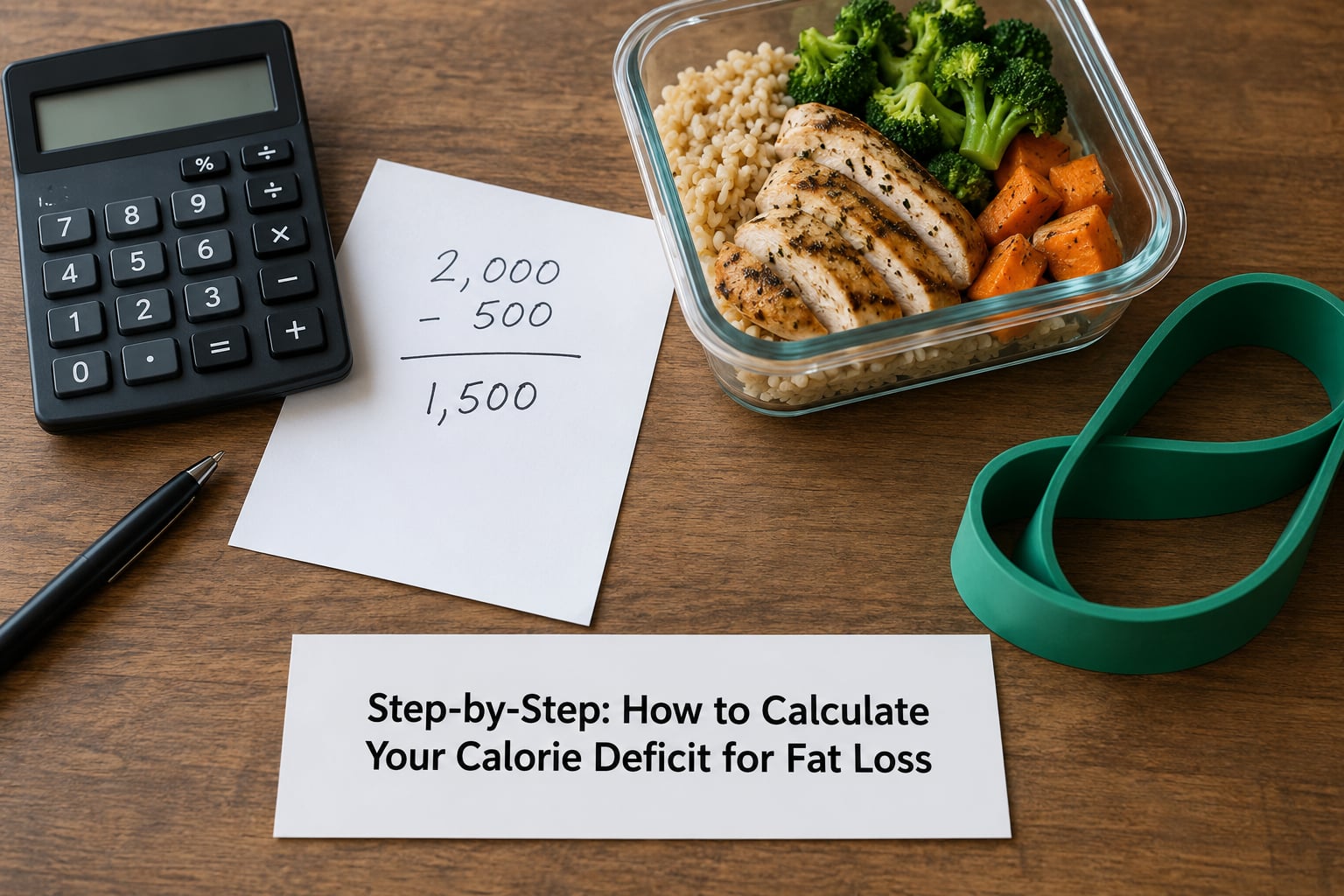
1,850 minus 500 gives you 1,350 calories a day.
As a second example, a 40-year-old man at 180 cm and 85 kg gets a BMR of 850 + 1,215 – 200 + 5, which is 1,870. At a moderately active 1.55, that is about 2,900 calories for maintenance, and a 500-calorie deficit puts him at roughly 2,400.
Now compare actual intake with that target. Weighing food for the first two weeks catches most of the gap, because restaurant meals, cooking oils, and packaged sauces are the usual reasons logged calories land well below what was actually eaten.
Then judge the trend over two to four weeks, not one morning. Weight moves for reasons that have nothing to do with fat, and women in particular often see two to five pounds of water weight swing across a menstrual cycle. Look at the average of your weekly numbers and ask whether the line is moving. If it is not moving after a month of honest tracking, that is an adjustment problem, and the fix is usually 100 to 200 fewer calories or more daily movement, not a dramatic cut.
Common Mistakes
These are the errors that come up most often, and each one has a straightforward fix.
- Treating BMR as maintenance calories. Your BMR is the calories you burn lying still. Multiply it by an activity factor before treating it as a daily number, or you will cut far more than you intended.
- Subtracting exercise calories twice. If the multiplier already includes your training week, those calories are in the number. Either build them into the multiplier or count them separately, never both.
- Picking a deficit that is too large to hold. A 1,000-calorie deficit on a 1,850 maintenance target leaves 850 calories, which most people cannot sustain for long. Start at 400 or 500 instead, then tighten later if you need to.
- Running the same old numbers. A formula set up with your weight from six months ago is no longer your BMR. Reweigh and recalculate every four to six weeks; maintenance calories fall as you do.
- Only counting weekdays. Two high-calorie weekend days can erase several days of careful tracking. Average the whole week, all seven days, before deciding whether the target is working.
- Reacting to a single bad scale reading. One number tells you almost nothing. Weight fluctuates daily with water, salt, bowel movements, and training. Judge the trend across weeks.
Habits that make a moderate deficit easier to live with are mostly about food quality rather than more restriction. Eat regular meals instead of skipping them, because skipped meals usually become evening catch-up eating. Prioritize protein, generally around 0.8 to 1 gram per pound of body weight, to help preserve muscle. Include fiber and volume foods so meals stay filling. Keep the same meal structure you already have and change small things, such as swapping a sugary drink for sparkling water or using half the oil in a stir-fry. Adjust in small increments rather than rewriting everything at once.
Frequently Asked Questions
Are online calorie-deficit calculators accurate?
No calculator is accurate in the way a laboratory measurement is. They are equations applied to four inputs, so two tools can differ by several hundred calories for the same person. Treat any result as a starting point, then adjust based on two to four weeks of real weight data. The formula matters less than staying consistent with your measurements and honestly logging what you eat.
Should I subtract exercise calories from my calorie deficit?
Only if your activity multiplier does not already account for your training. If you picked 1.55 because you exercise three to five days a week, the exercise calories are already built in, and subtracting them again puts you in a much larger deficit than you intended. Pick one method and stick with it. Watch devices tend to overestimate burn anyway, so treat their numbers as rough guidance.
How soon should I know whether my calorie target is working?
Give it two to four weeks. Daily weight is dominated by water, salt, bowel movements, and for many women, the menstrual cycle, so single readings tell you nothing useful. Look at the average of your weekly weights instead. A working target shows a slow downward trend over a month, not a change you can see tomorrow morning on the scale.
What if my calorie target feels too low or I feel hungry?
Check your inputs first. Most unrealistically low targets come from an activity multiplier set too low, not from a body that needs almost no food. Add 200 to 300 calories, usually from protein and fiber, and adjust after another two weeks. Persistent hunger, fatigue, poor sleep, or obsessive thinking about food are reasons to stop pushing and get professional guidance.
Can I lose fat without counting calories?
Yes, though the deficit still exists whether you measure it or not. Plenty of people lose fat by eating whole foods, protein at every meal, and portions they can eyeball, without logging a single number. The method in this guide simply removes the guesswork for people who want a specific number to adjust. Either approach works, as long as you are eating less than you burn.
When should I consult a doctor or registered dietitian for weight loss?
Consult one if you have a medical condition, take regular medication, are pregnant or breastfeeding, or have a history of disordered eating. Also seek guidance if your calculated target falls below commonly recommended intake levels, if you feel unwell while cutting, or if you have a specific goal and deadline. A professional can account for things a general equation cannot.
Conclusion
The whole method comes down to four numbers: your BMR, an honest activity multiplier, the deficit you subtract, and the weeks of data you use to check it. Start by recording your current weight, height, age, and sex, then estimate your maintenance calories. Choose a moderate deficit of 400 to 500 calories a day, and give it two to four weeks before deciding whether to adjust anything.
Most people who struggle with this are not bad at math. They are starting from a number their body cannot sustain, or judging results from a single morning on the scale.