
Hunger in a calorie deficit is normal, but it does not have to run your whole day. The practical answer to how to control hunger while in a calorie deficit is fairly boring and very repeatable: keep the deficit moderate, anchor every meal to protein, fiber and volume, eat slowly, drink water before you eat, and protect your sleep. Adjust those five things and most people notice a shift within a week.
This guide is general information for adults, not a personal eating plan. If you are managing diabetes, a history of disordered eating, or any medical condition, talk to a doctor or a registered dietitian before changing how much you eat.
Table of Contents
- What You Need
- Step-by-Step
- Start With a Moderate Deficit
- Build Meals Around Protein, Fiber, and Volume
- Eat Regularly and Plan Ahead
- Choose Foods You Actually Enjoy
- Manage Hunger Cues Instead of Reacting
- Support Hunger Control With Sleep and Movement
- Common Mistakes
- Frequently Asked Questions
- How long does hunger last in a calorie deficit?
- Is it normal to be constantly hungry in a calorie deficit?
- How do I deal with hunger at night when dieting?
- Is 1,200 calories a day starving?
- Should I eat if I am hungry but trying to lose weight?
- Do appetite suppressants and weight-loss medications help with hunger?
- Conclusion
What You Need
Most hunger problems start before the diet does. They start with a plan that is too tight, a meal that is mostly carbs, or a week with no structure at all. Get five things in place first, and the steps below get much easier to follow.
A moderate deficit number. Start roughly 15 to 20 percent below what you currently eat to maintain your weight. That is the range most dietitians point to because it takes off about half a pound to a pound a week without turning every waking hour into a negotiation with food.
One week of honest tracking. Before cutting anything, log what you normally eat for seven days. Restaurant portions, cooking oil, and nut butter are where most people lose count, and finding those gaps first is often enough to create the deficit without eating less real food.
A protein target you can hit. For most adults aiming to lose fat, roughly 1 gram per pound of goal body weight each day is a workable anchor. Higher end ranges are often quoted for people lifting heavy, and they matter more for holding muscle than they do for hunger.
Water within reach. A filled bottle, a glass at your desk, and a habit of drinking a full glass before each meal. Most of what people read as mid-afternoon hunger is thirst that nobody has tested.
Two or three go-to meals you actually like. Not aspirational meals from a cookbook. Meals you will cook on a Wednesday when you are tired, built from the same three or four ingredients, so decisions stop costing you mental energy.
A routine that survives a bad day matters more than a perfect plan. If your week includes one 20-minute walk and one planned snack, you have already built the thing that keeps a deficit going.
Step-by-Step
Six steps, in the order that works best. Each one gives you an action and a way to tell whether it is doing anything for you.
Start With a Moderate Deficit
Choose a deficit you could hold for twelve weeks, not four days. Fifteen to twenty percent under maintenance is the widely used starting range, and a steady loss of roughly half a pound to a pound a week is a fair sign the size is right.
Track three things weekly rather than weighing yourself daily: your average weight over seven days, your energy during the afternoon, and your strength in the gym. A deficit that pulls weight down while leaving you flat and weak is too big, no matter what the scale says that morning.
Build Meals Around Protein, Fiber, and Volume
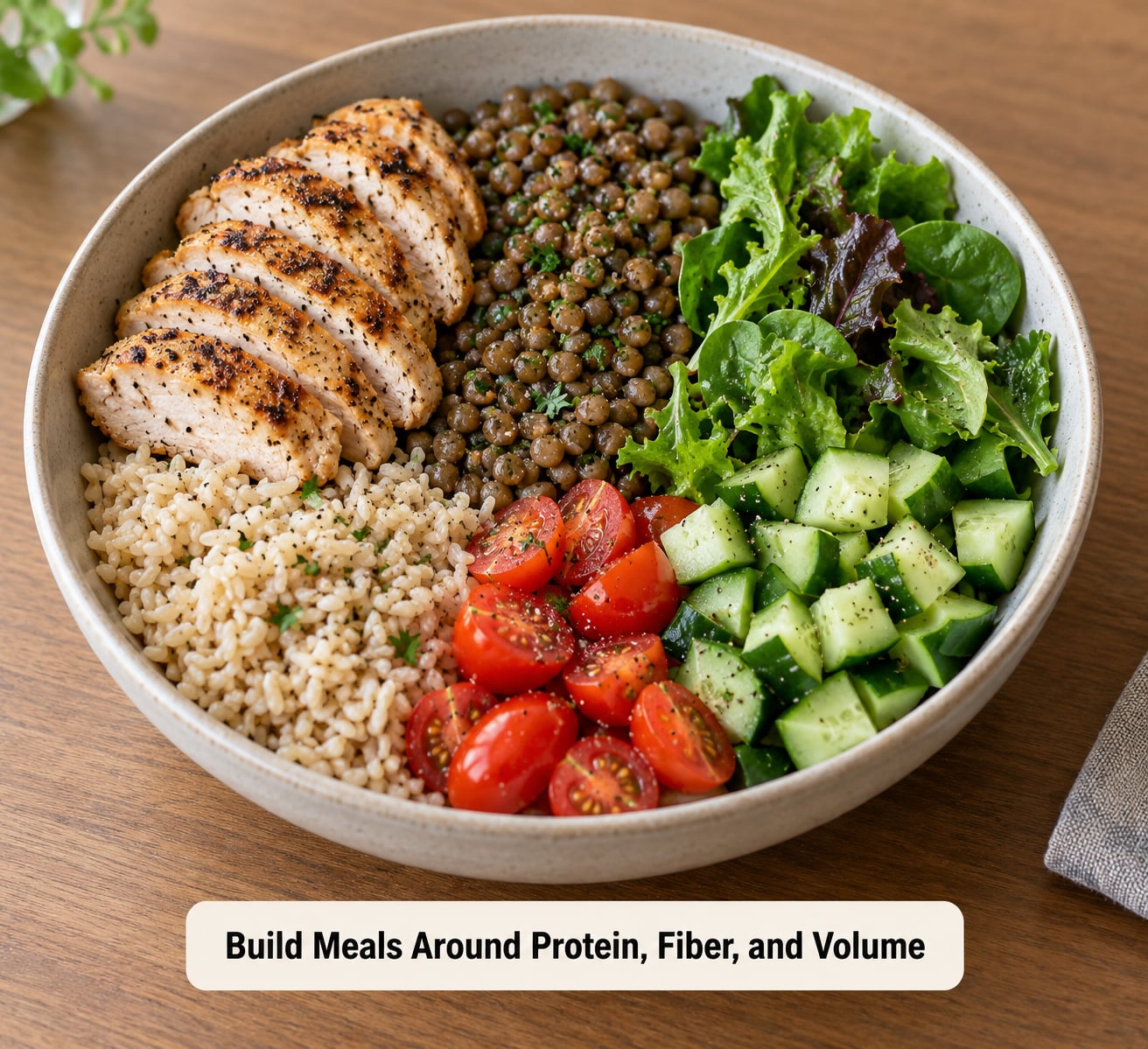
Build the plate protein first, then vegetables, then the carbohydrate, rather than the other way around. A quarter of the plate protein, half non-starchy vegetables, and a quarter of a starch such as rice or bread is a simple template that works for most people without weighing anything.
Fiber is the quiet lever. Most adults eat well under the 30 grams a day that public health guidance suggests, and closing that gap with beans, lentils, oats, berries, and vegetables adds bulk and slows digestion. A cup of lentils has more fiber than a cup of white rice, and that difference shows up an hour later as the difference between steady and desperate.
Volume does the rest. A large bowl of greens, cucumber, peppers, and broth-based soup costs far less than a snack bar and occupies the same space in your stomach. If you are hungry again twenty minutes after eating, the meal was probably too small for its calories rather than missing something magical.
Eat Regularly and Plan Ahead
Long gaps between meals make hunger louder, not quieter. Three meals with one or two planned snacks usually beats two large meals if you struggle at night, because the second meal arrives after a day of under-fueling.
Front-load calories where you can. When your schedule allows, put more of your intake at breakfast and lunch and keep dinner lighter, since most people report evening hunger as the hardest to outrun. Decide the next day’s lunch before you leave for work in the morning, when you are not negotiating with yourself.
How to control hunger while in a calorie deficit becomes a planning problem more than a willpower problem here. The people who do best are not stronger, they just have the next meal already decided.
Choose Foods You Actually Enjoy
A deficit built on food you tolerate but dislike will collapse, and usually around week three. Nobody sustains a plan of dry chicken and steamed broccoli for months; the version you keep is the one with enough fat, enough seasoning, and enough of your actual preferences in it to feel like food.
Give yourself a planned portion of something you look forward to rather than pretending it does not exist. Restaurants, the dessert you have on Sundays, the salty snack at the movie. A fixed, planned amount of a specific food is far easier on the nervous system than a constant fight to avoid it.
Spend your flavor budget where it counts. Vinegar, chili, garlic, smoked paprika, and toasted nuts make the same chicken and the same vegetables taste like a different meal for almost nothing extra.
Manage Hunger Cues Instead of Reacting
Not every hunger signal is hunger. Thirst, poor sleep, stress, boredom, and low blood sugar after skipping a meal all arrive as the same vague “I need something” feeling, and the fix for each one is different.
Use a ten-minute check before you eat or grab a snack. Drink a glass of water and wait. Rate your hunger from one to ten, where one is nothing and ten is urgent. Then ask what you actually want: food, rest, water, or a break from whatever you are avoiding.
Rate six or seven and physically uncomfortable, eat something real. Rate four or five and it passes quickly with water, movement, or ten minutes of anything else. Using a 1 to 10 scale is the single fastest habit on this list because it puts a number between you and the impulse.
Support Hunger Control With Sleep and Movement
Short sleep raises ghrelin and lowers leptin, the hormone that signals fullness, which is why a bad night leaves you starving the next afternoon no matter how well you ate. Seven to nine hours is the usual adult range and it is doing appetite work as much as recovery work.
Move most days, but do not add a punishing session to a deficit. Overtraining is a real hunger driver and lifters hit it more often than anyone. If your hunger spikes after a heavy week in the gym, the training volume is the variable to change first.
A ten-minute walk after dinner blunts the evening grazing for a lot of people. So does a short wind-down routine that keeps bedtime consistent, which brings us to the mistake most people make last.
Common Mistakes
Cutting calories too hard right away. A large drop creates the loudest possible hunger signal and rarely lasts past a month. Correction: aim for 15 to 20 percent, hold it for three weeks, then reassess.
Skipping meals to “save” calories for later. The saved calories rarely get saved, and the hunger lands at night when your self-control is lowest. Correction: eat three meals and plan the snack.
Living on liquid calories. Smoothies, coffees with four pumps of syrup, and alcohol do not produce the fullness of solid food and can leave you hungry again in an hour. Correction: keep drinks mostly water, sparkling water, or unsweetened tea and coffee.
Underestimating portions. Oils, sauces, cheese, and nuts stack up fast and nobody weighs them. Correction: measure for two weeks until your estimates get accurate.
Treating thirst as hunger. Correction: drink a full glass of water and wait ten minutes before deciding.
Restricting the foods you love into oblivion. The rebound urge is stronger than the original craving, and one unplanned night of eating can undo a week. Correction: plan a portion of the food in advance instead of banning it.
There is one more worth naming: going to bed hungry, which forum readers describe as losing an hour or two of sleep every night. Moving 150 to 200 calories from dinner into lunch often fixes it without changing the daily total.
Frequently Asked Questions
How long does hunger last in a calorie deficit?
Most people feel the sharpest hunger in the first two to three weeks, often called hunger lag, and it settles as their habits stabilize. Week one usually feels easy because of novelty. Weeks two and three are the hard stretch, and many people report hunger easing noticeably by week four. If it is still getting worse at week five rather than better, the deficit is probably too large rather than too new.
Is it normal to be constantly hungry in a calorie deficit?
Some hunger is normal, and expecting to feel none of it sets you up to quit. Constant, background-level hunger that follows you all day, keeps you thinking about food, and shows up as poor sleep or falling workouts is a different signal. That pattern usually means the deficit is bigger than you can sustain. Adding 150 to 250 calories a day and watching whether it eases is a fast test.
How do I deal with hunger at night when dieting?
Night hunger usually comes from eating too little during the day, not from needing food at 10pm. Shift 150 to 200 calories from dinner into lunch and keep a planned snack, such as yogurt with fruit or a boiled egg. If you still wake hungry, check sleep, because poor sleep raises ghrelin and lowers leptin the next day. For persistent insomnia or nausea alongside the hunger, see a doctor rather than pushing through it.
Is 1,200 calories a day starving?
For most adults, 1,200 calories a day is too low to sustain and is not a deficit you can hold. It under-supplies protein and micronutrients, and the hunger it creates tends to end in rebound eating rather than steady progress. Some adults on specific medical supervision use low intakes for limited periods, but that is a clinical decision. For general weight loss, a moderate 15 to 20 percent deficit protects muscle and keeps hunger manageable.
Should I eat if I am hungry but trying to lose weight?
Yes, if the hunger is real and repeated, because hunger you override comes back as a bigger urge later. The question is what you eat and how much. A planned snack of protein and fiber, like Greek yogurt with berries or apple with peanut butter, beats skipping and then overeating later. If you are genuinely hungry at most meals while your weight is already falling steadily, add calories and let your progress slow a little.
Do appetite suppressants and weight-loss medications help with hunger?
Over-the-counter appetite suppressant pills have weak evidence and often come with side effects that outweigh the benefit. Prescription GLP-1 medications such as semaglutide and tirzepatide do reduce appetite, but they are prescription drugs that belong in a conversation with a clinician who can weigh your history and monitor you. Neither medication replaces the eating and sleeping habits that keep weight off after you stop.
Conclusion
Start with three things this week: set a deficit of 15 to 20 percent under maintenance, hit your protein and fiber numbers, and drink a glass of water before each meal. Add a ten-minute wait and a 1 to 10 hunger rating when a pang shows up, and keep your sleep steady.
You are not trying to eliminate hunger. You are trying to keep it low enough that it never decides what you eat, and that is a weekly habit rather than a daily test of willpower. If hunger stays relentless for more than a few weeks, add calories back rather than fighting it, and bring your numbers to a doctor or registered dietitian if you are unsure.