You cannot reliably tighten loose skin after weight loss with a cream or a supplement. What helps is slow, patient work: steady weight, gradual strength training, enough protein, gentle skin care, and time. Skin that has been stretched for years can improve over months, and surgery is the only reliable option for large areas.
I want to be straight with you about the timeline, because the disappointment around loose skin is as much about expectations as it is about skin. A person who loses 150 pounds in two years through steady habits and lifts weights regularly will usually see more improvement than someone who drops the same weight in eight months on a crash diet. Neither number is a promise. It is just what the research and the people who have been through it tend to report.
This guide is general information, not medical advice. If any of this applies to a rash, an infection, a wound, or a concern that is weighing on you, a doctor or a board-certified dermatologist is the right call, and a registered dietitian can help with the food side.
Table of Contents
- What You Need
- Step-by-Step: How to Deal With Loose Skin After Weight Loss
- How to Deal with Loose Skin After Weight Loss: Check Your Starting Point
- How to Deal with Loose Skin After Weight Loss: Focus on Gradual Strength Work
- How to Deal with Loose Skin After Weight Loss: Support Recovery With Steady Nutrition
- How to Deal with Loose Skin After Weight Loss: Protect and Monitor Your Skin
- How to Deal with Loose Skin After Weight Loss: Give Your Body Time
- How to Deal with Loose Skin After Weight Loss: Ask a Doctor or Dermatologist
- How to Deal With Loose Skin After Weight Loss: Common Mistakes to Avoid
- Frequently Asked Questions
- How long does loose skin take to improve after weight loss?
- Will drinking more water help tighten loose skin?
- Does strength training permanently tighten loose skin?
- Can loose skin return if I regain weight?
- When should I see a doctor about loose skin after weight loss?
- Conclusion: Start With One Steady Step
What You Need
Before you start anything, five things need to be in place. Skipping them is why so many people spend a year on a routine that never had a chance to work.
- A weight that has actually settled. Skin keeps changing while your weight is still moving, so judging it week to week tells you very little. Most people find skin firms noticeably once their weight has been steady for several months.
- Realistic expectations about pace. Change here is slow and uneven. Looking at progress weekly sets you up to be disappointed by perfectly normal healing.
- A movement baseline you can handle. Walking, swimming, or whatever you already do without pain. Loose skin can cause real chafing and irritation, so starting gently matters more than starting hard.
- Steady eating. Restrictive dieting while you try to rebuild muscle is a losing combination, and it is the fastest route to losing muscle instead of keeping it.
- Access to a clinician. A primary care doctor, a board-certified dermatologist, and for some people a plastic surgeon, so that warning signs do not sit unanswered for a year.
Those last two are not formalities. Loose skin causes genuine medical problems, not just cosmetic ones, and it is worth having a professional look at anything that is painful, weeping, or spreading.
Step-by-Step: How to Deal With Loose Skin After Weight Loss
Six steps, in the order that tends to work best. Each one is modest on its own, and together they are the realistic answer to a question that gets a lot of hype online.
How to Deal with Loose Skin After Weight Loss: Check Your Starting Point
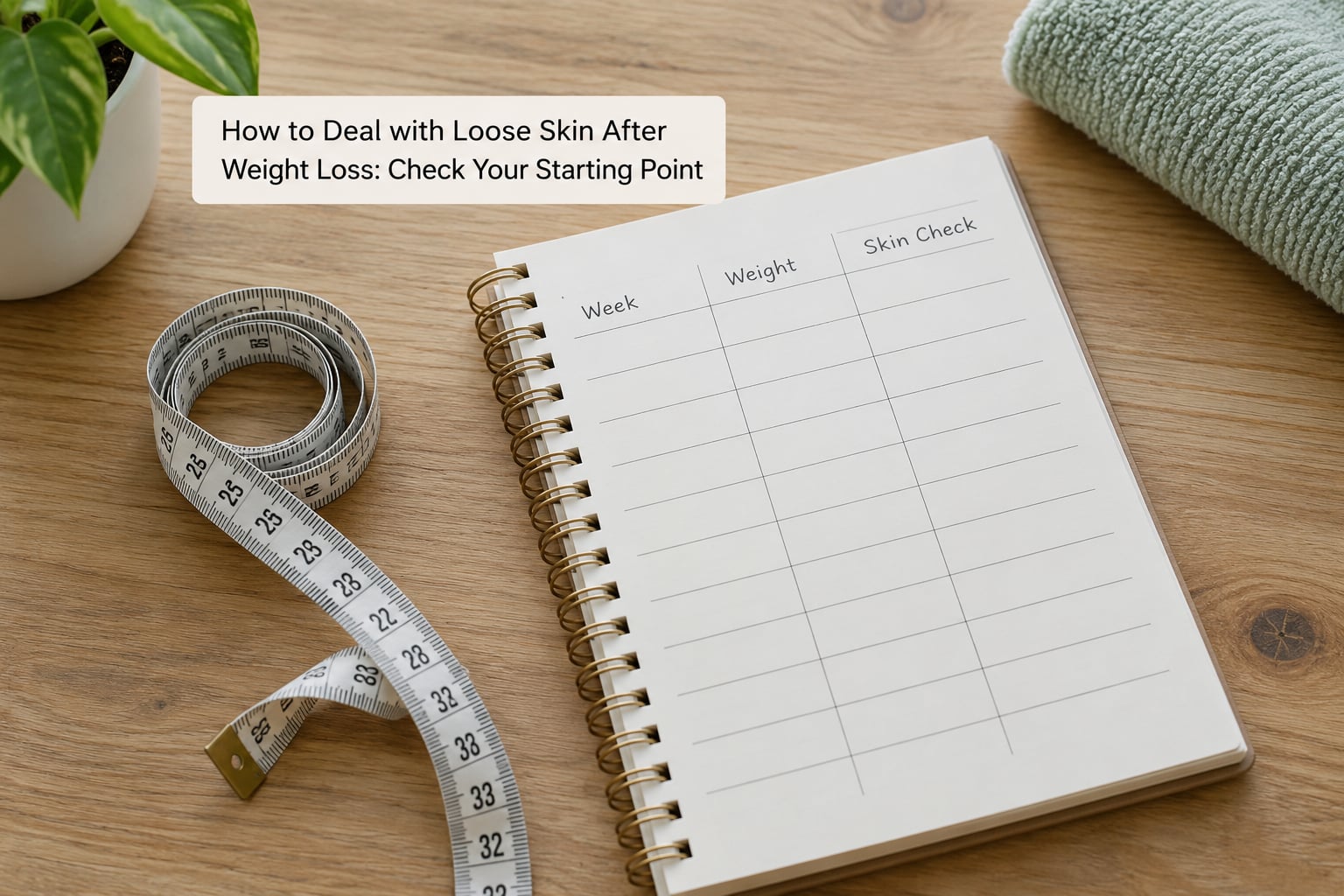
Start by writing down where you are, because memory is bad at this and photos taken in bad lighting are worse than useless.
Note when you started losing weight, how fast the weight came off, and roughly how much. Record how your clothes fit now, whether strength or stamina has changed, and any spots where skin rubs, sweats, or itches. Photos in the same spot, same light, same time of day, every four weeks give you the only comparison that means anything.
Do not judge your result from a picture someone posted online. Skin elasticity depends on your age, your genetics, how fast you lost, and whether you have lost and regained weight before, and none of that is visible in a stranger’s photo.
How to Deal with Loose Skin After Weight Loss: Focus on Gradual Strength Work
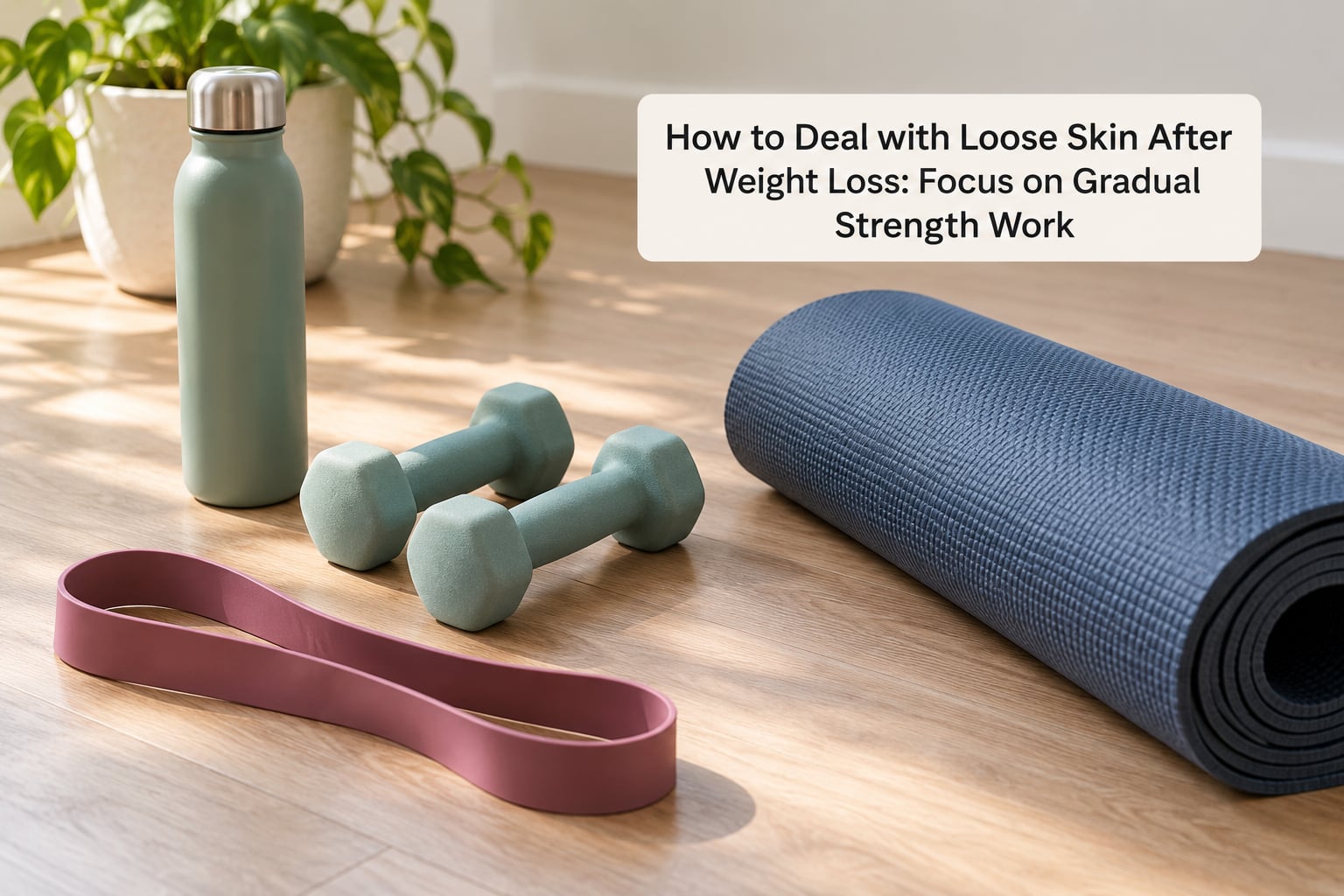
Strength training is the most recommended tactic for loose skin, and the one people most often report seeing results from, especially on arms and stomach.
It works indirectly. Muscle does not pull skin upward, but new muscle fills the space that fat left behind, so the skin has something to rest against instead of hanging over air. Full-body work two or three times a week is a reasonable starting target, and the movements can be very simple: rows, presses, squats, hinges, and carries.
Begin inside what you can comfortably do. If your skin catches on a bar or a machine, that is information, not a failure. Stop and get advice if you feel pain, dizziness, unusual shortness of breath, or anything that feels wrong, and clear any rash or open skin with a clinician before you train through it.
Build up slowly. Going from nothing to a heavy session every other day is a good way to injure yourself and quit in the same month.
How to Deal with Loose Skin After Weight Loss: Support Recovery With Steady Nutrition
Eating regularly with enough protein gives your body the material it needs to hold on to the muscle you are building. Crash dieting at this stage works against you twice, because you are asking for skin to recover while removing the fuel for the recovery.
Aim for three real meals most days rather than long gaps, and include a protein source in each one. Eggs, fish, chicken, dairy, beans, tofu, and meat all count, and the amount that suits you depends on your size and activity level.
Vegetables, fruit, and whole grains add fiber and volume, which matters more than most people expect. Hydration helps skin stay comfortable, and skin is mostly water, though drinking more than you need will not tighten anything on its own.
Any nutrition needs specific to you, including protein targets and how much you should still be eating, are a conversation with a registered dietitian. Do not take dosage or macro advice from a stranger online.
How to Deal with Loose Skin After Weight Loss: Protect and Monitor Your Skin
Loose skin folds trap moisture, and that is how chafing, rash, and yeast infections start. Dry the folds properly after a shower, change out of damp workout clothes instead of sitting in them, and use soft, breathable fabric against the skin.
Moisturizer is worth using for comfort when the skin feels dry or itchy. That is all it does. No cream, oil, butter, or topical collagen serum can rebuild stretched skin or remove a fold, and anyone selling one as a firming solution is describing a sensation, not a result.
The same goes for collagen supplements. Eating protein supports your training, but the evidence that a collagen powder tightens loose skin is weak, and the studies that exist measure small changes in skin hydration and elasticity in much younger volunteers than most people reading about this. If you take one, treat it as food, not as a treatment.
Sun protection is the one skin step that clearly pays off. Use a broad-spectrum sunscreen of SPF 30 or higher on exposed areas, because UV damage breaks down the collagen and elastin you are hoping to keep. Staying hydrated and eating enough protein support skin, but neither rebuilds it.
How to Deal with Loose Skin After Weight Loss: Give Your Body Time
Improvement is usually gradual and continues for a while. What often surprises people is that skin can look worse for a period, then firmer later, once the weight has been stable and collagen has had time to remodel.
A rough guide people report: give it six months of stable weight before you draw conclusions, allow a year for a fairer look, and treat two years as a more realistic outer window for natural change. Skin on the arms and belly tends to respond better than skin on the face, and facial skin is often the part people notice most because volume loss there shows up in every photo.
None of this is a measure of how hard you worked. Age, genetics, sun exposure, smoking, and how the weight came off all matter, and two people with identical numbers can have completely different results. If your weight is still moving, the honest move is to wait before spending money on anything.
How to Deal with Loose Skin After Weight Loss: Ask a Doctor or Dermatologist
Some things are worth a professional appointment rather than another month of internet research.
Get medical advice for skin that is persistently painful, cracked, weeping, or developing a rash in a fold, especially with odor or a rash spreading beyond the fold. Intertrigo, a yeast-related infection, is common in skin folds and responds quickly to the right treatment. The same goes for skin folds that limit your walking, your exercise, or your sleep, and for any wound that is not healing.
A dermatologist can also look at texture and crepey skin, talk about what has actually been shown to help, and tell you honestly whether a non-surgical option is worth it. Procedures such as radiofrequency, ultrasound, or laser treatments can help mild laxity, but results are modest and no clinician should promise a result to you before examining the skin.
For a large apron of skin on the abdomen, or significant excess after a very large loss, surgery such as abdominoplasty, an arm lift, a thigh lift, or a lower body lift is the one option that reliably removes it. That is a real operation with real recovery and real cost, and most surgeons want your weight stable for a considerable period first. A consultation with a board-certified plastic surgeon will tell you whether you are a candidate. It is a conversation, not a sales pitch, and you are allowed to ask for the risks, the scarring, and the recovery time before deciding anything.
How to Deal With Loose Skin After Weight Loss: Common Mistakes to Avoid
Almost every mistake here comes from wanting a faster result than skin biology allows. These are the ones that cost readers the most time and money.
- Losing weight faster while you try to recover. The corrective habit is a slower rate, on the order of one to two pounds a week if you are still losing. Rapid loss gives collagen less time to respond.
- Crash dieting. Severe restriction makes muscle loss more likely, and muscle is the volume that supports skin. Steady beats fast, especially now.
- Halting resistance training the moment weight loss ends. The muscle work is the part you keep doing. This is the habit that decides whether skin looks better at month eighteen.
- Expecting a visible change in four weeks. Pick a checkpoint four weeks out, a six month checkpoint, and a twelve month checkpoint. Comparing week to week only measures swelling and lighting.
- Spending on firming creams and serums. They may feel nice and they will not rebuild skin. Save the money.
- Overdoing exercise. More is not better when skin folds are rubbing. More walking, less chafing, and skin that heals beats an aggressive routine you abandon in a month.
- Comparing your timeline to someone else’s. Two people can lose the same weight and get different results. Their timeline is not a verdict on your effort.
One habit ties all of these together: write down one small action per week and check it once a week. Consistency on a small step beats intensity on a big plan that collapses.
Frequently Asked Questions
How long does loose skin take to improve after weight loss?
Most improvement is gradual rather than sudden. Many people notice their skin looking firmer somewhere around six months after their weight has become steady, and continued change can carry on for a year or two. Skin can look looser for a while before it firms, so the months right after you reach your goal weight are often the least flattering. If your weight is still moving, your skin is still changing and it is hard to judge anything yet.
Will drinking more water help tighten loose skin?
Hydration helps skin stay comfortable and supports normal function, and being dehydrated makes skin look duller and drier than it needs to. But extra water does not rebuild stretched collagen or pull skin back. If you are dehydrated, fixing that is worth doing. If you are already drinking normally, drinking more will not change the shape of your skin. Skin folds can also hold moisture and sweat, so keeping them dry matters more than total fluid intake.
Does strength training permanently tighten loose skin?
Strength training builds muscle that fills some of the space fat used to occupy, which can make skin look firmer and less slack, especially on the arms and stomach. It is not a permanent fix in the way surgery is, since muscle changes if you stop training, and it will not remove a large fold of skin. It is still the most useful natural habit for most people, and it supports your strength, your joints, and your weight maintenance at the same time.
Can loose skin return if I regain weight?
Regained weight usually stretches skin again, and if you gain and lose the same weight repeatedly, skin elasticity tends to be worse each time. That is why yo-yo dieting is one of the strongest predictors of loose skin. A moderate, stable regain may leave you close to where you started, since skin that has had time to settle can often accommodate some change. Faster regain is more likely to leave you with more loose skin than you had before.
When should I see a doctor about loose skin after weight loss?
See a doctor if skin folds are persistently painful, cracked, weeping, or developing a spreading rash, since infections in skin folds are common and treatable. Also get checked if folds limit your walking, exercise, or sleep, or if you have a wound that is not healing. A dermatologist can assess texture and discuss what has evidence behind it. A board-certified plastic surgeon is the right consultation if you are considering removing skin, ideally once your weight has been stable for a long period.
Conclusion: Start With One Steady Step
If you do one thing this week, write down your starting point: when you started, how fast the weight came off, and how your skin feels today. Then keep your weight steady, add two or three sessions a week of full-body strength work, eat regular meals with a protein source, and take care of your skin without spending money on products that promise what they cannot do.
Give it six months before you judge, and a year before you decide. If a fold is painful, infected, or getting in the way of your life, that is a medical question, not a cosmetic one, and a doctor or dermatologist can answer it properly.